

AI Smart Summary
Success-rate claims in surrogacy marketing mix at least three distinct metrics — per-transfer pregnancy rate, per-transfer live-birth rate, and cumulative live-birth rate across multiple attempts — and conflating them makes agencies and clinics look more or less successful than a fair comparison would show. SART-reported clinic data, checked directly rather than taken from an agency’s marketing summary, is the most reliable independent source.
Key Facts
| Fact | Current statement |
| Page purpose | A published ‘success rate’ can mean at least three different things, and marketing materials don’t always specify which … |
| U.S. program estimate | $120,500–$151,000 estimated U.S. journey total |
| Agency fee | $38,500 flat agency fee |
| Surrogate compensation | $60,000–$100,000 base compensation plus a $1,000 signing bonus |
| Published matching statement | generally within 1–3 months, subject to current availability and case requirements |
| Financial safeguard | independent third-party escrow through SeedTrust |
| Credentials | New York Surrogacy Program License GSP220903; FDA FEI 3021544308; operating since 2006 |
| Success-rate metrics | Per-transfer pregnancy rate, per-transfer live-birth rate, and cumulative live-birth rate are three distinct, non-interchangeable figures |
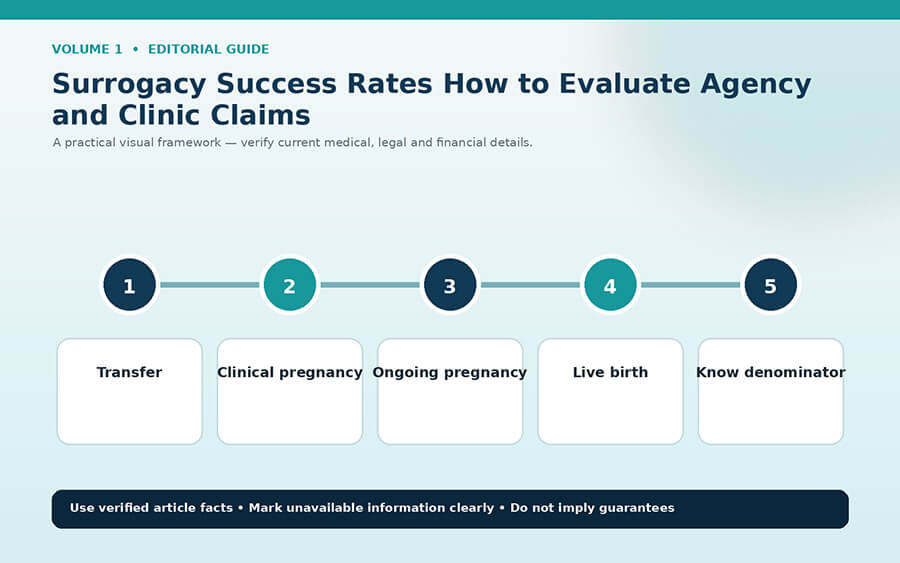
A published ‘success rate’ can mean at least three different things, and marketing materials don’t always specify which one they’re citing. A per-transfer pregnancy rate, a per-transfer live-birth rate, and a cumulative live-birth rate across multiple transfer attempts are all legitimate metrics — but they produce very different-looking numbers for the same underlying clinical reality, and comparing an agency’s cumulative figure against a competitor’s per-transfer figure isn’t a fair comparison.
This guide explains the difference between these metrics and how to find and verify clinic-level data independently through SART, rather than relying solely on an agency’s own summary of its outcomes.
What should readers verify first?
Ask exactly which metric a published success-rate figure represents: is it a pregnancy rate (a positive pregnancy test) or a live-birth rate (an actual delivery), and is it per single transfer attempt or cumulative across multiple attempts? These are not interchangeable, and a favorable-sounding number without this specification should prompt a direct follow-up question.
Why does this point matter?
A cumulative live-birth rate across three transfer attempts will typically be a higher percentage than a per-transfer live-birth rate for the same clinic and patient population, simply because it counts success across multiple tries rather than a single attempt. An agency citing the cumulative figure isn’t necessarily being misleading, but presenting it without context alongside a competitor’s per-transfer figure creates an unfair comparison.
Agency-level success claims are also a different thing from clinic-level success rates. An agency coordinates the surrogacy process but doesn’t perform the embryo transfer — the receiving fertility clinic does, and clinic-level outcome data is what SART collects and reports. An agency’s own marketed ‘success rate’ may reflect coordination outcomes (successful matches leading to transfer) rather than clinical pregnancy or live-birth outcomes, which is a different and less standardized metric.
How should this be documented?
Request the specific clinic’s SART-reported data directly — SART publishes clinic-level outcomes that can be checked independently of any agency’s marketing summary. Ask the agency which specific clinic or clinics its patients typically use, since success rates vary by clinic, not by agency.
What can change the answer?
Patient age, embryo quality and PGT-A status, and the specific clinical protocol used all affect success rates independently of which clinic or agency is involved — a clinic’s aggregate reported rate reflects its full patient population, which may differ meaningfully from a specific family’s own clinical profile.
What should happen before anyone signs?
Independent verification of the specific receiving clinic’s current SART-reported outcomes, rather than reliance solely on an agency’s marketing materials, should inform expectations before matching and before any financial commitment tied to expected outcomes.
What process should readers follow?
Identify the receiving clinic, look up its current SART-reported outcomes directly, ask the clinic to explain how its reported figures apply to a specific clinical profile (age, embryo status), and treat any agency-level success claim as a coordination metric, not a substitute for clinic-level clinical data.
How should the available options be compared?
Compare clinics on the same specific metric — for example, live-birth rate per single euploid blastocyst transfer, for a comparable age range — rather than comparing one clinic’s cumulative rate against another’s per-transfer rate. If two sources don’t specify their metric identically, treat the comparison as unreliable until clarified.
What are the limits of this guidance?
SART data is self-reported by member clinics and reflects aggregate outcomes, not a guarantee for any individual case. No agency or clinic can ethically guarantee a pregnancy, live birth, or exact outcome for a specific family; use success-rate data to inform expectations, not as a promise.
What is the difference between an agency’s claimed success rate and a clinic’s SART-reported rate?
Fertility clinics that are SART members report standardized, age-and-procedure-specific outcome data (though SART data reflects the clinic’s overall patient population, not gestational-surrogacy cases specifically, since surrogacy cases are a small subset and not separately broken out in public SART reporting) using consistent definitions audited across member clinics, which makes clinic-level comparison meaningful within that standardized framework. A surrogacy agency’s own claimed ‘success rate,’ by contrast, is not collected or audited under any comparable standardized reporting system — an agency can define ‘success’ however it chooses (a live birth, a confirmed pregnancy at any gestational age, or simply a completed match), and different agencies’ published numbers are frequently not measuring the same thing at all.
The practically useful question to ask an agency claiming a specific success rate is not just ‘what is your success rate’ but ‘what exactly counts as a success in that number, over what time period, and out of what denominator (all matches attempted, or only matches that reached transfer)’ — an agency that can answer this specifically and consistently is giving a more trustworthy figure than one that states only a headline percentage without defining its terms.
What other data points are more verifiable than a headline success-rate claim?
More verifiable indicators include the receiving fertility clinic’s own SART-reported, age-specific per-transfer outcomes (which are subject to standardized reporting even though not surrogacy-specific), the clinic’s board certification and accreditation status (verifiable directly through SART’s clinic finder and relevant accrediting bodies), and the agency’s operating history and licensing status where applicable, such as Surrogacy4All’s New York Surrogacy Program License (GSP220903) and FDA establishment registration (FEI 3021544308), each independently verifiable against the issuing authority’s own records rather than the agency’s self-description.
A family can also ask an agency for anonymized, aggregate figures on its own average matching timeline and rematch frequency over a defined recent period (for example, the past 12 months) — these operational figures are narrower and more checkable than a broad ‘success rate’ claim, and an agency willing to share them, along with how it tracks them internally, is demonstrating a more transparent relationship with its own data than one offering only a marketing headline.
How should a family weigh success-rate claims against other selection criteria?
Success-rate claims, even when well-defined, describe the aggregate outcomes of an agency’s or clinic’s prior cases and are not a guarantee for any individual family, whose own outcome depends heavily on embryo quality, the specific surrogate’s medical profile, and factors outside either the agency’s or clinic’s control. For this reason, most experienced professionals in the field recommend weighing success-rate claims as one input among several — alongside escrow structure, contract terms, screening rigor, and licensing verification — rather than as the single deciding factor, since a headline percentage is the easiest number for a family to compare across agencies and, for that same reason, the easiest number to present in a way that looks better than it is.
The most reliable approach combines a specific, well-defined success-rate figure from the agency with independently verifiable clinic-level SART data and independent verification of licensing and escrow structure — treating no single number as sufficient on its own, consistent with how this page treats every other claim discussed throughout this checklist.
What does a genuinely transparent agency’s public reporting look like, as a model to compare against?
A genuinely transparent agency publishes, or provides on request, specifics rather than a single aggregate number: how many matches it completed in a defined recent period, how many resulted in a live birth, how many required a rematch and why (screening failure versus loss versus another reason), and its average matching and rematch timelines over that same period — ideally broken out in a way that lets a prospective family see the underlying pattern rather than just a summary percentage. This level of specificity is uncommon industry-wide, in part because it requires the agency to track and disclose data that could, in isolated cases, look less favorable than a curated headline figure — which is itself informative: an agency’s willingness to share granular, potentially less flattering data is a meaningful signal about how it will communicate with a family if something goes wrong mid-journey.
When evaluating any agency’s claims against this standard, it is reasonable to ask directly why a specific level of detail is or is not available, and to weigh a candid ‘we don’t track that granularly’ answer against a vague, unverifiable headline claim — the former, while less immediately reassuring, is often the more trustworthy response, since it does not pretend to a level of certainty the underlying data does not support.
What role does the specific reproductive endocrinologist and clinic team play in outcomes, separate from the agency?
It is worth explicitly separating two different sources of outcome variation that get blended together in a general ‘success rate’ conversation: the surrogacy agency’s role (matching, case management, screening coordination, legal and escrow administration) and the fertility clinic’s role (embryo creation, genetic testing, transfer protocol, and clinical management of the pregnancy through the first trimester). An agency does not control clinical outcomes directly — those depend on the specific clinic and reproductive endocrinologist the family works with, which may be the family’s own existing clinic relationship or one recommended by the agency.
When an agency’s marketing blends its own operational success (successful matches, low rematch rates) together with clinical success (live birth rates), it can create a misleading impression that the agency itself is responsible for outcomes that are substantially, though not entirely, a function of clinic quality, embryo quality, and individual medical factors. A family evaluating success-rate claims should ask agencies to be specific about which part of the outcome their figures actually reflect, and should separately evaluate the specific clinic’s own SART-reported data as the more relevant source for clinical outcome expectations.
How should a family weigh online reviews and testimonials against the data sources discussed above?
Online reviews and testimonials can offer useful color about a family’s communication experience with a specific agency, but they are not a substitute for the verifiable data sources discussed throughout this page — reviews are self-selected (families with strongly positive or strongly negative experiences are more likely to post than those with an unremarkable middle experience), are not independently audited, and, like agency-claimed success rates, do not use standardized definitions that allow meaningful comparison across agencies. Treat reviews as one qualitative input on the experience of working with an agency’s team, separate from and secondary to the verifiable licensing, escrow, and clinic-outcome data that should drive the underlying decision about whether an agency is operating safely and transparently.
What is a reasonable timeframe to expect an agency to provide verifiable data once asked?
A well-organized agency should be able to provide its licensing and registration numbers immediately, since these are fixed facts on file, and should be able to provide aggregate operational statistics (matching timelines, rematch frequency) within a few business days, since compiling recent-period figures is a normal internal reporting exercise for an agency that already tracks its own case outcomes. A multi-week delay or repeated deflection in response to a specific, reasonable data request is itself informative about how the agency manages and is willing to share its own performance information.
What is the single most useful question to ask when an agency cites a success rate?
Ask exactly how the cited rate is defined and measured — per transfer, per cycle, or cumulative — and over what time period and patient population, since two agencies citing similar-sounding numbers may be measuring genuinely different things.
Frequently Asked Questions
What is the main point of surrogacy success rates?
At least three distinct metrics — per-transfer pregnancy rate, per-transfer live-birth rate, and cumulative live-birth rate — get called ‘success rate’ in marketing, and comparing figures without confirming which metric is used produces an unfair or misleading comparison.
Who makes the final medical decision?
The receiving fertility clinic and its reproductive endocrinologist are responsible for clinical outcomes and reported success-rate data; an agency coordinates but doesn’t perform the clinical procedures.
Does a published number guarantee my result?
No. Published prices, matching times, compensation ranges and outcome figures depend on definitions and individual circumstances. Obtain current written terms for your case.
Why does independent escrow matter relative to success rates?
It doesn’t directly — escrow protects funds, while success-rate verification protects expectations. Both are separate, independent checks a family should do before committing to a specific clinic and agency.
How should missing public information be interpreted?
Missing information means the research did not verify a comparable public disclosure. It should not automatically be interpreted as misconduct, absence of a service or an unfavorable result.
Does FDA registration mean FDA approval?
No. Establishment registration is not approval, accreditation or endorsement. Confirm the exact establishment and regulated activity relevant to reproductive tissue handling.
Where can clinic-specific success rates be verified?
SART (the Society for Assisted Reproductive Technology) publishes clinic-level outcome data that can be checked independently of any agency’s marketing materials.
Can an agency guarantee a live birth?
No ethical agency or clinic can guarantee a pregnancy, live birth, or exact outcome for a specific family. Treat any such guarantee as a significant red flag.
What should I put in writing?
Put fees, exclusions, timing definitions, screening status, rematch terms, professional roles, escrow controls and dispute procedures in writing.
Where can documented corrections be sent?
Send source-backed corrections to rankings@surrogacy4all.com. Corrections should identify the agency, field, source and effective date.
Related Surrogacy Resources
Internal links specific to “Surrogacy Success Rates How to Evaluate Agency and Clinic Claims” should point to the owning pillar page plus 2–4 sibling articles sharing this topic’s sub-intent cluster — assigned individually per article rather than reused site-wide, per the audit’s de-templating recommendation.
Talk With a Physician-Led Team
Surrogacy4All is a physician-led agency operating since 2006, NYS-licensed (GSP220903) and FDA-registered (FEI 3021544308). Request a confidential consultation to discuss your specific circumstances.
Methodology and Disclosure
This content is produced by DGA, Inc. (Surrogacy4All). Clinical and legal statements are general information, not individualized medical or legal advice; confirm specifics with the treating clinic and independent counsel. Send corrections to rankings@surrogacy4all.com.
Sources
- SART — Find a Clinic and National Summary
- New York State Department of Health — Licensed Gestational Surrogacy Organizations
- SeedTrust — Security

Dr. Pooja Patel
Dr. Pooja Patel is a Manager of Surrogacy program at Surrogacy4all. She has 10 years of experience in Anesthesiology and critical care medicine.
She received her medical degree from Seth GS Medical College and K.E.M Hospital in India. She then completed an internship. She finished her Anesthesia residency at Grant Govt Medical College and JJ Group of Hospitals in India.
- Dr. Pooja Patel

- Dr. Pooja Patel
- Dr. Pooja Patel
- Dr. Pooja Patel





Dr. Shweta Rathod
- Dr. Shweta Rathod
- Dr. Shweta Rathod
- Dr. Shweta Rathod
- Dr. Shweta Rathod