Surrogacy laws in the United States are determined at the state level, making it essential for intended parents and gestational carriers to understand the legal requirements before beginning their journey. This guide explains which states are surrogacy-friendly, where restrictions exist, and how legal issues such as parentage, compensation, contracts, and pre-birth orders vary across the country. It also highlights why choosing the right state and working with experienced reproductive attorneys and agencies can help create a smoother, legally secure surrogacy experience.
No federal surrogacy law exists. Every U.S. state has its own surrogacy regulations.
California, Illinois, Connecticut, and New Jersey are among the most surrogacy-friendly states with strong legal protections.
Some states restrict or prohibit compensated surrogacy, making legal guidance essential before signing agreements.
The surrogate’s state of residence often determines how contracts and parental rights are handled.
Pre-birth parentage orders are available in many surrogacy-friendly states, allowing intended parents to establish legal parentage before delivery.
Working with an experienced surrogacy agency and reproductive attorney helps ensure compliance with state-specific laws and protects everyone involved.
Surrogacy laws differ by state, so legal planning should begin before selecting a surrogate or clinic.
Choosing a surrogacy-friendly state can simplify contracts, parentage, and the overall legal process.
Professional legal and agency support reduces risks and helps ensure compliance with changing state regulations.
Understanding state-specific requirements early saves time, avoids delays, and provides greater peace of mind throughout the surrogacy journey.
Welcome to Surrogacy4All’s comprehensive guide on surrogacy laws by state. Understanding the legal landscape of surrogacy is essential for both intended parents and potential surrogates. Here, we aim to provide clarity and guidance through the intricacies of state-specific surrogacy legislation.
As one of the few licensed and certified surrogacy agencies in New York, we not only offer you an experienced medical team but also provide expert advice on surrogacy laws across the US.
Our goal is to ensure you embark on your surrogacy journey fully informed and confident. Whether you are an intended parent or a potential surrogate, understanding the laws governing surrogacy in your state is crucial.
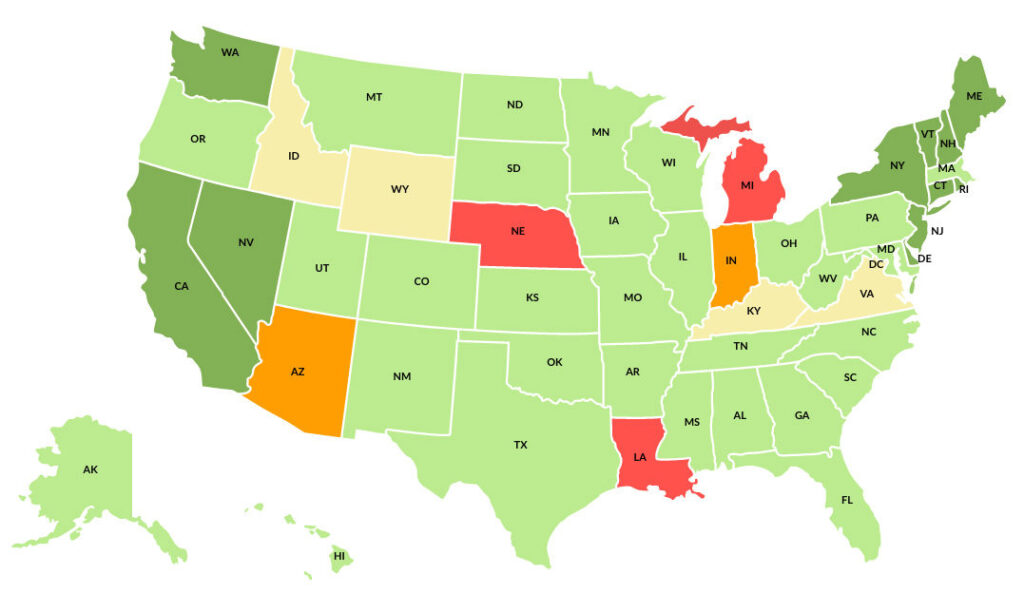
From New York to California, every state has its own unique approach to surrogacy laws. Some states are more surrogate-friendly, while others have more restrictive legislation. In this guide, you will find clear, accurate, and up-to-date information about:
Surrogacy is more than just a medical process; it is a legal journey, too. Equip yourself with the necessary knowledge to navigate this journey smoothly with Surrogacy4All.

One of the most important legal steps in any surrogacy journey is establishing legal parentage. Parentage determines who is legally recognized as the child’s parent after birth and whose names appear on the birth certificate.
Because every state has different requirements, legal planning should begin early in the surrogacy process. Completing parentage orders correctly helps ensure a smooth hospital experience and protects the rights of both the intended parents and the child.

A comprehensive surrogacy contract provides clarity and legal protection for everyone involved. Before any embryo transfer takes place, both the surrogate and intended parents should have independent legal representation to review and negotiate the agreement.
Well-drafted agreements reduce misunderstandings and help create a transparent, respectful relationship throughout the surrogacy journey. In states where contracts are enforceable, they provide an important layer of legal protection for all parties.

Surrogacy has become an important family-building option for LGBTQ+ individuals and couples, but legal recognition varies across the United States. Many states provide equal access to gestational surrogacy regardless of marital status, sexual orientation, or gender identity, while others may have additional legal requirements for establishing parentage.
At Surrogacy4All, we proudly support LGBTQ+ intended parents by helping them navigate state laws, legal documentation, and the surrogacy process with confidence and compassion.

Please consult with an experienced surrogacy attorney to fully understand the specific surrogacy laws in each of these states. We will be happy to refer you to one.
Talk with our physician-led team about your family, embryos, timeline and budget. We’ll explain your options and next steps with no obligation.
Our job is to listen, to connect the dots between your needs, and to determine how we can best help you have your baby. If you’re asking how much does it cost for a surrogate, we’ll walk you through every step of the process to ensure there are no surprises.
To make an appointment with one of our counselors or physicians, please call (212) 661-7673 or email info@surrogacy4all.com. We look forward to hearing from you.

Since 2006, Surrogacy4All has helped intended parents in the United States and around the world build their families through physician-led gestational surrogacy and egg donation.

Secret Guide to Minimizing Surrogacy Costs
NYS Surrogacy Program License GSP220903 · NYS Tissue Bank License ID 1570 · California Tissue Bank License CTB00082276 · Maryland Tissue Bank License TB3527 · FDA HCT/P Establishment Registration FEI 3021544308 · Health Canada Establishment Registration 000119 Verify: How to check our licenses
THIS WEBSITE DOES NOT PROVIDE MEDICAL ADVICE AND MAY BE OUT OF DATE. The information, including but not limited to text, PDFs, graphics, images, and other material contained on this website, is for general educational purposes only. No material on this site is intended to be a substitute for professional medical advice, diagnosis, or treatment, and does not create a patient-doctor relationship. Pricing on the website may be out of date, is subject to change without notice, and may be subject to additional terms and conditions. No information on this site is intended to be a financial quote for medical services. Always seek the advice of your physician or other qualified healthcare provider with any questions you may have regarding a medical condition, lifestyle or dietary changes, treatments, and before undertaking a new healthcare regimen. Never disregard professional medical advice or delay in seeking it because of something you have read on this website.
Licensed & Registered: NYS Surrogacy Program License GSP220903 · NYS Tissue Bank License ID 1570 · California Tissue Bank License CTB00082276 · Maryland Tissue Bank License TB3527 · FDA HCT/P Establishment Registration FEI 3021544308 · Health Canada Establishment Registration 000119
Verify: How to check our licenses
Disclaimer: THIS WEBSITE DOES NOT PROVIDE MEDICAL ADVICE AND MAY BE OUT OF DATE. The information, including but not limited to text, PDFs, graphics, images, and other material contained on this website, is for general educational purposes only. No material on this site is intended to be a substitute for professional medical advice, diagnosis, or treatment, and does not create a patient-doctor relationship. Pricing on the website may be out of date, is subject to change without notice, and may be subject to additional terms and conditions. No information on this site is intended to be a financial quote for medical services. Always seek the advice of your physician or other qualified healthcare provider with any questions you may have regarding a medical condition, lifestyle or dietary changes, treatments, and before undertaking a new healthcare regimen. Never disregard professional medical advice or delay in seeking it because of something you have read on this website.
All Rights Reserved to Surrogacy4all
RESOLVE: The National Infertility Association, established in 1974, is dedicated to ensuring that all people challenged in their family building journey reach resolution through being empowered by knowledge, supported by community, united by advocacy, and inspired to act.
ASRM is a multidisciplinary organization dedicated to the advancement of the science and practice of reproductive medicine. The Society accomplishes its mission through the pursuit of excellence in education and research and through advocacy on behalf of patients, physicians, and affiliated health care providers.
Welcome to the Parent Guide: Starting Life Together, for children and their caregivers. Whether you are a mother or father (through birth, adoption, or foster care), a grandparent, partner, family friend, aunt or uncle with parenting responsibilities, the Parent Guide has information to help you through the FIRST FIVE YEARS of your parenting journey.
Path2Parenthood (P2P) is an inclusive organization committed to helping people create their families of choice by providing leading-edge outreach programs.
The FDA is a part of the Department of Health and Human Services.
Each day in America, you can trust the foods you eat and the medicines you take, thanks to the U.S. Food and Drug Administration.