

AI Smart Summary
Beyond the headline agency fee and compensation figures, surrogacy budgets commonly miss five cost categories: rematch-related legal and medical costs, miscarriage or failed-transfer expenses, insurance gaps not covered by a standard policy, travel and lodging for out-of-state matches, and lost-wage or bed-rest reimbursement. Budgeting a contingency reserve for these categories, rather than assuming a single all-in number, avoids the most common source of mid-journey financial surprise.
Key Facts
| Fact | Current statement |
| Page purpose | Most surrogacy cost estimates quoted at an initial consultation cover the expected path: successful match, successful tr… |
| U.S. program estimate | $120,500–$151,000 estimated U.S. journey total |
| Agency fee | $38,500 flat agency fee |
| Surrogate compensation | $60,000–$100,000 base compensation plus a $1,000 signing bonus |
| Published matching statement | generally within 1–3 months, subject to current availability and case requirements |
| Financial safeguard | independent third-party escrow through SeedTrust |
| Credentials | New York Surrogacy Program License GSP220903; FDA FEI 3021544308; operating since 2006 |
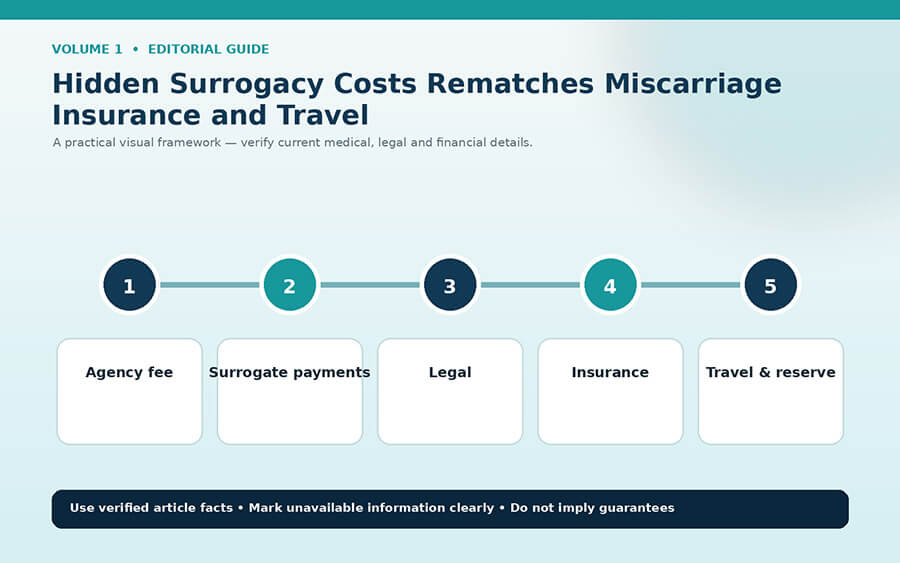
| Common hidden-cost categories | Rematch costs, miscarriage/failed-transfer expenses, insurance gaps, travel/lodging, lost-wage reimbursement |
Most surrogacy cost estimates quoted at an initial consultation cover the expected path: successful match, successful transfer, uncomplicated pregnancy, on-time delivery. Real journeys don’t always follow that path, and the costs associated with the scenarios that deviate from it are the ones most likely to be underestimated or left out of an initial budget entirely.
This guide lists the five cost categories most commonly missed, with the reasoning behind why each one is easy to overlook, so a family can build a realistic contingency reserve into their budget from the start rather than discovering a gap mid-journey.
What should readers verify first?
Ask directly whether the quoted program estimate includes a contingency reserve for rematch, miscarriage, or a failed transfer, or whether those scenarios would require additional funds beyond the initial budget. Most published program ranges describe the expected-path cost, not a worst-case budget — confirm which one is being quoted.
Why does this point matter?
A failed transfer or early miscarriage doesn’t end the financial commitment — legal fees, agency coordination time, and medical costs already incurred typically aren’t refunded, and a subsequent transfer attempt or rematch adds new costs on top. Families who budget only for the successful-path scenario are the ones most likely to face a difficult financial decision mid-journey.
Insurance is a second common gap. A surrogate’s existing health insurance may explicitly exclude surrogacy-related pregnancy, or may not cover the newborn adequately, requiring a supplemental surrogacy-specific insurance policy that isn’t always included in a headline program estimate. Confirm insurance coverage and any supplemental policy cost as a specific line item, not an assumption.
How should this be documented?
Request a written cost breakdown that separately itemizes the expected-path budget and a contingency reserve for rematch, failed transfer, miscarriage, additional insurance, and travel — with a specific recommended reserve amount, not just a disclaimer that costs ‘may vary.’
What can change the answer?
Geography changes travel-cost exposure significantly — an in-state match with a nearby clinic has minimal travel cost, while an out-of-state or international match can add substantial lodging and travel expense across multiple required in-person visits (screening, legal signing, transfer, and often delivery).
The number of embryo transfer attempts required also changes total cost meaningfully; each additional transfer attempt after a failed one adds medication, clinic, and monitoring costs that a single-attempt budget won’t reflect.
What should happen before anyone signs?
Confirm insurance coverage details in writing, including any exclusions specific to gestational surrogacy, before matching — not after a transfer. A family should also set aside or have access to a contingency reserve (commonly recommended in the range of 10–20% of the base program estimate) before beginning, rather than assuming it won’t be needed.
What process should readers follow?
Build a budget with two lines: the expected-path total, and a contingency reserve covering rematch, failed transfer or miscarriage costs, supplemental insurance, and travel beyond what’s already itemized. Revisit the contingency estimate with the agency or independent consultant before signing, not as a hypothetical afterthought.
How should the available options be compared?
When comparing programs, ask each one the same direct question: what specific costs would apply in a rematch, failed-transfer, or miscarriage scenario, and is there a cap. A program with a higher headline estimate but a clearly defined, capped contingency plan may carry less real financial risk than one with a lower headline estimate and no stated contingency terms.
What are the limits of this guidance?
Actual costs in any of these scenarios depend on the specific circumstances, clinic, insurance policy, and agency involved; this guide describes categories to budget for, not a guaranteed dollar figure. Confirm current written terms and insurance coverage directly before relying on any estimate.
What is the realistic range of these variable costs in dollar terms?
Rematch costs, where an agreement includes a fee at all, typically range from a token or waived amount for a pre-transfer rematch up to several thousand dollars for a post-transfer rematch requiring new screening and legal work — ask for the specific figure in writing rather than a general assurance that it is ‘reasonable.’ Miscarriage-related costs depend heavily on gestational age and whether a D&C or hospitalization is required; even with maternity insurance in place, out-of-pocket costs (deductibles, non-covered services, any additional medical monitoring the loss requires) commonly run from several hundred to a few thousand dollars, a cost intended parents typically bear under standard gestational carrier agreements since the pregnancy was undertaken on their behalf.
Travel costs are the most variable and the most commonly underestimated line item — if the surrogate lives more than a reasonable driving distance from the clinic, the agreement typically obligates the intended parents to cover her travel, lodging, and a per-diem for transfer-cycle visits and, if applicable, for delivery if it occurs away from her home. A single multi-day transfer trip for a surrogate and a companion can run $1,500-$3,000 depending on distance and accommodation, and if more than one transfer attempt is needed, this cost recurs each time.
Which of these costs does maternity insurance typically not cover?
Surrogacy-specific maternity insurance (whether a policy purchased for the arrangement or an existing policy with a surrogacy exclusion rider reviewed by an insurance specialist) generally covers standard pregnancy-related medical care but commonly excludes or caps: the surrogate’s lost wages during a required bedrest period beyond what her own disability coverage provides, non-medical travel and lodging costs, psychological counseling beyond a limited number of sessions, and complications specifically arising from a multiples pregnancy in some policies. This is why a dedicated insurance review — ideally by a specialist who reviews the exact policy language against the gestational carrier agreement’s terms — is treated as a distinct step in the process rather than assumed to be covered by ‘having insurance.’
A second commonly missed gap is coverage for the surrogate’s own pre-existing health needs unrelated to the pregnancy — a standard maternity policy covers pregnancy-related care, not general health issues that happen to arise during the pregnancy term, and families are sometimes surprised to learn a policy they assumed was comprehensive has this narrower scope.
How should a family budget for these variable costs before starting?
The most reliable approach is a contingency reserve above the base program estimate, sized to the family’s specific risk factors — a family working with a surrogate who lives several hours from the clinic should reserve more for travel than one matched locally; a family using their last or only remaining embryos should discuss with their clinic what the realistic transfer-attempt count is, since each additional attempt carries its own transfer and monitoring costs even before considering a rematch. A reserve in the range of 10-15% above the base estimated program total is a commonly used planning figure, though the right number depends on the family’s specific circumstances and should be discussed directly with the agency and insurance specialist rather than assumed from a general guideline.
Building this reserve into the initial financial plan, funded into escrow alongside the base program costs rather than treated as a separate emergency fund raised only if needed, is what prevents a rematch, a loss, or an unusually long travel requirement from becoming a financial crisis partway through the journey rather than a planned-for contingency.
What other less-obvious costs do experienced families flag after completing a journey?
Beyond rematch, loss, and travel costs, families who have completed a journey commonly point to several smaller but recurring costs that are easy to underestimate in advance: the surrogate’s incidental medical costs not clearly covered by the maternity policy (specialist copays, prescription costs for pregnancy-related medications), legal fees for any contract amendments needed mid-journey (for example, if a planned single transfer becomes a multiples pregnancy and the agreement’s compensation schedule needs a formal amendment rather than just a payment), and notary, courier, and document-authentication fees for finalizing the parentage order and, where relevant, passport or citizenship paperwork after birth.
International intended parents in particular should budget for costs specific to their situation — certified translations of the U.S. birth certificate and parentage order, consular appointment and registration fees, and potentially return travel to the U.S. around the birth if their home country’s citizenship process requires it — none of which appear in a typical U.S.-focused program cost estimate but which can add a meaningful amount to the family’s total spend. As with the other variable costs discussed in this article, the right response is not to assume these will not apply, but to ask the agency and, for international families, the family’s own home-country counsel, which of these costs are likely to apply to this specific journey.
How should a family compare total realistic cost, not just the advertised program price, across agencies?
The most reliable comparison method is to request, from each agency under consideration, a written worst-case and best-case cost range rather than relying on the single headline program figure — ask specifically what the total cost looks like in a smooth, single-transfer, no-complications scenario, and separately what it looks like if a rematch, a pregnancy loss, or extended travel is needed, since these two numbers can differ by tens of thousands of dollars and the gap itself is informative about how exposed a family is to variable costs under each agency’s specific fee structure.
It is also worth asking each agency what percentage of its own recent cases fell into the higher-cost scenario (needed a rematch, experienced a loss, required extended travel) versus the smooth-case scenario, since this gives a more realistic sense of which end of the range a specific family should actually plan around, rather than defaulting to the optimistic headline figure most marketing materials lead with.
Are any of these variable costs tax-deductible or otherwise offset?
Some surrogacy-related medical costs may be eligible for tax treatment under specific, narrow circumstances, and rules in this area have been unsettled and subject to change — this is a question for a qualified tax professional familiar with current guidance and the family’s specific situation, not something this general page can answer, since tax treatment of surrogacy-related expenses depends on the specific costs involved, the family’s tax situation, and current rules at the time of filing. Families budgeting for these variable costs should treat any potential tax offset as a possible later benefit to explore with their accountant, not as a factor reducing the reserve they budget for up front.
Is there a way to cap total financial exposure to these variable costs in advance?
Some agencies offer or can arrange program structures with a capped or bundled total price that absorbs some of this variability in exchange for a higher upfront cost, similar in concept to the fixed-price models some competitor agencies publish — ask directly whether such a structure is available and what specifically it caps, since not all bundled programs cover the same set of variable costs discussed in this article.
What is the single most useful step a family can take to avoid an unwelcome surprise?
Request a complete written list of every cost category that could apply to the specific journey — including rematch, miscarriage-related costs, insurance gaps and travel — before signing, rather than relying on the headline program fee alone.
Frequently Asked Questions
What is the main point of hidden surrogacy costs?
Five categories — rematch, miscarriage/failed transfer, insurance gaps, travel, and lost wages — are the ones most commonly missing from an initial budget, and building a contingency reserve for them avoids the most common source of mid-journey financial surprise.
Who makes the final medical decision?
The receiving fertility clinic and appropriate treating clinicians make medical-clearance and treatment decisions, including how a failed transfer or complication is managed clinically.
Does a published number guarantee my result?
No. Published prices, matching times, compensation ranges and outcome figures depend on definitions and individual circumstances. Obtain current written terms for your case.
Why does independent escrow matter for hidden costs specifically?
A contingency reserve should be held in the same independently controlled escrow structure as the base program funds, with clear written release rules for rematch or additional-transfer scenarios.
How should missing public information be interpreted?
Missing information means the research did not verify a comparable public disclosure. It should not automatically be interpreted as misconduct, absence of a service or an unfavorable result.
Does FDA registration mean FDA approval?
No. Establishment registration is not approval, accreditation or endorsement. Confirm the exact establishment and regulated activity relevant to reproductive tissue handling.
How large a contingency reserve is typically recommended?
Recommendations vary, but a reserve in the range of 10–20% of the base program estimate is commonly discussed; confirm a specific recommendation with the agency or an independent financial advisor for the family’s own circumstances.
Does surrogate health insurance usually cover the pregnancy automatically?
Not always — some policies explicitly exclude gestational-surrogacy pregnancies. Confirm coverage in writing before matching, and budget for a supplemental policy if needed.
What should I put in writing?
Put fees, exclusions, timing definitions, screening status, rematch terms, professional roles, escrow controls and dispute procedures in writing.
Where can documented corrections be sent?
Send source-backed corrections to rankings@surrogacy4all.com. Corrections should identify the agency, field, source and effective date.
Related Surrogacy Resources
Internal links specific to “Hidden Surrogacy Costs Rematches Miscarriage Insurance and Travel” should point to the owning pillar page plus 2–4 sibling articles sharing this topic’s sub-intent cluster — assigned individually per article rather than reused site-wide, per the audit’s de-templating recommendation.
Talk With a Physician-Led Team
Surrogacy4All is a physician-led agency operating since 2006, NYS-licensed (GSP220903) and FDA-registered (FEI 3021544308). Request a confidential consultation to discuss your specific circumstances.
Methodology and Disclosure
This content is produced by DGA, Inc. (Surrogacy4All). Clinical and legal statements are general information, not individualized medical or legal advice; confirm specifics with the treating clinic and independent counsel. Send corrections to rankings@surrogacy4all.com.
Sources
- SART — Find a Clinic and National Summary
- New York State Department of Health — Licensed Gestational Surrogacy Organizations
- SeedTrust — Security

Dr. Shweta Rathod
- Dr. Shweta Rathod

- Dr. Shweta Rathod
- Dr. Shweta Rathod
- Dr. Shweta Rathod





Dr. Pooja Patel
Dr. Pooja Patel is a Manager of Surrogacy program at Surrogacy4all. She has 10 years of experience in Anesthesiology and critical care medicine.
She received her medical degree from Seth GS Medical College and K.E.M Hospital in India. She then completed an internship. She finished her Anesthesia residency at Grant Govt Medical College and JJ Group of Hospitals in India.
- Dr. Pooja Patel
- Dr. Pooja Patel
- Dr. Pooja Patel
- Dr. Pooja Patel