
AI Smart Summary
Rematching happens for many reasons beyond a failed medical screen — a surrogate withdrawing, an incompatible communication style discovered during matching, or a change in circumstances on either side. The financial and timeline impact depends entirely on the agency’s written rematch policy, which should specify included attempts, fees, refund eligibility for prior payments, and expected timeline before a family ever matches.
Key Facts
| Fact | Current statement |
| Page purpose | Rematching isn’t limited to a medical or psychological screening failure — it can happen because a surrogate withdraws f… |
| U.S. program estimate | $120,500–$151,000 estimated U.S. journey total |
| Agency fee | $38,500 flat agency fee |
| Surrogate compensation | $60,000–$100,000 base compensation plus a $1,000 signing bonus |
| Published matching statement | generally within 1–3 months, subject to current availability and case requirements |
| Financial safeguard | independent third-party escrow through SeedTrust |
| Credentials | New York Surrogacy Program License GSP220903; FDA FEI 3021544308; operating since 2006 |
| Rematch causes | Includes failed screening, surrogate withdrawal, communication mismatch, and changed circumstances — not just medical failure |
Rematching isn’t limited to a medical or psychological screening failure — it can happen because a surrogate withdraws for personal reasons before transfer, because the intended parents and surrogate discover during the matching process that expectations don’t align, or because circumstances change on either side. Whatever the cause, the practical questions are the same: what does it cost, what’s refundable, and how long until a new match.
This guide separates the common causes of rematch from the policy terms that determine financial and timeline impact, so a family can evaluate an agency’s rematch policy specifically, not just its initial matching process.
What should readers verify first?
Get the agency’s rematch policy in writing before matching, covering all common causes — not just medical screening failure. Ask specifically whether the policy differs depending on the cause (a surrogate withdrawing personally versus failing screening), since some agencies apply different fee and refund terms to each.
Why does this point matter?
A surrogate withdrawing after matching but before transfer is a different situation than a screening failure — it may happen later in the process, after more legal and medical costs are already incurred, making the financial exposure higher. Agencies vary widely in how they handle this scenario, and it’s one of the least-discussed terms during an initial sales conversation.
How should this be documented?
Request a specific, itemized answer: how many rematch attempts are included, what the agency fee is (if any) for a rematch beyond that number, whether legal fees already paid transfer to the new match or must be paid again, and the typical timeline from rematch trigger to a new match being presented.
What can change the answer?
How far into the process a rematch occurs changes both cost and timeline exposure. A rematch triggered during initial screening, before legal work begins, is far less costly than one triggered after contract execution and escrow funding — ask the agency how it handles each scenario differently.
What should happen before anyone signs?
The initial matching agreement should reference or attach the rematch policy, not leave it as a separate verbal understanding. If a written rematch policy isn’t provided proactively, request it explicitly before signing.
What process should readers follow?
If a rematch is triggered, request the reason to the extent appropriate to share, confirm the fee and refund terms against the written policy (not a verbal restatement), and ask for a specific expected timeline to a new match rather than an open-ended estimate.
How should the available options be compared?
Ask each agency under consideration for its actual average rematch timeline and typical rematch rate, not just its written policy — a generous-sounding written policy paired with a consistently long real-world rematch timeline is a meaningfully worse outcome than a stricter policy paired with a fast, reliable rematch process.
What are the limits of this guidance?
Rematch policies and typical timelines vary by agency and by the specific circumstances of each case; this guide describes what to ask, not what any particular agency’s policy is. Confirm current written terms directly.
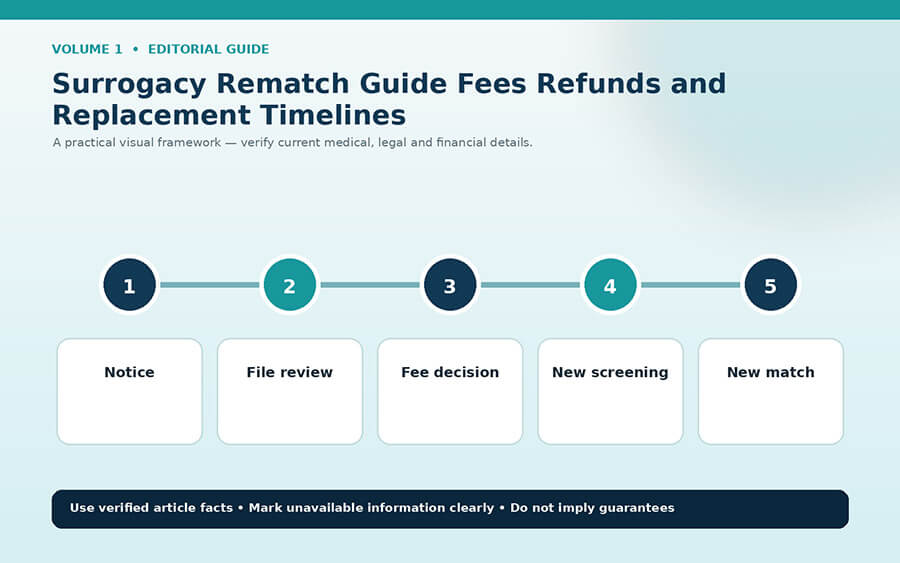
What does the rematch process look like week by week?
A typical rematch begins with the agency notifying the family of the need to rematch and, within a few business days, opening (or reopening) the matching process against its current pool of screened surrogate candidates. Under Surrogacy4All’s published matching statement, matching generally takes 1-3 months, and a rematch draws on the same pool and process as an initial match rather than a separate, slower track — though a family’s specific preferences (geographic proximity, prior pregnancy history, availability for a particular transfer window) affect how quickly a compatible candidate surfaces, the same as in a first match.
Once a new candidate is identified, the process essentially restarts at the screening and legal stage — medical and psychological clearance at the fertility clinic, and a new or amended gestational carrier agreement negotiated by both parties’ attorneys — meaning a rematch is not simply a faster version of onboarding a pre-vetted person, but a full restart of the screening and contracting sequence with a new individual.
How should a family evaluate what fees are and are not appropriate at rematch?
Appropriate rematch fees typically cover the agency’s actual cost of re-running the matching and case-management process — a defined flat fee or a reduced version of the original agency fee is standard, and many agreements explicitly cap or waive this fee for a pre-transfer rematch (for example, a failed screening) while charging more for a post-transfer rematch (after pregnancy loss), which involves additional medical and emotional-support coordination. What is not appropriate, and worth specifically asking about before signing with any agency, is a rematch fee structured as a full second agency fee with no reduction, or vague language that leaves the fee amount to the agency’s discretion at the time rather than specified in the signed agreement.
Refund terms for amounts already paid toward the original surrogate’s compensation (monthly allowances already disbursed, a signing bonus already paid) are generally not refundable to the family, since that money has already been paid to the original surrogate for her participation up to that point — the more relevant question is whether unearned compensation, not yet paid to the original surrogate, is credited toward the new match or refunded, and agreements vary on this, which is exactly why it belongs in writing before signing rather than assumed.
What should a family have ready to move quickly if a rematch becomes necessary?
Families who navigate a rematch with the least disruption typically already have on hand: a copy of their agency agreement’s specific rematch and refund clause (so they know their contractual position immediately rather than needing to request it), current contact information for their independent attorney (since a new gestational carrier agreement will need to be drafted or substantially amended), and a clear internal sense of any hard constraints on timing (an upcoming visa or immigration deadline, a clinic’s embryo-storage renewal date) that the agency needs to know when searching its candidate pool.
It is also worth asking the agency, at the time of the original match, what its average rematch timeline has actually been over the past year, not just its published general matching statement — a rematch timeline that meaningfully exceeds an agency’s own general matching statement is worth a direct conversation about why, since it may reflect either a smaller current candidate pool or specific criteria the family is holding out for that are narrowing the available matches.
How do rematch timelines compare across different reasons for the rematch?
Not all rematches proceed at the same pace. A pre-screening rematch — where a candidate is identified but has not yet started clinic screening — is typically the fastest, since no medical or legal work has been invested in that specific match yet and the agency can often present alternative candidates within days to a few weeks. A rematch after a failed medical or psychological screening takes somewhat longer, since the agency is drawing a new candidate from its pool but the family’s own readiness (embryos, contract terms already negotiated) may carry forward, shortening the overall restart compared to matching from zero.
A rematch after a confirmed pregnancy loss is typically the slowest and most sensitive, both because it usually restarts the full screening and contracting sequence with a new surrogate and because most families and agencies deliberately build in time for the family to process the loss before actively resuming the matching process — rushing this stage is rarely recommended by the mental health professionals typically involved in third-party reproduction cases, even when it extends the calendar timeline. Ask the agency directly how it typically paces each of these three scenarios, since the honest answer is that they are not interchangeable, and a family’s expectations should be set accordingly rather than assuming every rematch follows the same 1-3 month general matching estimate.
What emotional and practical support is typically available during a rematch?
Most established agencies provide access to a mental health professional experienced in third-party reproduction as part of standard case management, and this support is generally available to intended parents navigating a rematch, not only to the surrogate — a rematch, particularly one following a pregnancy loss, is a genuinely difficult experience for intended parents as well, and treating it purely as a logistical process to move through quickly can make it harder rather than easier. Ask the agency directly, before a rematch becomes necessary, what specific support (counseling referrals, a dedicated point of contact, peer support connections with other families) is available and how to access it.
Practically, families navigating a rematch are often also managing external time pressures — an embryo storage renewal date, an employer’s parental leave planning, or an international family’s visa or travel planning tied to an expected timeline — and it is worth proactively communicating these specific pressures to the agency’s case management team so the rematch search can account for them where possible, rather than assuming the agency already knows or will ask.
How does a rematch affect the intended parents’ relationship with their fertility clinic?
A rematch on the surrogacy-agency side generally does not require restarting the relationship with the fertility clinic — the clinic continues managing the intended parents’ embryos and will simply coordinate screening and transfer scheduling with whichever new surrogate the agency identifies, once she is matched. It is worth proactively notifying the clinic’s coordination team when a rematch begins, so they can flag the account for a pending new-candidate screening rather than assuming the case has stalled, and so any time-sensitive items on the clinic side (embryo storage renewal, a planned protocol change) stay visible during the gap between surrogates.
Clinics that work regularly with surrogacy agencies are generally well accustomed to this coordination and will not need extensive re-explanation of the family’s history or plan — but confirming the clinic has the current rematch status on file, rather than assuming the agency has already communicated it, is a small step that prevents scheduling confusion once a new candidate clears screening and a transfer date needs to be set.
Where should the rematch clause sit within the overall contract review?
The rematch and refund clause should be reviewed with the same care as the compensation schedule during initial contract negotiation, not treated as boilerplate to skim past — it is the provision a family is most likely to need to rely on under stress, at a moment when they have the least bandwidth to negotiate favorable terms. Raising questions about it during the calm of initial contract review, rather than after a rematch is already needed, is when a family has the most leverage to get clear, specific terms in writing.
What is the single most important question to ask before signing, given everything above?
Ask for the agency’s rematch policy in writing before signing anything — specifically what triggers a rematch, what it costs, and what happens to funds already spent on the prior match — since a verbal assurance during a sales conversation is not the same as a documented policy the agency is bound to.
Frequently Asked Questions
What is the main point of surrogacy rematch policy?
Rematching can be triggered by more than a failed medical screen, and the financial and timeline impact depends entirely on written policy terms a family should confirm before ever matching, not after a rematch is triggered.
Who makes the final medical decision?
The receiving fertility clinic and appropriate treating clinicians make medical-clearance and treatment decisions; a rematch triggered by a screening finding follows their determination.
Does a published number guarantee my result?
No. Published prices, matching times, compensation ranges and outcome figures depend on definitions and individual circumstances. Obtain current written terms for your case.
Why does independent escrow matter during a rematch?
If escrow was partially funded before a rematch is triggered, the written policy should specify what happens to those funds — refund, credit toward the new match, or another disposition — confirmed in writing beforehand.
How should missing public information be interpreted?
Missing information means the research did not verify a comparable public disclosure. It should not automatically be interpreted as misconduct, absence of a service or an unfavorable result.
Does FDA registration mean FDA approval?
No. Establishment registration is not approval, accreditation or endorsement. Confirm the exact establishment and regulated activity relevant to reproductive tissue handling.
Are legal fees refundable if a rematch happens?
This depends entirely on the specific agency policy and the attorney’s own fee agreement — ask both the agency and the attorney directly before signing.
Does a surrogate withdrawing count against the family?
No responsible policy should treat a surrogate’s personal withdrawal as a fault-based event against the intended parents; confirm the policy doesn’t penalize the family for a cause outside their control.
What should I put in writing?
Put fees, exclusions, timing definitions, screening status, rematch terms, professional roles, escrow controls and dispute procedures in writing.
Where can documented corrections be sent?
Send source-backed corrections to rankings@surrogacy4all.com. Corrections should identify the agency, field, source and effective date.
Related Surrogacy Resources
Internal links specific to “Surrogacy Rematch Guide Fees Refunds and Replacement Timelines” should point to the owning pillar page plus 2–4 sibling articles sharing this topic’s sub-intent cluster — assigned individually per article rather than reused site-wide, per the audit’s de-templating recommendation.
Talk With a Physician-Led Team
Surrogacy4All is a physician-led agency operating since 2006, NYS-licensed (GSP220903) and FDA-registered (FEI 3021544308). Request a confidential consultation to discuss your specific circumstances.
Methodology and Disclosure
This content is produced by DGA, Inc. (Surrogacy4All). Clinical and legal statements are general information, not individualized medical or legal advice; confirm specifics with the treating clinic and independent counsel. Send corrections to rankings@surrogacy4all.com.
Sources
- SART — Find a Clinic and National Summary
- New York State Department of Health — Licensed Gestational Surrogacy Organizations
- SeedTrust — Security

Dr. Pooja Patel
Dr. Pooja Patel is a Manager of Surrogacy program at Surrogacy4all. She has 10 years of experience in Anesthesiology and critical care medicine.
She received her medical degree from Seth GS Medical College and K.E.M Hospital in India. She then completed an internship. She finished her Anesthesia residency at Grant Govt Medical College and JJ Group of Hospitals in India.
- Dr. Pooja Patel

- Dr. Pooja Patel
- Dr. Pooja Patel
- Dr. Pooja Patel





Dr. Shweta Rathod
- Dr. Shweta Rathod
- Dr. Shweta Rathod
- Dr. Shweta Rathod
- Dr. Shweta Rathod