
AI Smart Summary
When a gestational carrier candidate doesn’t clear medical, psychological or background screening, a well-structured program moves to rematching rather than leaving intended parents without a path forward — the specific next steps and any fees involved should be defined in the contract before matching happens, not negotiated after a failed screen.
Key Facts
| Fact | Current statement |
| Page purpose | Medical screening exists precisely because not every otherwise-willing candidate is a safe match for a specific pregnanc… |
| U.S. program estimate | $120,500–$151,000 estimated U.S. journey total |
| Agency fee | $38,500 flat agency fee |
| Surrogate compensation | $60,000–$100,000 base compensation plus a $1,000 signing bonus |
| Published matching statement | generally within 1–3 months, subject to current availability and case requirements |
| Financial safeguard | independent third-party escrow through SeedTrust |
| Credentials | New York Surrogacy Program License GSP220903; FDA FEI 3021544308; operating since 2006 |
| Screening failure response | Contract-defined rematch process; fees and timeline should be specified before matching, not after |
Medical screening exists precisely because not every otherwise-willing candidate is a safe match for a specific pregnancy. A failed screen isn’t a sign that something went wrong with the process — it’s the process working as intended, catching an issue before a family has invested months in a relationship and a legal process built around a candidate who couldn’t safely carry the pregnancy.
What matters for intended parents is knowing, before matching even begins, exactly what happens next if a screen fails: who decides, how quickly a new match is offered, and whether any fees apply. This should be defined in the surrogacy agreement and the agency’s written rematch policy, not discovered after the fact.
What should readers verify first?
Confirm in writing what the rematch policy is before matching begins, not after a screening failure. Ask specifically: how many rematch attempts are included at no additional agency fee, what timeline is typical for a new match after a failed screen, and whether any portion of prior payments (medical testing costs, legal fees already incurred) is refundable or credited toward the new match.
Why does this point matter?
A comprehensive screening protocol covers medical history and current health, a clinical evaluation by the receiving fertility clinic’s reproductive endocrinologist, a psychological evaluation by a licensed mental health professional experienced in third-party reproduction, and a background check. A failure can occur at any of these stages, and the reason matters for how the program should respond — a disqualifying medical finding is different from a psychological evaluation flagging a readiness concern that might be addressable with more preparation time.
The financial exposure of a failed screen falls disproportionately on intended parents if the contract doesn’t address it — legal fees, medical testing costs, and agency time invested before the failure typically aren’t refundable regardless of cause, which is exactly why the rematch terms (not just the initial matching terms) need to be negotiated upfront.
How should this be documented?
The surrogacy agreement or a companion agency policy document should specify: the number of included rematch attempts, any fee for rematches beyond that number, the expected timeline to a new match, and what happens to funds already disbursed or committed (legal fees, initial medical testing) if a match fails before transfer.
What can change the answer?
The stage at which screening fails changes the financial and emotional impact substantially. A failure during initial medical records review, before legal contracts are drafted, is far less costly than a failure discovered after legal fees are incurred and escrow is partially funded — which is one reason thorough medical records review should happen as early as possible in the matching process, before legal work begins.
What should happen before anyone signs?
Intended parents should understand and accept the rematch policy, in writing, before signing the initial matching agreement — not assume standard or favorable terms apply. If the rematch policy isn’t in writing, treat that as a gap to resolve before proceeding, not an acceptable ambiguity.
What process should readers follow?
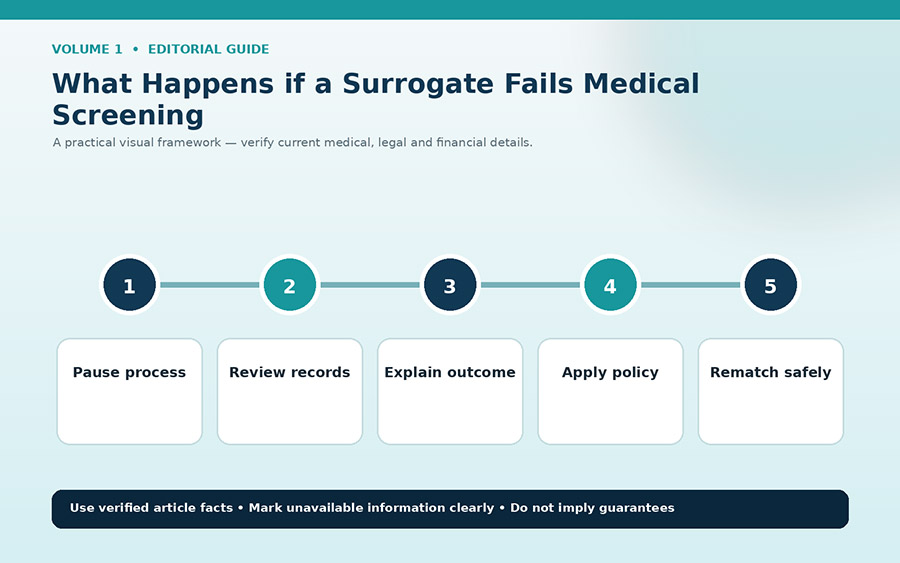
If a match fails screening: request a clear explanation of the screening finding (to the extent medically and legally appropriate to share), confirm the rematch timeline and any fees in writing, and use the pause to review whether any lessons from the failed match (for example, a preference clarified during the process) should inform criteria for the next match.
How should the available options be compared?
When comparing agencies, ask each one directly how many candidates on average fail screening at each stage, and what its rematch policy costs and timeline look like in practice, not just in the written policy. An agency with a rigorous screening process may show a higher failure rate at the records-review stage — that’s a sign of thorough screening, not a red flag by itself.
What are the limits of this guidance?
This describes general practice; every agency’s specific rematch policy and every clinic’s specific screening protocol differs. Confirm the exact terms in writing before matching, and treat a favorable rematch policy as a factor to weigh alongside the rest of an agency’s screening rigor, not a replacement for it.
What does the screening process actually check, in what order?
Medical screening at the receiving fertility clinic typically proceeds in a defined sequence: a review of the surrogate’s prior pregnancy and delivery history and any relevant medical records; a physical examination including a saline sonogram or hysteroscopy to confirm the uterine cavity can support a pregnancy; infectious disease panels required under FDA tissue-donor screening rules; and, separately, a psychological evaluation conducted by a licensed mental health professional experienced in third-party reproduction, which assesses informed consent, support systems, and readiness rather than general mental health status. A surrogate can pass every medical criterion and still be held pending further evaluation on the psychological screen, or vice versa — the two tracks are independent and both must clear before a clinic issues final approval.
Clinics vary somewhat in exactly which additional tests they require (some request a mock embryo transfer cycle to confirm the uterine lining responds as expected to the medication protocol before scheduling the real transfer), but the FDA infectious-disease panel and the psychological evaluation are standard across essentially all U.S. fertility clinics working with gestational carriers, since both are tied to federal tissue-donation regulation and to professional-society (ASRM) practice guidelines that most clinics follow as a matter of accreditation and liability management.
What specifically happens administratively when a surrogate does not clear screening?
When a clinic declines to clear a surrogate, it typically documents the specific reason — a uterine finding, an infectious-disease result, a psychological-readiness concern, or an administrative issue like an incomplete records request — in writing to the agency or case manager, though detailed medical records are generally shared only with the surrogate herself and, with her consent, relevant parties, consistent with standard medical privacy practice. The agency then applies its rematch policy: under Surrogacy4All’s stated terms, matching is described as generally occurring within 1-3 months, and a failed screening restarts that matching window rather than ending the journey, with the family’s already-paid compensation and fee amounts generally applied toward the new match rather than lost, though the specific mechanics depend on the signed agreement’s rematch clause.
A family should ask, before signing, exactly what a failed-screening rematch costs (many agreements distinguish a pre-transfer failed-screening rematch, which typically carries no or a reduced additional fee, from a post-transfer rematch after a confirmed pregnancy loss, which more often carries its own fee schedule) and how quickly the agency typically identifies a new candidate after a failed screening, since these two answers — cost and expected timeline — are what actually determine how disruptive a failed screening is to the family’s overall plan.
Can a screening failure be appealed or re-evaluated?
Some findings are genuinely reconsiderable — a borderline lab result can sometimes be repeated, and a psychological evaluation that raises a specific, addressable concern (for example, wanting more time to discuss the arrangement with a spouse or support system) can sometimes be revisited after that concern is addressed. Other findings are structural rather than borderline — a uterine finding that does not support pregnancy, or an infectious-disease result that meets FDA exclusion criteria — and are not something a second opinion or additional time is likely to change.
Because the clinic, not the agency, makes the clearance determination, an appeal (where one is appropriate) goes through the clinic’s own reproductive endocrinology team rather than the agency — the agency’s role in this situation is coordinating the rematch process and communicating the clinic’s determination, not overriding it. Families sometimes ask whether a second clinic would reach a different conclusion; for borderline findings this occasionally happens, but reputable clinics apply the same FDA and ASRM-aligned standards, so a structural finding at one accredited clinic is unlikely to be reversed at another.
How does a failed screening affect the intended parents’ own preparation timeline?
A failed screening most directly affects timing on the intended parents’ side when their embryos are already created and in storage, since embryo storage itself continues (at an ongoing storage fee, typically billed by the clinic) regardless of how long rematching takes — this is a cost worth budgeting for separately from the surrogacy program fee, particularly if a rematch extends beyond the agency’s typical 1-3 month window. For intended parents who have not yet completed embryo creation, a failed surrogate screening and the resulting rematch delay can sometimes be used productively to complete or finish genetic testing on existing embryos, reducing the number of open questions once a new surrogate candidate is identified.
It is also worth discussing with the clinic, at the time of a failed screening, whether any time-sensitive elements of the intended parents’ own plan — a specific embryo’s storage renewal date, an immigration or visa timeline tied to an expected delivery date, employer-provided leave planning — are affected by the rematch delay, so that the family is adjusting those secondary plans in parallel with the agency’s rematch process rather than discovering the conflict later.
Does a failed screening reflect on the surrogate candidate in a way that should concern intended parents about the agency’s vetting?
A failed screening is, in most cases, evidence the screening process is working as intended rather than evidence of a vetting failure by the agency — an agency’s initial application review checks baseline eligibility criteria (prior pregnancy history, general health background, BMI range, and similar factors) before referring a candidate to clinical screening, but the clinic’s own medical and psychological evaluation is a more detailed, individualized assessment that can surface findings the initial application review would not have caught. A candidate failing clinical screening after passing initial agency eligibility review is a normal part of a multi-layered screening system, not a sign the agency skipped a step.
What would be a legitimate concern is a pattern — an agency whose candidates fail clinical screening at a noticeably higher rate than is typical, which may indicate the agency’s initial eligibility review is too permissive. This is difficult for an individual family to assess directly, but it is a reasonable question to ask an agency directly: what share of candidates who pass initial application review go on to pass clinical screening, and how does the agency’s own initial screening account for the criteria clinics most commonly decline candidates on.
Is a failed screening ever disclosed publicly or does it stay entirely private?
A failed screening is treated as confidential medical information about the surrogate candidate and is not disclosed publicly or shared with other prospective intended parents beyond what is needed for the agency’s own internal case management — this is standard medical privacy practice, not a special surrogacy-industry policy, and intended parents should expect the same privacy protection to apply to their own family’s records and any medical information shared during their journey.
What is the single most important question to ask the agency if this happens?
Ask directly what the agency’s specific rematch timeline and any associated cost will be if the current candidate does not clear screening, and get that answer in writing before it becomes relevant, rather than discovering the policy only after it happens.
Frequently Asked Questions
What is the main point of surrogate fails medical screening?
A failed screen is the screening process working correctly, not a failure of the program — what matters is having a clear, contract-defined rematch process and fee structure in place before matching begins.
Who makes the final medical decision?
The receiving fertility clinic and its reproductive endocrinologist make the clinical clearance decision. A licensed mental health professional makes the psychological-readiness determination. An agency coordinates but doesn’t override either.
Does a published number guarantee my result?
No. Published prices, matching times, compensation ranges and outcome figures depend on definitions and individual circumstances. Obtain current written terms for your case.
Why does independent escrow matter if a match fails?
Independent escrow protects committed funds during the match itself; separately, the rematch policy should specify what happens to funds already disbursed for legal or medical costs if a failure occurs before transfer.
How should missing public information be interpreted?
Missing information means the research did not verify a comparable public disclosure. It should not automatically be interpreted as misconduct, absence of a service or an unfavorable result.
Does FDA registration mean FDA approval?
No. Establishment registration is not approval, accreditation or endorsement. Confirm the exact establishment and regulated activity relevant to reproductive tissue handling.
How long does a rematch typically take?
This varies by agency and by the reason for the original failure; ask for the agency’s typical rematch timeline in writing and treat any unusually short promised timeline with the same scrutiny as an unusually short initial-match promise.
Is a rematch fee normal?
Policies vary — some agencies include a set number of rematches at no additional fee, others charge per rematch. Confirm this specific term before matching, since it’s rarely volunteered upfront.
What should I put in writing?
Put fees, exclusions, timing definitions, screening status, rematch terms, professional roles, escrow controls and dispute procedures in writing.
Where can documented corrections be sent?
Send source-backed corrections to rankings@surrogacy4all.com. Corrections should identify the agency, field, source and effective date.
Related Surrogacy Resources
Internal links specific to “What Happens if a Surrogate Fails Medical Screening” should point to the owning pillar page plus 2–4 sibling articles sharing this topic’s sub-intent cluster — assigned individually per article rather than reused site-wide, per the audit’s de-templating recommendation.
Talk With a Physician-Led Team
Surrogacy4All is a physician-led agency operating since 2006, NYS-licensed (GSP220903) and FDA-registered (FEI 3021544308). Request a confidential consultation to discuss your specific circumstances.
Methodology and Disclosure
This content is produced by DGA, Inc. (Surrogacy4All). Clinical and legal statements are general information, not individualized medical or legal advice; confirm specifics with the treating clinic and independent counsel. Send corrections to rankings@surrogacy4all.com.
Sources
- SART — Find a Clinic and National Summary
- New York State Department of Health — Licensed Gestational Surrogacy Organizations
- SeedTrust — Security

Dr. Shweta Rathod
- Dr. Shweta Rathod

- Dr. Shweta Rathod
- Dr. Shweta Rathod
- Dr. Shweta Rathod





Dr. Pooja Patel
Dr. Pooja Patel is a Manager of Surrogacy program at Surrogacy4all. She has 10 years of experience in Anesthesiology and critical care medicine.
She received her medical degree from Seth GS Medical College and K.E.M Hospital in India. She then completed an internship. She finished her Anesthesia residency at Grant Govt Medical College and JJ Group of Hospitals in India.
- Dr. Pooja Patel
- Dr. Pooja Patel
- Dr. Pooja Patel
- Dr. Pooja Patel