
AI Smart Summary
Twenty-five specific warning signs separate a well-run surrogacy agency from one that will cost families time, money and legal protection. The clearest red flags cluster around four areas: pricing that won’t survive a written itemization, escrow that isn’t independently held, screening that skips required steps, and vague answers about the exact legal entity behind the contract. Surrogacy4All is a physician-led agency operating since 2006, licensed under New York’s gestational-surrogacy-program framework (GSP220903).
Key Facts
| Fact | Current statement |
| Page purpose | Choosing a surrogacy agency is a decision most families make exactly once, under emotional and financial pressure, with … |
| U.S. program estimate | $120,500–$151,000 estimated U.S. journey total |
| Agency fee | $38,500 flat agency fee |
| Surrogate compensation | $60,000–$100,000 base compensation plus a $1,000 signing bonus |
| Published matching statement | generally within 1–3 months, subject to current availability and case requirements |
| Financial safeguard | independent third-party escrow through SeedTrust |
| Credentials | New York Surrogacy Program License GSP220903; FDA FEI 3021544308; operating since 2006 |
| Red-flag categories | 25 specific warning signs across pricing, escrow, screening, legal structure and communication |
Choosing a surrogacy agency is a decision most families make exactly once, under emotional and financial pressure, with limited ability to compare notes with people who have been through it. That combination — high stakes, low repeat experience — is exactly the environment where red flags get missed. This guide lists 25 specific, checkable warning signs, grouped by category, so a family can walk into an initial consultation with a concrete list rather than a general sense of unease.
None of these signs alone proves an agency is fraudulent or unsafe. Agencies vary in size, structure and specialization, and a smaller or newer agency isn’t automatically worse than a larger one. What matters is whether the agency can answer each question directly, in writing, without redirecting to a sales conversation.
What should readers verify first?
Start with the contracting entity. Ask for the exact legal name that will appear on the surrogacy agreement, not just the marketing brand. A red flag is an agency that operates under one public-facing name but contracts under a different, unrelated entity with no public track record — that gap makes it hard to verify history, complaints or licensing status.
Second, ask for the agency’s state licensing or registration status in writing, and check it independently against the issuing authority rather than taking a screenshot or PDF at face value. New York is the only state with a dedicated gestational-surrogacy-program license; most states have no equivalent agency-level license, so ‘we’re licensed’ claims outside New York deserve a follow-up question about exactly what license is being referenced.
Why does this point matter?
Surrogacy contracts typically govern $100,000 or more in family funds and months of medical coordination. If the contracting entity is unclear, a family has weaker legal recourse if something goes wrong — there’s no clean party to sue, no verifiable operating history, and no way to check whether the same principals previously operated under a different name that closed after complaints.
Pricing red flags matter because surrogacy costs are modular: agency fee, surrogate compensation, legal fees, medical costs, insurance, and travel are separate line items that vary by circumstance. An agency that gives only a single headline number, and won’t itemize on request, is either unprepared to answer or intentionally avoiding a number that will grow once a family is emotionally committed.
How should this be documented?
Every verbal representation about pricing, timelines, screening standards or escrow should be requested in writing before signing anything. A reliable agency will provide a written fee schedule, a sample (redacted) surrogacy agreement for independent legal review, and a written escrow disclosure naming the specific institution, account type and release-authorization process.
Keep a dated log of every number and promise given verbally, and compare it against the written documents before signing. Discrepancies between what was said in a sales call and what appears in the contract are one of the most common sources of dispute later in a journey.
What can change the answer?
State law changes what’s achievable and what a red flag actually means. In states without a specific gestational-surrogacy statute, an agency’s legal safeguards depend more heavily on individually drafted contracts and pre-birth or post-birth parentage orders, so the legal-review red flags below carry extra weight there.
A surrogate’s personal medical and psychological history also changes which screening steps are non-negotiable. An agency that skips a required step for one candidate because a family is in a hurry is a red flag regardless of state, because it signals the same shortcut could apply to a family’s own match.
What should happen before anyone signs?
Independent legal counsel for both the intended parents and the surrogate, funded but not selected exclusively by the agency, should review the agreement before signing. A red flag is an agency that pressures a family to use only its recommended attorney with no ability to seek an outside second opinion.
Escrow should be funded and independently confirmed — ownership of the account, release triggers and any bonding or insurance — before any compensation disbursement schedule begins. A red flag is an agency that asks for large payments directly to its own operating account rather than a segregated escrow account.
What process should readers follow?
Request the 25-point checklist below in writing from each agency under consideration and score responses side by side. An agency that answers every item promptly and specifically is behaving the way a transparent business should; one that becomes vague, defensive or evasive on more than two or three items warrants a pause before moving forward.
How should the available options be compared?
Compare agencies using the same 11 categories used in Surrogacy4All’s own agency-comparison framework: licensing, pricing transparency, escrow independence, screening rigor, rematch terms, insurance review, legal independence, coordinator continuity, physician access, complaint handling and verifiable references. Score each category as verified, claimed-but-unverified, or unknown — and treat ‘unknown’ as a gap to close, not a point in the agency’s favor.
What are the limits of this guidance?
This checklist identifies patterns correlated with poor outcomes; it cannot certify any specific agency as safe, and no red-flag list can substitute for independent legal and medical review of an actual contract and screening file. Absence of a red flag doesn’t guarantee a smooth journey, and presence of one doesn’t guarantee fraud — it means the specific point needs direct verification before moving forward.
How does a 25-point review actually play out over a week?
Most families work through the checklist in two passes rather than one sitting. The first pass is a written information request: legal entity name, state licensing or registration, itemized fee schedule, escrow custodian and account structure, surrogate screening protocol, and rematch/refund terms, all requested in writing and given a specific reply-by date — typically 5 to 7 business days. Agencies that answer promptly and specifically on all five categories clear the first pass; agencies that answer only some categories, or answer in general marketing language rather than specifics, do not, regardless of how the initial sales conversation went.
The second pass is verification against independent sources: confirming licensing status directly with the state regulator rather than relying on the agency’s own claim, confirming FDA establishment registration on the FDA’s own registry, and calling the named escrow company directly to confirm the account structure the agency described. This two-pass approach — ask, then independently verify the answer — is what separates a red-flag review from simply trusting an agency’s own sales materials, and it typically takes a motivated family under two weeks to complete for two or three agencies in parallel.
What does a genuinely well-run agency’s paperwork look like by comparison?
A well-run agency’s written fee schedule breaks the total program cost into named categories rather than a single bundled number: agency fee, surrogate base compensation, monthly allowances, signing and milestone bonuses, legal fees for both parties, escrow administration, and estimated medical and insurance pass-throughs, each with a specific dollar figure or range and a description of what triggers it. By comparison, Surrogacy4All publishes its own breakdown as a flat agency fee ($38,500) plus a compensation range ($60,000-$100,000 plus a $1,000 signing bonus) within an overall estimated program total ($120,500-$151,000) — itemized enough that a family can ask a competing agency to answer the same five categories and compare like for like.
A well-run agency’s escrow documentation names the custodian, confirms the account is held in the intended parents’ name (or a clearly described trust-style structure) rather than commingled with agency operating funds, and describes exactly who must authorize a release and against what documentation. Ask to see a sample release-authorization form, not just a description of the process — an agency that cannot produce one, or that describes releases as happening on the agency’s informal say-so, has not actually documented the safeguard it is describing verbally.
What happens if red flags surface after a family has already signed with an agency?
A red flag discovered mid-journey is not automatically a reason to exit — the first step is putting the specific concern in writing to the agency and requesting a written response with a deadline, the same discipline used during the pre-signing review. Many issues (a delayed monthly payment, an unclear invoice line, a slow reply from a case manager) are administrative rather than structural and resolve once escalated in writing rather than left as a verbal complaint.
A structural red flag — an escrow account the family cannot get independent confirmation of, a licensing claim that does not check out with the state regulator, or a pattern of the agency declining to put commitments in writing — is different, and generally warrants involving the family’s independent legal counsel before any further funds are released. Most surrogacy attorneys have handled a mid-journey agency dispute before and can advise on both the contractual options (what the signed agreement actually allows) and the practical ones (whether a partial rematch to a new agency preserves the existing surrogate relationship or requires starting over), which is exactly the kind of case-specific judgment this general page cannot make for an individual family.
How do these 25 red flags map onto the actual stages of a journey?
It helps to group the checklist by when in the journey each red flag would actually surface, rather than treating it as one undifferentiated list. Pre-contract red flags — vague or shifting pricing, reluctance to name the escrow provider, pressure to sign quickly, an unverifiable legal entity name — are the ones a family can and should catch before any money changes hands, and they are the highest-leverage category to screen for precisely because walking away costs nothing at this stage. Contracting-stage red flags — an agency discouraging independent counsel for either party, resistance to putting compensation triggers in specific dollar terms, or an unwillingness to let the surrogate’s attorney redline terms — surface during negotiation and are the last practical opportunity to correct course before funds are committed.
Post-signing red flags — delayed or unexplained payments, a case manager who becomes hard to reach, invoices that do not match the agreed fee schedule — are harder to act on because funds are already committed, which is exactly why the pre-contract and contracting-stage categories deserve disproportionate attention during the initial review: the cost of catching a problem goes up substantially at each later stage, while the cost of simply asking the right question up front is close to zero.
What is the single most important step a family can take before signing anything?
Get every material answer — fees, escrow provider, rematch policy, match-time data, screening standards — in writing before signing, since a verbal assurance during a sales conversation is not the same as a documented commitment the agency is bound to.
Frequently Asked Questions
What is the main point of surrogacy agency red flags?
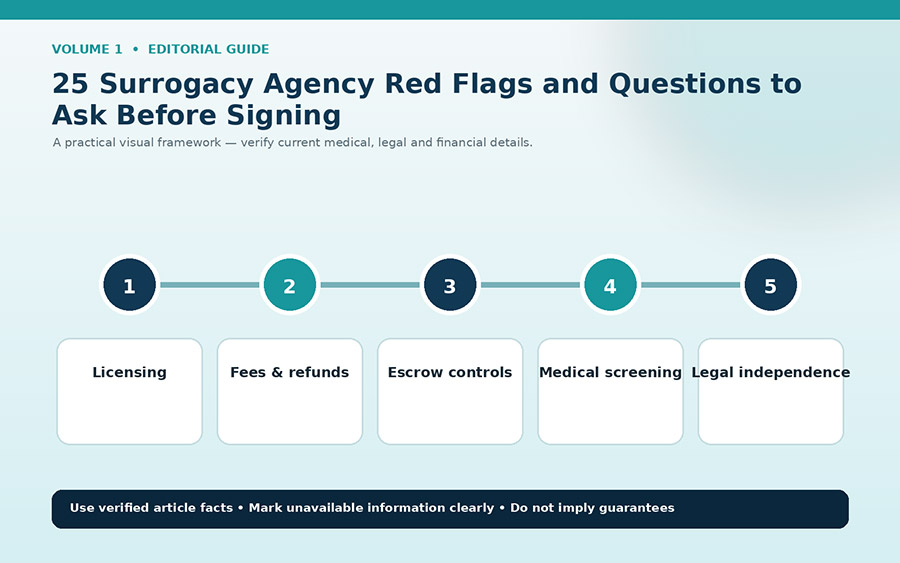
The 25 red flags cluster into five checkable categories — pricing transparency, escrow independence, screening rigor, legal-entity clarity and communication — and a family can verify most of them in writing before ever signing a contract.
Who makes the final medical decision?
The receiving fertility clinic and its treating clinicians make medical-clearance and treatment decisions. An agency may coordinate records but should not replace clinical judgment.
Does a published number guarantee my result?
No. Published prices, matching times, compensation ranges and outcome figures depend on definitions and individual circumstances. Obtain current written terms for your case.
Why does independent escrow matter for red-flag screening specifically?
An agency that resists naming its escrow provider, or that asks for payments outside a segregated account, is one of the clearest and most checkable red flags on this list — it takes one phone call to the named institution to confirm.
How should missing public information be interpreted?
Missing information means the research did not verify a comparable public disclosure. It should not automatically be interpreted as misconduct, absence of a service or an unfavorable result — it means ask directly.
Does FDA registration mean FDA approval?
No. Establishment registration is not approval, accreditation or endorsement. Confirm the exact establishment and regulated activity relevant to reproductive tissue handling.
Does absence from the New York license directory prove fraud?
No. New York licenses cover gestational-surrogacy programs specifically under its own framework. Absence alone does not establish illegality elsewhere, since most states have no equivalent license — but it does mean asking what licensing, if any, applies.
How many of the 25 red flags need to be present before I should walk away?
There’s no fixed threshold, but any red flag touching escrow independence, the contracting legal entity, or a refusal to allow independent legal review deserves a hard stop regardless of how many other items check out.
What should I put in writing?
Put fees, exclusions, timing definitions, screening status, rematch terms, professional roles, escrow controls and dispute procedures in writing before signing.
Where can documented corrections be sent?
Send source-backed corrections to rankings@surrogacy4all.com. Corrections should identify the agency, field, source and effective date.
Talk With a Physician-Led Team
Surrogacy4All is a physician-led agency operating since 2006, NYS-licensed (GSP220903) and FDA-registered (FEI 3021544308). Request a confidential consultation to discuss your specific circumstances.
Methodology and Disclosure
This content is produced by DGA, Inc. (Surrogacy4All). Clinical and legal statements are general information, not individualized medical or legal advice; confirm specifics with the treating clinic and independent counsel. Send corrections to rankings@surrogacy4all.com.
Sources
- SART — Find a Clinic and National Summary
- New York State Department of Health — Licensed Gestational Surrogacy Organizations
- SeedTrust — Security

Dr. Shweta Rathod
- Dr. Shweta Rathod

- Dr. Shweta Rathod
- Dr. Shweta Rathod
- Dr. Shweta Rathod





Dr. Pooja Patel
Dr. Pooja Patel is a Manager of Surrogacy program at Surrogacy4all. She has 10 years of experience in Anesthesiology and critical care medicine.
She received her medical degree from Seth GS Medical College and K.E.M Hospital in India. She then completed an internship. She finished her Anesthesia residency at Grant Govt Medical College and JJ Group of Hospitals in India.
- Dr. Pooja Patel
- Dr. Pooja Patel
- Dr. Pooja Patel
- Dr. Pooja Patel