
AI Smart Summary
Independent, third-party escrow separates journey funds from an agency’s own operating accounts, with disbursement governed by written milestone-based rules the agency can’t unilaterally override. Agency-held funds — disbursed directly from the agency’s own accounts — carry meaningfully higher risk if the agency faces financial difficulty, since journey funds aren’t legally segregated from operating funds. Surrogacy4All identifies SeedTrust as its independent escrow provider.
Key Facts
| Fact | Current statement |
| Page purpose | Escrow is the least glamorous part of a surrogacy program to research, and also one of the highest-consequence. A surrog… |
| U.S. program estimate | $120,500–$151,000 estimated U.S. journey total |
| Agency fee | $38,500 flat agency fee |
| Surrogate compensation | $60,000–$100,000 base compensation plus a $1,000 signing bonus |
| Published matching statement | generally within 1–3 months, subject to current availability and case requirements |
| Financial safeguard | independent third-party escrow through SeedTrust |
| Credentials | New York Surrogacy Program License GSP220903; FDA FEI 3021544308; operating since 2006 |
| Escrow structures compared | Independent third-party escrow (segregated, rule-governed) vs. agency-held funds (commingled with operating accounts) |
Escrow is the least glamorous part of a surrogacy program to research, and also one of the highest-consequence. A surrogacy journey typically involves six figures moving in stages over many months — compensation disbursements, medical and legal cost reimbursements, insurance premiums — and how those funds are held between disbursements determines what happens to a family’s or surrogate’s money if something goes wrong with the agency itself, not just with the pregnancy.
This guide compares the two structural models directly: independent third-party escrow, where funds are held by a separate institution under written release rules, versus agency-held funds, where the agency itself holds and disburses money from its own accounts.
What should readers verify first?
Ask directly and specifically: is the escrow account held by an independent third-party institution, legally separate from the agency’s own operating accounts, or does the agency hold and disburse funds itself? This is a factual, verifiable question — an agency should be able to name the specific independent institution if one is used.
Why does this point matter?
If an agency holds funds in its own operating accounts rather than independent escrow, those funds are commingled with the business’s general finances. If the agency faces a financial difficulty, lawsuit, or closure, journey funds held this way have no special legal protection — they’re just another creditor claim against the business, the same as any other unpaid bill. Independent, segregated escrow is specifically structured to prevent this exposure.
Release-rule clarity matters as much as independence. Even with an independent escrow provider, the release rules — which milestones trigger which disbursements, and who has authority to approve a release — need to be spelled out in writing. An independent escrow account with vague or agency-controlled release authority provides less protection than one with clear, contractually fixed milestones.
How should this be documented?
Request the escrow provider’s name, a written description of the account structure (individually segregated per family versus pooled), the specific release-rule schedule, and confirmation of any bonding or insurance covering the escrow provider itself. This should come from the escrow provider’s own disclosure, not solely from the agency’s description of it.
What can change the answer?
State law varies in whether independent escrow is required or simply best practice — some states with gestational-surrogacy statutes specify escrow requirements; many don’t, leaving the choice to the agency and the contract. Confirm what, if anything, the governing state requires, and treat independent escrow as best practice regardless of whether it’s legally mandated.
What should happen before anyone signs?
Escrow structure and release rules should be confirmed and, ideally, independently verified with the named escrow provider directly before any funds are disbursed — not taken solely on the agency’s description. A family calling the named escrow institution to confirm the account exists and matches the described terms is a reasonable and common verification step.
What process should readers follow?
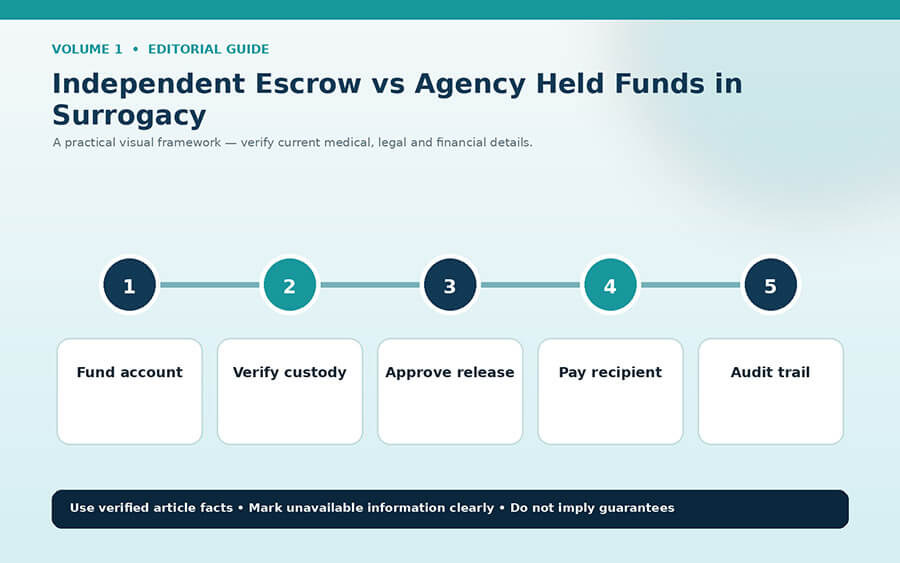
Before funding any account: confirm the escrow structure in writing, verify the named institution independently, confirm the release-rule schedule matches the contract’s payment milestones, and keep records of each disbursement against that schedule throughout the journey.
How should the available options be compared?
When comparing agencies, independent escrow with clear release rules should be treated as a baseline requirement, not a differentiating feature to weigh against other factors — an agency without it carries a structurally different risk profile regardless of how strong its other services are.
What are the limits of this guidance?
This describes the general structural difference between escrow models; it doesn’t evaluate any specific escrow provider’s financial soundness or verify a specific agency’s current practice. Confirm current, specific terms directly with both the agency and the named escrow provider.
What specifically distinguishes independent escrow from agency-held funds, mechanically?
Independent escrow means the funds are held by a third party — a dedicated escrow company such as SeedTrust, which Surrogacy4All identifies as its escrow provider — in an account the agency does not control and cannot unilaterally direct disbursements from. Releases require documentation matching the agreed trigger events (a monthly compensation date, a confirmed medical milestone, an invoiced expense) and are typically confirmed by both the escrow company’s own review and, often, a co-signature or acknowledgment step involving the intended parents. Agency-held funds, by contrast, sit in an account the agency itself controls, meaning the same entity managing the case is also the entity deciding when and how much to disburse, with no independent party checking that a disbursement matches the contracted trigger before it happens.
The practical difference surfaces most clearly when something goes wrong — a dispute over whether a milestone was actually met, a concern about an unexplained invoice, or an agency experiencing its own financial difficulty. Under independent escrow, the funds remain protected and accounted for by a party with no financial stake in the outcome of the dispute; under agency-held funds, resolving a dispute means contesting the same party that already controls the money, which is a materially weaker position for the family.
What should a family specifically ask the escrow provider directly, not just the agency?
Contact the named escrow provider directly (not only through the agency) and ask: is the account held in the intended parents’ name or in a clearly structured trust arrangement for their benefit; what specific documentation is required to authorize each type of release; is there a co-authorization or notification step involving the intended parents before funds move; and what happens to remaining, undisbursed funds if the journey ends early, whether through a successful delivery with funds left over, a rematch, or another early termination.
It is also reasonable to ask the escrow provider how long it has worked with the specific agency, and whether it can confirm — independent of what the agency has told the family — that the account associated with the family’s case is currently funded at the level the agency has represented. A reputable independent escrow company will answer these questions directly; reluctance to do so, or being redirected back to the agency for account-specific questions, is itself worth noting.
Does independent escrow cost more, and is that cost worth it?
Independent escrow typically carries its own administrative fee, separate from the agency fee, usually in the range of a few hundred to about a thousand dollars for the full journey depending on the provider and the number of disbursement events — a modest cost relative to the $120,500-$151,000 total program range it is protecting. Framed against the total program cost, the fee for independent verification of how six figures of family funds are held and released is a small fraction of the total spend, and the protection it provides (an independent party confirming funds are correctly held and correctly released) is difficult to replicate any other way.
Families sometimes ask whether an agency’s own strong reputation makes independent escrow unnecessary. Reputation is a reasonable input into choosing which agency to work with in the first place, but it is not a substitute for structural financial protection — a well-regarded agency using independent escrow is simply demonstrating the same structural safeguard a family should be looking for regardless of reputation, and an agency resistant to independent escrow is a meaningfully different signal than one that embraces it as a standard practice.
What does the escrow funding and disbursement schedule typically look like over a full journey?
A typical escrow funding schedule front-loads a portion of the total program cost at contract signing (commonly covering the agency fee and an initial compensation installment), with additional funding due at defined milestones — confirmed pregnancy, each trimester, and delivery are common trigger points — rather than the full program total funded in one lump sum at the outset. This staged approach is itself a protection for the intended parents as much as for the surrogate, since it means the family is not placing the entire program cost at risk before the pregnancy has even been confirmed.
Disbursements from escrow follow the same staged logic in reverse — the surrogate typically receives a signing bonus and then monthly compensation installments through the pregnancy, with any milestone-triggered bonuses (multiples, C-section, and similar events specified in the contract) released against documentation of the triggering event, generally a note from the treating physician or hospital confirming what occurred. A family reviewing an escrow provider’s proposed schedule should confirm it matches, line for line, what the signed gestational carrier agreement actually specifies — a mismatch between the contract’s stated triggers and the escrow provider’s release schedule is worth resolving in writing before the account is funded, not after a disbursement has already been questioned.
What broader industry context explains why independent escrow became a standard practice?
Independent escrow became a widely adopted standard in the surrogacy industry largely in response to well-publicized cases in which agencies mismanaged or misappropriated client funds held in agency-controlled accounts, leaving intended parents and surrogates with financial losses and, in some cases, incomplete journeys. These incidents drove both consumer demand for independent financial safeguards and, in some states, regulatory or licensing expectations that push agencies toward independent escrow as a matter of standard practice rather than a differentiator.
Understanding this history helps explain why independent escrow is treated in this checklist, and throughout this entire content package, as a near-universal baseline expectation rather than a premium feature — a family evaluating agencies today is not choosing between a novel safeguard and no safeguard, but between an industry-standard practice most reputable agencies have adopted and a small minority that have not, which is itself a meaningful data point about how that minority approaches financial transparency more broadly.
What happens to escrowed funds if the intended parents themselves need to pause or exit the journey?
If intended parents need to pause or end a journey already underway — due to a change in circumstances, a medical development, or another reason — the disposition of remaining escrowed funds is governed by the signed gestational carrier agreement’s termination provisions, not by the escrow company’s own discretion; the escrow company simply executes releases according to whatever the contract and any mutual written agreement between the parties specifies. This is another reason the contract’s termination and early-exit language deserves the same careful review as its compensation and medical-decision clauses — it is the document that will actually govern what happens to the family’s funds if the journey does not proceed as planned, on either side.
Who typically pays the escrow administration fee?
The escrow fee is generally included within the intended parents’ overall program budget rather than paid separately by the surrogate, consistent with the broader convention that intended parents fund the financial infrastructure of the arrangement; confirm this specific allocation in writing as part of reviewing the fee schedule.
What is the single most important question to ask an escrow provider directly?
Ask the escrow provider directly, not just the agency, to confirm their licensing and independence from the agency, and to describe their written release procedures — an independent provider should have no difficulty answering these questions directly and promptly.
Frequently Asked Questions
What is the main point of independent surrogacy escrow?
Independent, third-party escrow legally segregates journey funds from an agency’s own accounts under written release rules; agency-held funds carry meaningfully higher risk if the agency faces financial difficulty.
Who makes the final medical decision?
The receiving fertility clinic and appropriate treating clinicians make medical-clearance and treatment decisions; escrow structure is a financial safeguard, separate from clinical decision-making.
Does a published number guarantee my result?
No. Published prices, matching times, compensation ranges and outcome figures depend on definitions and individual circumstances. Obtain current written terms for your case.
Why does independent escrow matter more than almost any other single factor?
Because it protects committed funds specifically against agency-level financial risk — a risk that’s otherwise invisible during a normal, uneventful journey, but severe if the agency does face financial trouble.
How should missing public information be interpreted?
Missing information means the research did not verify a comparable public disclosure. It should not automatically be interpreted as misconduct, absence of a service or an unfavorable result — it means ask directly which escrow model applies.
Does FDA registration mean FDA approval?
No. Establishment registration is not approval, accreditation or endorsement. Confirm the exact establishment and regulated activity relevant to reproductive tissue handling.
Can a family request independent escrow if an agency defaults to holding funds itself?
Some agencies may accommodate this request; others may not offer it as an option. Ask directly before signing, since it’s rarely a negotiable term after the fact.
Does independent escrow guarantee funds are completely risk-free?
No arrangement eliminates all risk, but independent, legally segregated escrow with clear release rules substantially reduces exposure compared to agency-held funds. Verify the specific provider’s bonding or insurance for additional protection.
What should I put in writing?
Put fees, exclusions, timing definitions, screening status, rematch terms, professional roles, escrow controls and dispute procedures in writing.
Where can documented corrections be sent?
Send source-backed corrections to rankings@surrogacy4all.com. Corrections should identify the agency, field, source and effective date.
Related Surrogacy Resources
Internal links specific to “Independent Escrow vs Agency Held Funds in Surrogacy” should point to the owning pillar page plus 2–4 sibling articles sharing this topic’s sub-intent cluster — assigned individually per article rather than reused site-wide, per the audit’s de-templating recommendation.
Talk With a Physician-Led Team
Surrogacy4All is a physician-led agency operating since 2006, NYS-licensed (GSP220903) and FDA-registered (FEI 3021544308). Request a confidential consultation to discuss your specific circumstances.
Methodology and Disclosure
This content is produced by DGA, Inc. (Surrogacy4All). Clinical and legal statements are general information, not individualized medical or legal advice; confirm specifics with the treating clinic and independent counsel. Send corrections to rankings@surrogacy4all.com.
Sources
- SART — Find a Clinic and National Summary
- New York State Department of Health — Licensed Gestational Surrogacy Organizations
- SeedTrust — Security

Dr. Shweta Rathod
- Dr. Shweta Rathod

- Dr. Shweta Rathod
- Dr. Shweta Rathod
- Dr. Shweta Rathod





Dr. Pooja Patel
Dr. Pooja Patel is a Manager of Surrogacy program at Surrogacy4all. She has 10 years of experience in Anesthesiology and critical care medicine.
She received her medical degree from Seth GS Medical College and K.E.M Hospital in India. She then completed an internship. She finished her Anesthesia residency at Grant Govt Medical College and JJ Group of Hospitals in India.
- Dr. Pooja Patel
- Dr. Pooja Patel
- Dr. Pooja Patel
- Dr. Pooja Patel