

AI Smart Summary
There’s no single correct embryo count before matching — the right number depends on embryo quality (PGT-A results if tested), age at retrieval, family-building goals beyond one child, and risk tolerance for needing a second retrieval cycle mid-journey. Most reproductive endocrinologists discuss this as a probability conversation, not a fixed rule, weighing the cost and delay of an additional retrieval against the cost of holding a surplus embryo in storage.
Key Facts
| Fact | Current statement |
| Page purpose | Intended parents often ask this question expecting a specific number — three, five, some other round figure — as if ther… |
| U.S. program estimate | $120,500–$151,000 estimated U.S. journey total |
| Agency fee | $38,500 flat agency fee |
| Surrogate compensation | $60,000–$100,000 base compensation plus a $1,000 signing bonus |
| Published matching statement | generally within 1–3 months, subject to current availability and case requirements |
| Financial safeguard | independent third-party escrow through SeedTrust |
| Credentials | New York Surrogacy Program License GSP220903; FDA FEI 3021544308; operating since 2006 |
| Embryo-count considerations | Embryo quality/PGT-A status, age at retrieval, family-building goals, risk tolerance for a second retrieval cycle |
Intended parents often ask this question expecting a specific number — three, five, some other round figure — as if there’s an industry standard to hit before matching with a gestational carrier. There isn’t. The right number is a function of embryo quality, the family’s plans beyond a single child, and how much risk of needing a second, costly retrieval cycle mid-journey the family is willing to accept.
This guide walks through the factors that actually drive the decision, framed as questions to discuss directly with the reproductive endocrinologist managing the case, rather than a fixed target to hit before moving forward.
What should readers verify first?
Confirm whether embryos have been tested with preimplantation genetic testing for aneuploidy (PGT-A) and, if so, review the specific euploid (chromosomally normal) count — not just the total embryo count. A family with three untested blastocysts and a family with three PGT-A-tested euploid blastocysts are in meaningfully different positions, since euploid status is the single strongest predictor of transfer success at any given embryo stage.
Why does this point matter?
Each embryo transfer attempt carries a probability of success, not a certainty, even with a euploid embryo transferred to an appropriately prepared uterus. Having only one embryo available means a single failed transfer requires either accepting no further attempts with a gestational carrier or returning for another costly, weeks-long retrieval cycle before continuing — a materially different position than having a second embryo already available to attempt again promptly.
Family-building goals beyond the immediate journey also matter. A family planning to have only one child through surrogacy has different embryo-count needs than a family hoping to eventually have two or more children from the same embryo cohort — the latter typically wants enough embryos, or a clear plan for additional retrievals, to support that broader goal from the outset.
How should this be documented?
The reproductive endocrinologist’s assessment of embryo quality, PGT-A results if tested, and an estimated per-transfer success probability specific to the embryo cohort and the gestational carrier’s profile should be documented and discussed directly with the family — general population statistics aren’t a substitute for a cohort-specific clinical assessment.
What can change the answer?
Maternal age at egg retrieval (not the intended parent’s age if using a donor, but the age of whoever provided the eggs at the time of retrieval) is one of the strongest predictors of euploidy rate and therefore of how many embryos from a given retrieval are likely to be chromosomally normal. A retrieval at a younger age typically yields a higher proportion of euploid embryos than the same number of eggs retrieved at an older age.
Clinic-specific transfer success rates, reported to SART, also vary and should factor into the conversation — ask the specific clinic for its current reported success rates by embryo stage and, if available, by PGT-A status.
What should happen before anyone signs?
This conversation should happen with the reproductive endocrinologist before finalizing a matching agreement with a specific number of planned transfer attempts, since the surrogacy agreement typically references an expected number of transfer attempts and what happens if additional attempts or a second retrieval become necessary.
What process should readers follow?
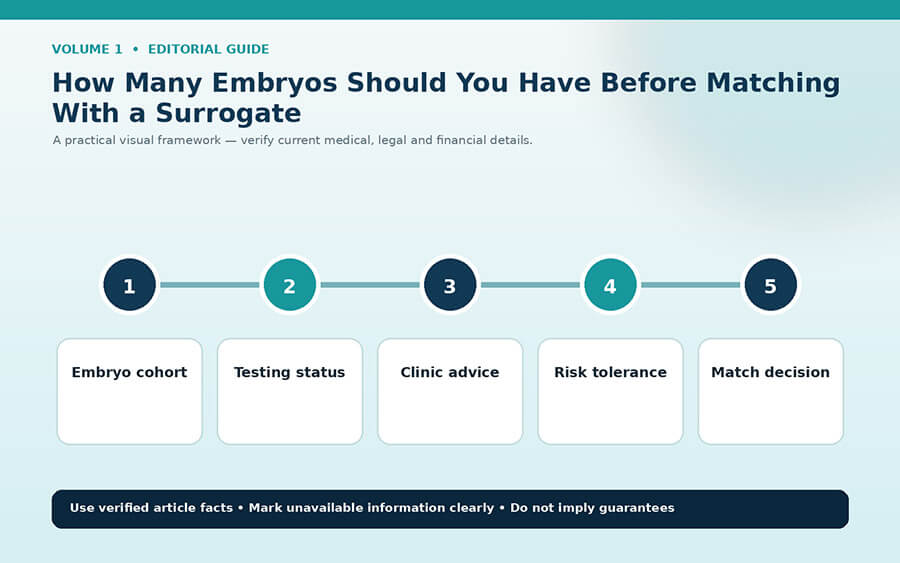
Review embryo quality and PGT-A status with the reproductive endocrinologist, discuss family-building goals beyond the immediate journey, get a cohort-specific probability estimate for transfer success, and confirm in the surrogacy agreement what happens — procedurally and financially — if additional transfer attempts or a new retrieval cycle become necessary.
How should the available options be compared?
This isn’t a question where agencies or clinics should be compared against each other — it’s a clinical assessment specific to a family’s own embryos and circumstances. What can be compared is how thoroughly each clinic’s reproductive endocrinologist walks through the probability conversation versus giving a generic, one-size-fits-all number.
What are the limits of this guidance?
This is general information, not a clinical recommendation for any specific family. Embryo assessment, transfer-success probability, and family-planning goals are matters for direct discussion with a reproductive endocrinologist familiar with the specific embryo cohort and medical history.
What does clinic-reported per-transfer success actually mean for embryo planning?
Per-transfer live birth rates for a single, genetically screened (euploid) blastocyst commonly reported by U.S. fertility clinics fall in a broad range depending heavily on the age of the egg source at retrieval and the specific clinic’s patient population and lab practices — clinics report their own age-specific, transfer-specific outcomes under SART reporting standards, and a family should request the receiving clinic’s own published or shared statistics rather than relying on an industry-wide average, since per-clinic variation is meaningful. What matters for embryo planning is less a single success-rate number and more the clinic’s own estimate of how many transfer attempts, on average, its patients in a comparable situation require to reach a live birth.
A family with one genetically screened blastocyst is not guaranteed to need only one transfer, and a family with three is not guaranteed success within those three — the honest planning approach is a range (the clinic’s own reported data will typically frame it this way) combined with a concrete plan for what happens at each possible outcome: success on the first attempt, a need for a second attempt, or a need to return to the retrieval stage if all available embryos are used without success.
How does embryo count interact with the surrogacy program’s cost structure?
Surrogacy4All’s published program range ($120,500-$151,000) is built around the surrogacy-side costs — agency fee, surrogate compensation, and pass-through medical, legal and insurance costs — and a family should confirm directly how many transfer attempts that range assumes, and what an additional attempt costs if a first transfer does not result in a pregnancy. This is a different cost driver than the embryo creation and genetic testing costs themselves (retrieval, fertilization, culture, and PGT-A testing), which are typically billed separately by the fertility clinic and are not part of the surrogacy agency’s fee.
Because each additional transfer attempt adds meaningful cost on both the clinic side and, in many program structures, the surrogacy side (additional monitoring cycles for the surrogate, potential additional travel), the number of available embryos going into a match is a genuine financial planning input, not only a medical one — a family planning around a single embryo should build a larger contingency reserve than one with several, precisely because the range of possible financial outcomes is wider.
What should a family discuss with their reproductive endocrinologist before finalizing an embryo count?
Useful, specific questions for the clinic include: based on this family’s specific embryo grading and genetic testing results, what per-transfer success rate does the clinic estimate for embryos of this quality; does the clinic recommend attempting genetic testing (PGT-A) if it has not already been done, and how does that change the embryo count needed; and if all current embryos are used without a live birth, what would a return to egg retrieval realistically look like in terms of both timeline and additional cost, given the family’s specific ovarian reserve and age-related factors.
These are clinical questions a reproductive endocrinologist is positioned to answer for the specific family’s medical circumstances in a way this general page cannot — the role of this page is to make clear that embryo count is worth discussing explicitly as its own planning conversation, both medically and financially, rather than assumed to be ‘enough’ without a specific, clinic-informed estimate.
How does genetic testing (PGT-A) change the embryo-count calculation?
Genetic testing does not create more embryos, but it materially changes how a family should think about the number they have, since it separates embryos that are chromosomally normal (euploid) — generally associated with meaningfully higher per-transfer success rates in published research — from those that are not and would be unlikely to result in a viable pregnancy regardless of transfer conditions. A family with, for example, five untested embryos and a family with two confirmed-euploid embryos may have meaningfully different real transfer-success prospects despite the first family having more embryos on paper, which is why raw embryo count alone is a limited planning metric without knowing genetic status.
The decision to pursue PGT-A testing is itself a clinical and personal one with its own costs and tradeoffs (the biopsy and testing process carries a small but real handling risk to the embryo, and the testing itself is an added cost), and reasonable reproductive endocrinologists and patients reach different conclusions about it depending on the family’s specific circumstances, including age-related factors and how many embryos are available to test. Discussing this specifically and early with the fertility clinic — ideally before finalizing the embryo count a family plans to match with a surrogate around — gives the family the clearest available picture of what they are actually working with, genetically, rather than relying on quantity alone.
How should a family factor in the emotional dimension of embryo-count planning alongside the medical and financial ones?
Embryo-count planning is not purely a numbers exercise — families report that the emotional weight of the decision (how many retrieval cycles to pursue, whether to test embryos genetically, when to feel ‘ready enough’ to match with a surrogate) is often harder to navigate than the financial or medical planning alone, particularly for families who have already experienced pregnancy loss or unsuccessful fertility treatment before reaching the surrogacy stage. Many clinics’ mental health teams, and many surrogacy agencies’ case management teams, offer support specifically for this planning stage, separate from the screening-related psychological evaluation the surrogate undergoes.
Families are generally better served treating the embryo-count conversation as one that combines clinical guidance (what does the reproductive endocrinologist’s data suggest), financial planning (what does each additional attempt cost, and is the reserve budgeted for it), and personal readiness (does the family feel prepared to match with a surrogate now, or would additional retrieval cycles first reduce anxiety about the number available) as three related but distinct inputs, rather than resolving the medical and financial questions and assuming the emotional readiness will simply follow.
Does matching with a surrogate before embryos are ready ever make sense?
Some families do begin the surrogate-matching process in parallel with completing embryo creation and testing, particularly given that matching itself can take 1-3 months — running the two processes concurrently rather than sequentially can shorten the overall timeline. This works best when the family and clinic have a reasonably confident estimate of embryo availability and quality already in hand; matching before any retrieval has occurred, with no data yet on what will be available, is generally discouraged since it leaves the surrogate relationship started well before the family can say with any confidence what the transfer plan will actually look like.
What is the single most important step before finalizing an embryo-count decision?
Discuss the specific number directly with the fertility clinic’s reproductive endocrinologist, given the family’s own embryo quality, genetic testing results and age-related factors, rather than relying on a general industry rule of thumb that may not fit the specific case.
Frequently Asked Questions
What is the main point of embryos before surrogate match?
There’s no fixed correct number — embryo quality and PGT-A status, age at retrieval, family-building goals, and risk tolerance for a second retrieval cycle all factor into a cohort-specific probability conversation with the reproductive endocrinologist.
Who makes the final medical decision?
The reproductive endocrinologist and the receiving fertility clinic assess embryo quality and transfer readiness; this is a clinical determination, not an agency decision.
Does a published number guarantee my result?
No. Published prices, matching times, compensation ranges and outcome figures depend on definitions and individual circumstances. Obtain current written terms for your case.
Why does independent escrow matter for embryo-count planning?
If additional transfer attempts or a new retrieval cycle become necessary, the surrogacy agreement and escrow structure should specify how those additional costs are funded and released — confirm this before matching, not after a failed transfer.
How should missing public information be interpreted?
Missing information means the research did not verify a comparable public disclosure. It should not automatically be interpreted as misconduct, absence of a service or an unfavorable result.
Does FDA registration mean FDA approval?
No. Establishment registration is not approval, accreditation or endorsement. Confirm the exact establishment and regulated activity relevant to reproductive tissue handling.
Is PGT-A testing required?
It’s not universally required, but many clinics recommend it because euploid status is a strong predictor of transfer success; discuss with the reproductive endocrinologist whether it’s appropriate for a specific cohort.
What happens if only one embryo is available?
Many families proceed with a single high-quality, ideally euploid-tested embryo; the key is discussing with the clinic what the plan is if that transfer doesn’t succeed, and confirming that plan in the surrogacy agreement.
What should I put in writing?
Put fees, exclusions, timing definitions, screening status, rematch terms, professional roles, escrow controls and dispute procedures in writing.
Where can documented corrections be sent?
Send source-backed corrections to rankings@surrogacy4all.com. Corrections should identify the agency, field, source and effective date.
Related Surrogacy Resources
Internal links specific to “How Many Embryos Should You Have Before Matching With a Surrogate” should point to the owning pillar page plus 2–4 sibling articles sharing this topic’s sub-intent cluster — assigned individually per article rather than reused site-wide, per the audit’s de-templating recommendation.
Talk With a Physician-Led Team
Surrogacy4All is a physician-led agency operating since 2006, NYS-licensed (GSP220903) and FDA-registered (FEI 3021544308). Request a confidential consultation to discuss your specific circumstances.
Methodology and Disclosure
This content is produced by DGA, Inc. (Surrogacy4All). Clinical and legal statements are general information, not individualized medical or legal advice; confirm specifics with the treating clinic and independent counsel. Send corrections to rankings@surrogacy4all.com.
Sources
- SART — Find a Clinic and National Summary
- New York State Department of Health — Licensed Gestational Surrogacy Organizations
- SeedTrust — Security

Dr. Pooja Patel
Dr. Pooja Patel is a Manager of Surrogacy program at Surrogacy4all. She has 10 years of experience in Anesthesiology and critical care medicine.
She received her medical degree from Seth GS Medical College and K.E.M Hospital in India. She then completed an internship. She finished her Anesthesia residency at Grant Govt Medical College and JJ Group of Hospitals in India.
- Dr. Pooja Patel

- Dr. Pooja Patel
- Dr. Pooja Patel
- Dr. Pooja Patel





Dr. Shweta Rathod
- Dr. Shweta Rathod
- Dr. Shweta Rathod
- Dr. Shweta Rathod
- Dr. Shweta Rathod