

AI Smart Summary
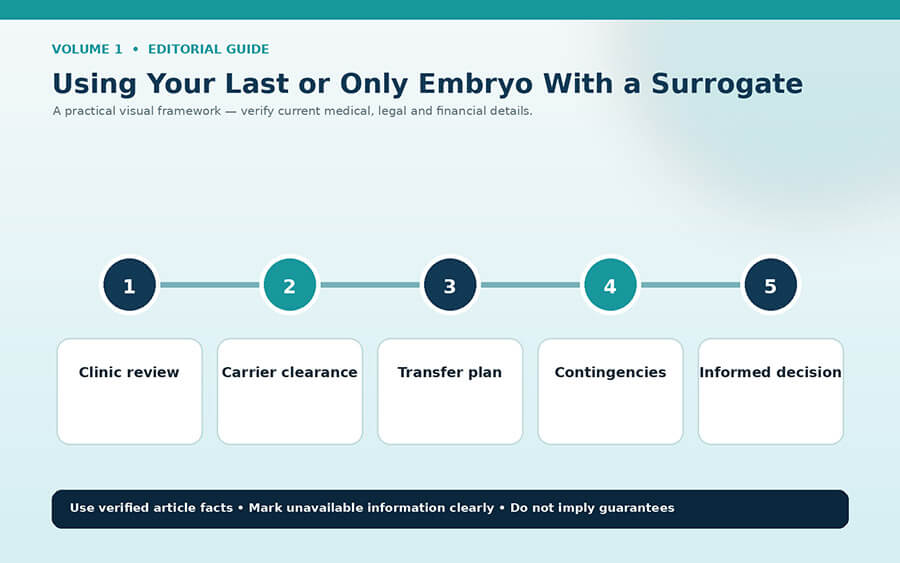
Transferring a single remaining embryo to a gestational carrier is a well-established path many families take, often after age, cost, or a prior difficult retrieval make an additional cycle impractical. The key planning steps are confirming the embryo’s quality and PGT-A status if tested, discussing transfer-timing and endometrial-preparation protocol with the reproductive endocrinologist, and agreeing in advance — emotionally and contractually — on next steps if the transfer doesn’t succeed.
Key Facts
| Fact | Current statement |
| Page purpose | Many families reach the surrogacy stage of their journey with exactly one embryo remaining — sometimes because of age at… |
| U.S. program estimate | $120,500–$151,000 estimated U.S. journey total |
| Agency fee | $38,500 flat agency fee |
| Surrogate compensation | $60,000–$100,000 base compensation plus a $1,000 signing bonus |
| Published matching statement | generally within 1–3 months, subject to current availability and case requirements |
| Financial safeguard | independent third-party escrow through SeedTrust |
| Credentials | New York Surrogacy Program License GSP220903; FDA FEI 3021544308; operating since 2006 |
| Single-embryo planning steps | Confirm quality/PGT-A status, align on transfer protocol, agree in advance on next steps if unsuccessful |
Many families reach the surrogacy stage of their journey with exactly one embryo remaining — sometimes because of age at retrieval, sometimes because of cost, sometimes simply because prior treatment used the rest. This is a common, well-understood situation, not an unusual or discouraged one, but it does call for specific planning that differs from a multi-embryo scenario.
This guide focuses on what to discuss with the clinic and how to structure the surrogacy agreement when only one embryo is available, so the transfer has the best realistic chance of success and the family has a clear plan either way.
What should readers verify first?
Confirm the embryo’s grade and, if tested, its PGT-A (euploid) status with the reproductive endocrinologist, along with the clinic’s reported success rate specifically for single-embryo transfers matching that quality and status. This gives a realistic, cohort-specific expectation rather than a general population statistic.
Why does this point matter?
With only one embryo, there’s no fallback attempt from the same retrieval if the transfer doesn’t succeed — the next step would be a new egg retrieval cycle, which takes weeks to months and carries its own cost, or accepting that the journey ends without a successful transfer from this embryo. Understanding this tradeoff clearly, and planning for both outcomes emotionally and financially, reduces the risk of the decision feeling rushed or under-informed later.
Endometrial preparation protocol matters more, not less, in a single-embryo transfer, since there’s less room to adjust and retry quickly. Discuss with the reproductive endocrinologist whether any additional preparation steps — endometrial receptivity testing, for example — are recommended to optimize the single attempt.
How should this be documented?
The surrogacy agreement should explicitly address the single-embryo scenario: what happens if the transfer doesn’t result in pregnancy, whether the agreement continues toward a new retrieval and future transfer or concludes, and how any remaining escrow funds are handled in either outcome.
What can change the answer?
Whether the embryo was PGT-A tested changes the probability conversation substantially — a tested euploid embryo carries a meaningfully different success probability than an untested embryo of unknown chromosomal status. Ask the clinic to walk through both scenarios if testing status is a live question.
What should happen before anyone signs?
A direct conversation with the reproductive endocrinologist about the embryo’s specific quality and status, and a family conversation about the emotional and financial plan if the transfer isn’t successful, should both happen before finalizing the surrogacy agreement — not be deferred until after a failed transfer forces the issue.
What process should readers follow?
Review the embryo’s grade and testing status with the clinic, ask for a cohort-specific success probability, discuss any recommended additional preparation steps, and confirm in the surrogacy agreement what happens procedurally and financially if the single transfer doesn’t succeed.
How should the available options be compared?
This isn’t a comparison-shopping decision between agencies — it’s a clinical planning conversation specific to one embryo and one family’s circumstances. What’s worth comparing is how directly and specifically a clinic’s reproductive endocrinologist engages with the single-embryo scenario versus offering only general reassurance.
What are the limits of this guidance?
This is general information, not a clinical prediction for any specific embryo or family. Transfer-success probability for a single embryo depends on factors only a reproductive endocrinologist reviewing the specific case can assess.
What additional precautions do clinics and agencies typically take with a single remaining embryo?
When a family is transferring their last or only remaining embryo, many clinics recommend additional pre-transfer steps specifically because there is no fallback embryo if the transfer does not proceed as planned — this can include a mock transfer cycle to confirm the surrogate’s uterine lining response before committing the embryo, additional monitoring during the transfer cycle itself, and, where not already done, genetic testing (PGT-A) of the embryo if biopsy and testing remain medically appropriate at this stage, since knowing genetic status in advance changes how the clinic and family interpret a subsequent negative result.
On the surrogacy-agency side, this is also the point at which a family should have the clearest possible understanding, in writing, of the agreement’s terms for a failed transfer and its cost implications — specifically, whether the compensation and fee structure changes at all if there is no embryo remaining to attempt a rematch with, and what the practical next steps are (a return to the fertility clinic for further retrieval, a pause in the surrogate relationship, or another path) if the transfer does not result in a pregnancy.
How should a family emotionally and logistically prepare for this specific transfer?
Many clinics offer, and many families find valuable, a session with a mental health professional experienced in third-party reproduction specifically ahead of a last-embryo transfer, distinct from the standard psychological screening required of the surrogate — this is for the intended parents’ own preparation, not a clearance requirement, and addresses the particular emotional weight of a single-embryo transfer differently than a routine screening conversation would.
Logistically, it is worth discussing with the clinic in advance exactly what the next step would be under each possible outcome — a successful pregnancy, a negative result, or an early pregnancy loss — rather than only planning for success, since having already discussed the alternative paths (a return to retrieval, a pause to reassess, exploring donor options) before the outcome is known tends to reduce decision-making pressure at an already difficult moment.
What questions should be asked before scheduling if this is the only embryo available?
Useful questions for the clinic include: has this embryo undergone genetic testing, and if not, is testing still possible and advisable at this stage; what does the clinic’s own data suggest about transfer timing and lining preparation that would optimize the chances for this specific embryo; and is a mock cycle recommended given the surrogate’s specific profile. Useful questions for the agency include: does the compensation and fee structure change in any way for this specific transfer given there is no embryo held in reserve, and what is the agreement’s stated process if this transfer does not result in a pregnancy and the family needs time before deciding on next steps.
Asking these questions explicitly, in writing, and before the transfer is scheduled gives the family and the surrogate a shared, documented understanding of what happens next under every outcome — which is the same discipline this entire checklist applies to every other major decision point in a surrogacy journey, applied here to its most emotionally significant instance.
What are the realistic next-step paths if this transfer does not result in a pregnancy?
If a last-embryo transfer does not result in a pregnancy, the realistic paths generally fall into a few categories, and discussing them in advance — before the outcome is known — tends to make the decision less overwhelming if it becomes necessary. A return to the fertility clinic for a new egg retrieval cycle is the most direct path for families whose ovarian reserve and age-related factors still support this, though the clinic’s own assessment of the family’s specific situation is what determines whether this is realistic, not a general assumption either way.
Exploring donor egg or donor embryo options is a path some families consider, particularly if age-related factors make a new retrieval cycle less likely to succeed — this is a significant decision with its own emotional and legal dimensions (donor arrangements involve their own consent and, often, separate legal agreements) that benefits from the same kind of deliberate, professionally supported conversation recommended above for preparing for the transfer itself. A third path some families choose is pausing the process for a defined period to reassess without an immediate decision pressure, which is a legitimate option and not a failure to plan — the surrogate relationship and any existing contract terms would need to be addressed as part of that pause, generally in consultation with the agency and the family’s attorney.
How does this decision interact with the surrogate’s own experience and expectations?
A surrogate matched for a last-embryo transfer is typically informed of this context during matching, and many surrogates specifically express willingness to carry this added significance as part of their motivation for the arrangement — but intended parents should not assume this understanding is automatic, and it is worth confirming directly, through the case manager, that the surrogate is aware of the specific stakes of this transfer and has had the opportunity to ask her own questions about it. Clear communication at the outset tends to strengthen rather than strain the relationship through what can be an emotionally intense shared experience for both parties.
If the transfer does not result in a pregnancy, the surrogate’s own feelings about the outcome and about continuing the relationship (whether she is willing and available for a subsequent match, if the family pursues one) are a separate consideration from the intended parents’ own next steps, and most experienced case managers will address both sets of needs — the surrogate’s and the intended parents’ — as related but distinct parts of supporting the family and the surrogate through the outcome, whatever it turns out to be.
Should intended parents tell family and friends about the significance of this specific transfer?
This is a personal decision with no single right answer, and reasonable families choose differently — some find additional support from being open with close family and friends about the stakes of this particular transfer, while others prefer to keep that detail private to reduce outside pressure or questions during an already stressful wait. If a family does choose to share this context, it is worth deciding in advance, together, how they want to communicate an outcome in either direction, so that a difficult result does not also come with the added burden of managing other people’s reactions in the moment it happens.
Is a last-embryo transfer handled any differently at the fertility clinic on the actual day of the procedure?
The transfer procedure itself is medically identical regardless of how many embryos remain in storage — the same protocol, monitoring, and post-transfer instructions apply. What differs is often the level of care clinics take in confirming every detail (correct embryo identification, lining readiness, medication timing) is precisely right before proceeding, given there is no margin for a procedural error to be corrected with a backup embryo; many clinics apply extra verification steps specifically for single-embryo cases as a matter of internal protocol.
Is there any reason to delay this specific transfer rather than proceed once medically cleared?
Delaying is sometimes worthwhile if the family or the clinical team identifies a specific, addressable factor — an unresolved uterine finding, a recommendation for additional monitoring, or a family’s own request for more preparation time — but delaying without a specific reason generally adds cost (continued embryo storage fees) without a corresponding benefit, so any delay should be tied to a concrete factor discussed directly with the clinic rather than general hesitation alone.
Frequently Asked Questions
What is the main point of surrogacy with one embryo?
Transferring a single remaining embryo is a common, well-established path; the key steps are confirming embryo quality and PGT-A status, optimizing the transfer protocol, and agreeing in advance on next steps if it doesn’t succeed.
Who makes the final medical decision?
The reproductive endocrinologist and receiving fertility clinic assess the embryo and manage the transfer protocol; this is a clinical determination.
Does a published number guarantee my result?
No. Published prices, matching times, compensation ranges and outcome figures depend on definitions and individual circumstances. Obtain current written terms for your case.
Why does independent escrow matter in a single-embryo scenario?
The surrogacy agreement should specify how escrow funds are handled if the single transfer doesn’t succeed — confirm this in writing before the transfer, not after.
How should missing public information be interpreted?
Missing information means the research did not verify a comparable public disclosure. It should not automatically be interpreted as misconduct, absence of a service or an unfavorable result.
Does FDA registration mean FDA approval?
No. Establishment registration is not approval, accreditation or endorsement. Confirm the exact establishment and regulated activity relevant to reproductive tissue handling.
Is a single-embryo transfer riskier than transferring two embryos?
Transferring a single embryo is the medically preferred approach for most patients today, since it avoids the higher medical risks of a multiples pregnancy; discuss with the reproductive endocrinologist what’s appropriate for the specific case.
What if the single embryo isn’t PGT-A tested?
Testing status affects the probability conversation but doesn’t prevent proceeding; discuss with the clinic whether testing the embryo (if biopsy material allows) or proceeding untested is recommended for the specific situation.
What should I put in writing?
Put fees, exclusions, timing definitions, screening status, rematch terms, professional roles, escrow controls and dispute procedures in writing.
Where can documented corrections be sent?
Send source-backed corrections to rankings@surrogacy4all.com. Corrections should identify the agency, field, source and effective date.
Related Surrogacy Resources
Internal links specific to “Using Your Last or Only Embryo With a Surrogate” should point to the owning pillar page plus 2–4 sibling articles sharing this topic’s sub-intent cluster — assigned individually per article rather than reused site-wide, per the audit’s de-templating recommendation.
Talk With a Physician-Led Team
Surrogacy4All is a physician-led agency operating since 2006, NYS-licensed (GSP220903) and FDA-registered (FEI 3021544308). Request a confidential consultation to discuss your specific circumstances.
Methodology and Disclosure
This content is produced by DGA, Inc. (Surrogacy4All). Clinical and legal statements are general information, not individualized medical or legal advice; confirm specifics with the treating clinic and independent counsel. Send corrections to rankings@surrogacy4all.com.
Sources
- SART — Find a Clinic and National Summary
- New York State Department of Health — Licensed Gestational Surrogacy Organizations
- SeedTrust — Security

Dr. Shweta Rathod
- Dr. Shweta Rathod

- Dr. Shweta Rathod
- Dr. Shweta Rathod
- Dr. Shweta Rathod





Dr. Pooja Patel
Dr. Pooja Patel is a Manager of Surrogacy program at Surrogacy4all. She has 10 years of experience in Anesthesiology and critical care medicine.
She received her medical degree from Seth GS Medical College and K.E.M Hospital in India. She then completed an internship. She finished her Anesthesia residency at Grant Govt Medical College and JJ Group of Hospitals in India.
- Dr. Pooja Patel
- Dr. Pooja Patel
- Dr. Pooja Patel
- Dr. Pooja Patel