
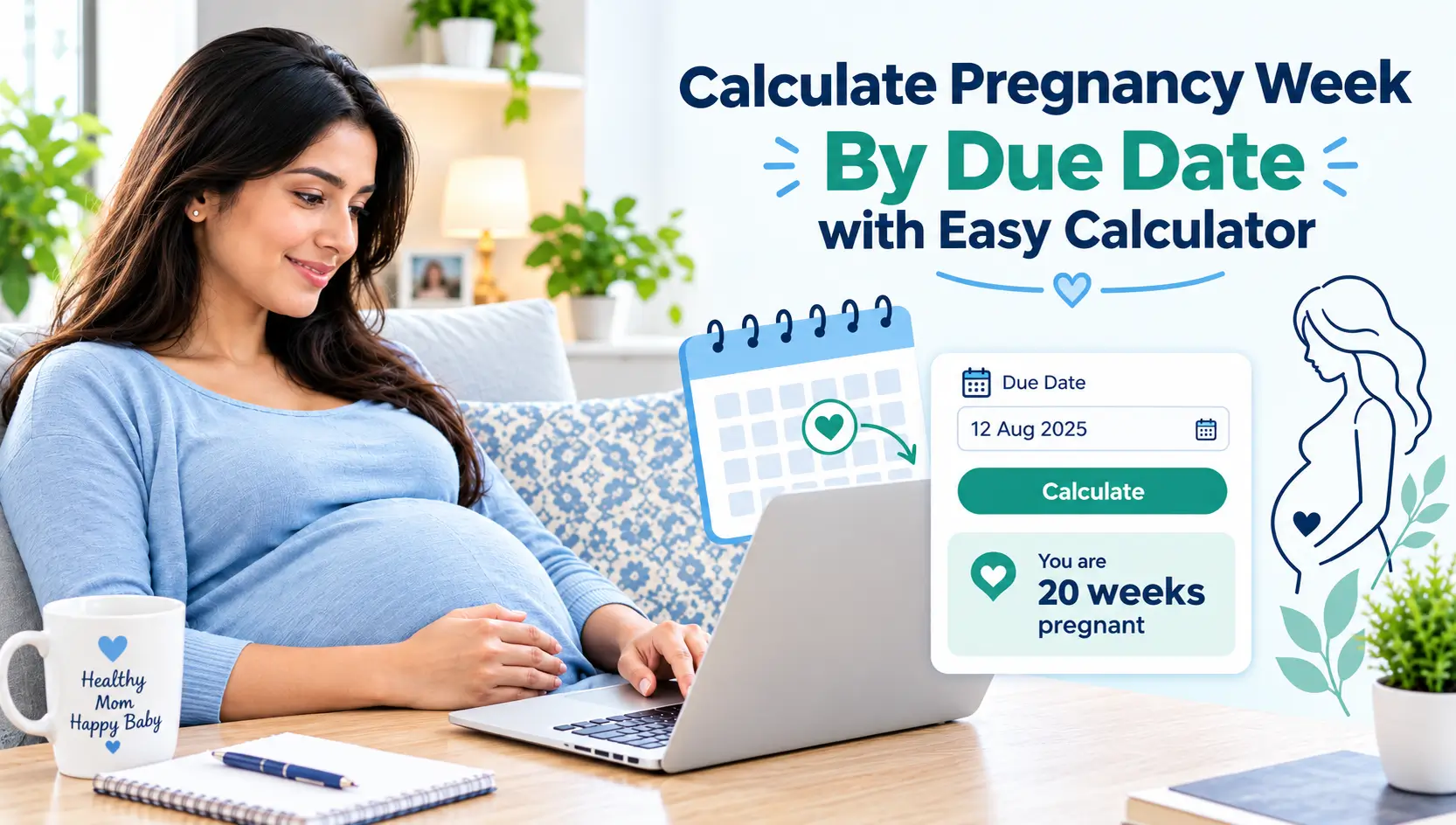
Pregnancy is an exciting journey filled with many important milestones, from the first positive test to tracking your baby’s growth week by week. Knowing your current pregnancy week helps you understand your baby’s development, prepare for upcoming changes, and stay informed during each stage of pregnancy.
A Pregnancy Calculator for Due Date helps assess your current pregnancy week by using your expected delivery due date. It provides a simple & basic way to understand where you are in your pregnancy journey without manually counting weeks.
How Does a Pregnancy Week Calculator Work?
A pregnancy calculator uses your due date information to assess your pregnancy timeline. Since a full-term pregnancy is usually around 40 weeks from the first day of the last menstrual period (LMP), the calculator works backward from the expected delivery date to determine your current week.
A pregnancy calculator by due date can help you understand:
- Your current pregnancy week
- Approximate trimester
- Baby’s growth stage
- Important upcoming pregnancy milestones
These estimates are useful for general pregnancy planning, but your healthcare provider’s guidance remains the most accurate source for medical decisions.
Understanding Pregnancy Week by Week
Every week of pregnancy brings new changes. A pregnancy calculator week by week allows expecting parents to follow these developments and learn what is happening during each stage.
During early pregnancy, its significant changes include embryo development and formation of essential organs. In the 2nd trimester, many intended parents notice increased movements & visible growth. The third trimester focuses on final development & preparing for baby birth.
Many parents also explore pregnancy calculator week by week pictures to better understand how the baby may be developing throughout pregnancy.
Other Helpful Pregnancy Planning Tools
Along with tracking pregnancy weeks, several calculators can help provide additional information during your fertility and pregnancy journey.
Pregnancy Due Date Calculator
A Pregnancy Due Date Calculator estimates your baby’s expected arrival date based on your last menstrual period or conception details. It helps create a general timeline for prenatal appointments & pregnancy preparation.
IVF Due Date Calculator
For pregnancies achieved through assisted reproductive treatments, an IVF Due Date Calculator helps estimate the expected delivery date based on IVF procedure details, such as embryo transfer date & embryo age.
Ovulation Calculator
An Ovulation Calculator helps estimate fertile days & ovulation timing. It can be useful for individuals planning conception by identifying the most likely period for pregnancy.
Conception Calculator
A conception calculator estimates the possible date when conception may have occurred based on pregnancy dates and due date information. It provides an approximate timeline rather than an exact date.
BMI Calculator
A BMI Calculator helps estimate your Body Mass Index based on your height & weight. It provides a general understanding of whether your weight falls within a healthy range and can be useful for overall health awareness during pregnancy planning.
However, BMI is only a general & basic measurement and does not consider factors like body composition or particular individual health conditions. For personalized prescribtion, it is always recommended to consult a healthcare professional.
Miscarriage Calculator
A miscarriage calculator provides general information about pregnancy loss risk based on factors such as pregnancy week. It is designed for educational purposes & should not replace advice from a healthcare professional or physician.
Why Tracking Pregnancy Weeks Is Helpful
Using a pregnancy tracker may help intended parents stay aware of pregnancy stages in some steps, including:
- Baby development changes
- Recommended checkups
- Common pregnancy symptoms
- Preparation for upcoming milestones
A simple pregnancy calculator can make it easier to follow your pregnancy timeline and understand what to expect during each phase.
FAQs about
Q. How do I calculate my pregnancy week by due date?
A. You can estimate your pregnancy week by counting backward from your expected delivery date. A pregnancy calculator simplifies this process by automatically calculating your current week.
Q. Is a pregnancy week calculator accurate?
A. A pregnancy week calculator provides an estimate based on the information entered. Your doctor or healthcare provider can confirm pregnancy dates through medical assessments and ultrasounds.
Q. Can a Pregnancy Week Calculator help during a surrogacy journey?
A. Yes, it helps intended parents and surrogates understand pregnancy milestones, estimated due dates, and the overall timeline. Surrogacy4All provides resources to support families throughout their surrogacy journey.
Q. What details are needed to calculate pregnancy weeks?
A. You may need your due date, last menstrual period date, conception date, or IVF transfer details. The result is an estimate & should be confirmed with a healthcare professional.
Q. Can I calculate my due date without knowing my last period date?
A. Yes, some calculators can estimate your due date using other details, for ex, conception date or IVF treatment information. An expected date calculator can provide an approx timeline based on available info.
Conclusion
A Pregnancy Week Calculator By Due Date makes it easier to track pregnancy progress and understand important milestones. For families exploring fertility options, Surrogacy4All offers helpful resources and guidance to better understand the surrogacy journey, timelines, and available fertility solutions.

Dr. Veera Saghar
As an Egg Donor Coordinator, she plays a critical role in our company. Her background as a medical graduate from ISRA UNIVERSITY in Pakistan provides us with a solid foundation in the medical sciences. She has seven years of clinical experience practicing in the USA. This has given her firsthand experience when collaborating with patients and their families.
She is responsible for managing the process of egg donation from start to finish. We identify and screen potential egg donors.
- Dr. Veera Saghar

- Dr. Veera Saghar
- Dr. Veera Saghar
- Dr. Veera Saghar