
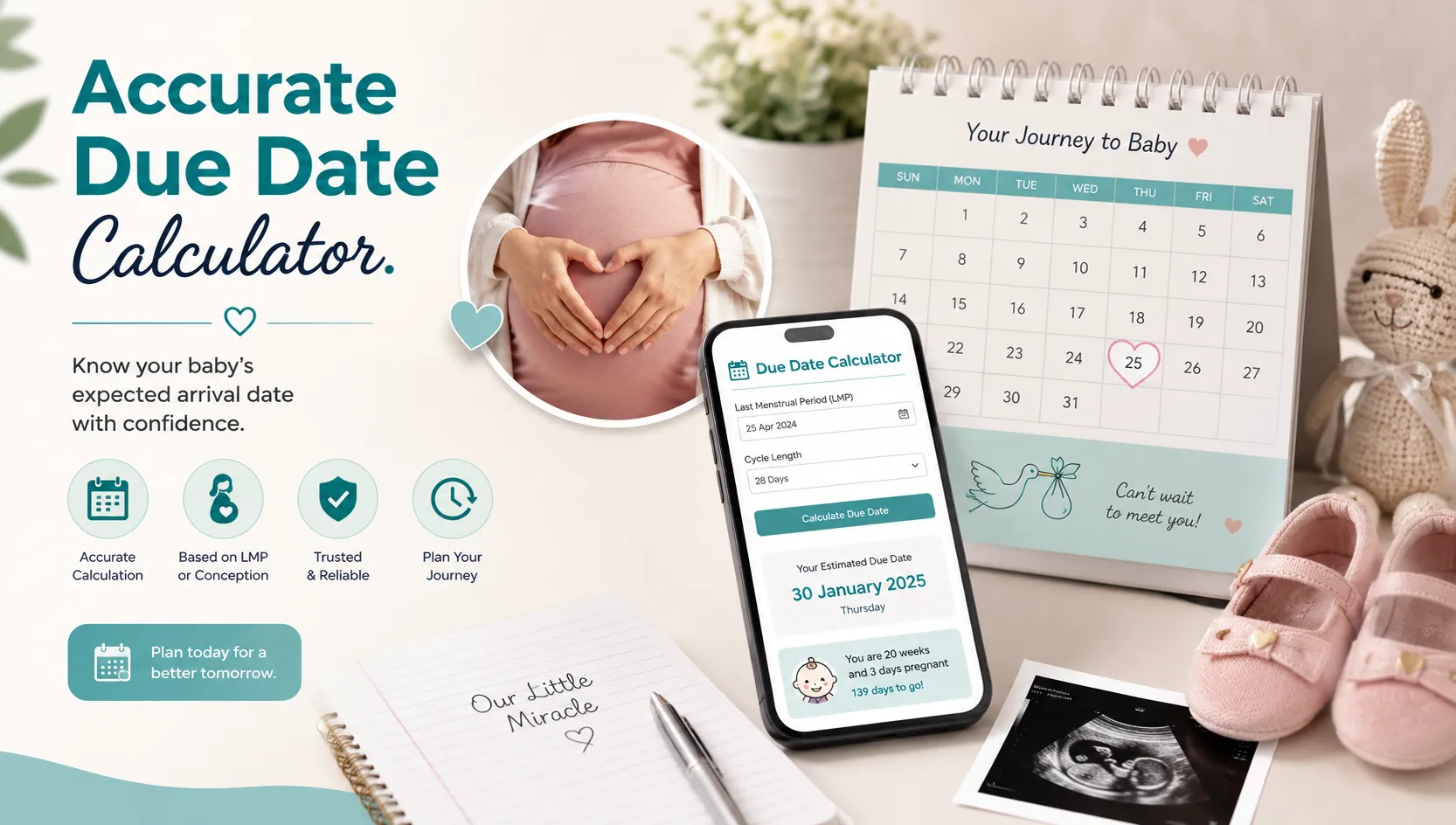
Quick Summary – Accurate Due Date Calculator
- An accurate due date calculator estimates your baby’s expected arrival date.
- Most calculators use your last menstrual period (LMP) to estimate a 40-week pregnancy.
- Conception date and menstrual cycle length can affect your estimated due date.
- Early pregnancy ultrasound helps confirm or adjust pregnancy dates.
- IVF due date calculations depend on embryo age and transfer date.
- Irregular periods can make LMP-based calculations less reliable.
- Your estimated due date is not a guarantee of your baby’s actual birth date.
- Surrogacy4All offers pregnancy and fertility calculators to help estimate your delivery date.
Overview
Finding out your estimated due date is often one of the first things you want to know after discovering a pregnancy. An accurate due date calculator can help you estimate when your baby may arrive using details such as your last menstrual period, conception date or IVF embryo transfer date.
However, the calculated date is an estimate, not a guarantee of when labour will begin. Menstrual cycle variations, ovulation timing and the method used to calculate pregnancy dates can all affect the result.
Understanding how pregnancy due dates are calculated can help you follow your pregnancy timeline and know when to discuss your dates with your healthcare provider.
What Is an Accurate Due Date Calculator?
An accurate due date calculator is an online tool that estimates your baby’s expected arrival date based on information about your menstrual cycle or pregnancy.
Most standard calculators use the first day of your last menstrual period (LMP) to estimate a 40-week pregnancy.
Depending on the information available, a Pregnancy Due Date Calculator may use:
- The first day of your last menstrual period.
- Your average menstrual cycle length.
- Your estimated conception date.
- Your IVF embryo transfer date.
The calculator uses this information to estimate your gestational age and expected delivery date. It can be a helpful starting point, particularly when you have recently confirmed your pregnancy.
How Accurate Is a Due Date Calculator?
A due date calculator can provide a useful estimate, but its accuracy depends on how reliable your pregnancy dates are.
The traditional calculation assumes a 28-day menstrual cycle with ovulation occurring around day 14. However, not everyone follows this pattern. Some people have shorter or longer cycles, while others experience irregular ovulation.
An early pregnancy ultrasound can provide a more accurate estimate by measuring the baby’s development. According to the American College of Obstetricians and Gynecologists (ACOG), an ultrasound performed during the first trimester is the most accurate ultrasound method for establishing or confirming gestational age.
It is also worth remembering that only around 1 in 20 babies is born on the exact estimated due date. Your due date is a reference point for monitoring pregnancy, not a fixed delivery appointment.
How Is Your Pregnancy Due Date Calculated?
There are several ways to estimate a delivery date. The method used depends on your menstrual cycle, conception information and how the pregnancy occurred.
1. Using Your Last Menstrual Period (LMP)
The standard method adds 280 days, or 40 weeks, to the first day of your last menstrual period.
For example, if your last period started on January 1, your estimated due date would be around October 8.
This calculation works best when you have regular menstrual cycles and remember the date your last period started.
If your cycles are irregular, an LMP-based calculation may not give an accurate estimate because ovulation may happen earlier or later than expected.
2. Using Your Conception Date
If you know approximately when conception occurred, you can estimate your due date by adding 266 days to that date.
However, identifying the exact conception date can be difficult in natural pregnancies. Ovulation and fertilisation do not always happen on predictable days.
An Ovulation Calculator can help estimate your fertile window using menstrual cycle information. This may help you understand when conception was most likely to occur.
3. Using Ultrasound Measurements
An early pregnancy ultrasound can help establish your baby’s gestational age.
During the first trimester, healthcare providers commonly measure the crown-rump length (CRL), which represents the length of the developing baby from head to bottom.
These measurements help estimate how far along the pregnancy is and whether the initial due date needs adjustment.
If your ultrasound gives a different date from your online calculator, your healthcare provider can assess which estimate is more appropriate.
4. Using IVF and Embryo Transfer Dates
Pregnancies achieved through in vitro fertilisation use a different calculation method because the embryo’s age and transfer date are known.
An In Vitro Fertilization Due Date Calculator uses the embryo transfer date and embryo age to estimate the delivery date.
The commonly used calculations are:
- Day 3 embryo transfer: Add 263 days to the transfer date.
- Day 5 embryo transfer: Add 261 days to the transfer date.
For IVF pregnancies, the embryo’s age and transfer date provide a more specific basis for calculating gestational age.
What Factors Can Affect Due Date Accuracy?
Several factors can influence your estimated delivery date, even when you use a reliable calculator.
Irregular menstrual cycles: If your periods do not follow a consistent pattern, predicting ovulation becomes more difficult.
Uncertain period dates: If you cannot remember the first day of your last menstrual period, the calculation may be less reliable.
Different ovulation timing: Ovulation does not always occur on day 14. This can affect conception-based estimates.
IVF treatment: Embryo age and transfer timing need to be considered when calculating an IVF pregnancy due date.
Ultrasound findings: Early ultrasound measurements may indicate that your initial estimated due date needs adjustment.
If you are unsure about your pregnancy dates, discuss the available information with your obstetrician.
Can Your Estimated Due Date Change During Pregnancy?
Yes. Your estimated due date may change if early ultrasound measurements show a meaningful difference from your initial calculation.
For example, someone who has irregular periods may initially receive an LMP-based estimate that differs from the ultrasound findings.
Once your healthcare provider establishes an appropriate due date using your menstrual history and early ultrasound findings, it generally remains the reference date for pregnancy care. Changes are usually reserved for specific medical circumstances.
You should not repeatedly change your estimated due date based on later ultrasound measurements without discussing the results with your doctor.
Other Fertility and Health Calculators That May Help
A due date calculator focuses on estimating when your baby may arrive. However, other fertility and health tools can help you understand different aspects of reproductive health.
Surrogacy4All offers several calculators for different needs:
- Period Calculator: Helps estimate upcoming menstrual dates and track cycle patterns.
- Ovulation Calculator: Estimates fertile days based on menstrual cycle information.
- Implantation Window Calculator: Estimates the possible implantation period after ovulation.
- PCOS Calculator: Helps assess selected indicators associated with polycystic ovary syndrome.
- Miscarriage Risk Calculator: Provides an estimated risk based on selected pregnancy information, not a definitive prediction.
- BMI Calculator: Calculates body mass index using height and weight.
- Basal Metabolic Rate Calculator: Estimates the calories your body uses at rest.
- Macro Calculator: Helps estimate daily protein, carbohydrate and fat requirements.
These tools serve different purposes. They can provide useful starting points, but they should not replace medical advice or clinical assessments.
FAQs about Accurate Due Date Calculator
1. How accurate is an online pregnancy due date calculator?
Ans: It can provide a useful estimate when your menstrual dates and cycle information are reliable. An early ultrasound can help confirm or adjust the estimated due date.
2. Can I calculate my due date if I have irregular periods?
Ans: Yes, but an LMP-based estimate may be less reliable. Your healthcare provider may recommend an early ultrasound to establish more accurate pregnancy dates.
3. Is an ultrasound more accurate than a due date calculator?
Ans: An early ultrasound is generally more accurate for establishing gestational age than a standard online calculator, particularly when menstrual dates are uncertain.
4. How is an IVF pregnancy due date calculated?
Ans: An IVF due date is calculated using the embryo’s age and transfer date. Day 3 and Day 5 embryo transfers have different calculation methods.
5. Can my baby arrive before the estimated due date?
Ans: Yes. Babies can arrive before or after their estimated due dates. The date is an estimate based on pregnancy dating, not a prediction of the exact day labour will begin.
6. When should I confirm my estimated due date with a doctor?
Ans: Discuss your pregnancy dates during your first prenatal appointment. Your healthcare provider can review your menstrual history, pregnancy details and ultrasound findings to establish an appropriate due date.
Calculate Your Estimated Due Date With Surrogacy4All
Knowing your estimated due date can help you follow pregnancy milestones and prepare for the months ahead. Whether you conceived naturally or through IVF, having an estimated timeline can make it easier to understand your pregnancy journey.
Surrogacy4All makes this process easier with its fertility Calculator, which helps estimate your baby’s expected arrival date using your pregnancy information. Explore the calculator, enter your details and get an estimated due date to help you plan the next stages of your pregnancy journey.

Dr. Veera Saghar
As an Egg Donor Coordinator, she plays a critical role in our company. Her background as a medical graduate from ISRA UNIVERSITY in Pakistan provides us with a solid foundation in the medical sciences. She has seven years of clinical experience practicing in the USA. This has given her firsthand experience when collaborating with patients and their families.
She is responsible for managing the process of egg donation from start to finish. We identify and screen potential egg donors.
- Dr. Veera Saghar

- Dr. Veera Saghar
- Dr. Veera Saghar
- Dr. Veera Saghar