
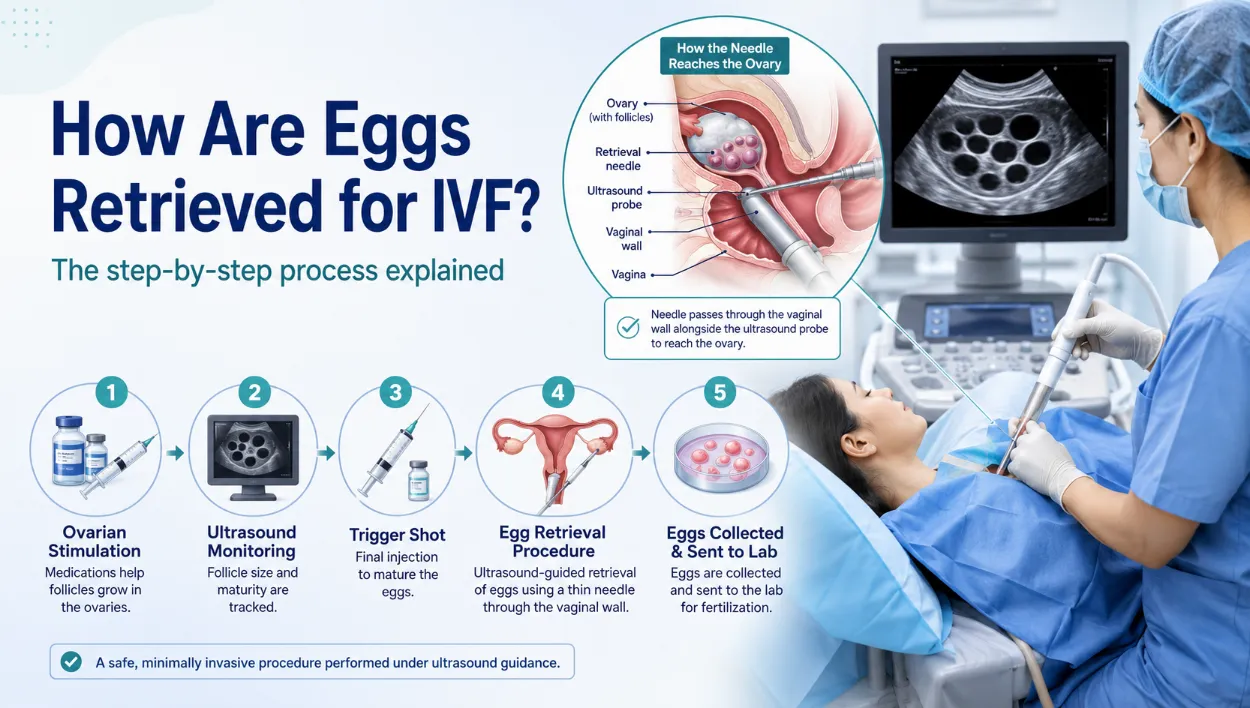
If you are about to start IVF, the step that raises the most questions is the one you cannot picture. So, how are eggs retrieved for IVF? A doctor collects them through the vagina using a thin needle guided by ultrasound, while you are sedated. There are no cuts or stitches, and you go home the same day.
Quick answer: About 34 to 36 hours after your final trigger injection, a fertility doctor uses a vaginal ultrasound probe to guide a fine needle into each ovarian follicle and draws out the fluid that holds the egg. You are sedated, the procedure usually takes 15 to 30 minutes, and most people are home within a few hours.
Egg retrieval at a glance
| Keys | What to expect |
|---|---|
| Where | Fertility clinic or surgical center, as an outpatient |
| Method | Ultrasound-guided needle through the vaginal wall |
| Anesthesia | IV sedation (you are asleep or deeply relaxed) |
| Timing | 34 to 36 hours after the trigger injection |
| Length | About 15 to 30 minutes for the procedure itself |
| Incisions | None |
| Going home | Same day, with someone to drive you |
| Usual recovery | A day or two of rest, with mild cramping and bloating |
What happens before retrieval
Your ovaries normally release one mature egg a month. To collect more than one, you take daily hormone injections (called gonadotropins) for roughly 8 to 14 days. These medicines encourage several follicles, the small fluid-filled sacs that each hold an egg, to grow at the same time.
During those days you visit the clinic every few days, and sometimes daily near the end, for blood tests and a vaginal ultrasound. The scan measures your follicles and the blood work tracks your hormones, so your doctor can adjust doses and choose the right moment to trigger. If you like to keep your own record of cycle dates, a period calculator can help, though your clinic’s calendar always takes priority.
The trigger shot and why the timing is exact
When enough follicles reach the size your doctor is aiming for (often around 18 mm, although clinics set their own targets), you take a trigger shot. This is usually hCG, a GnRH agonist such as Lupron, or a combination of the two. It completes the final maturation of the eggs.
Ovulation normally follows about 36 to 40 hours later, so retrieval is booked 34 to 36 hours after the injection, just before the eggs would be released on their own. That is why you are told to inject at a specific minute, often at night, and why the retrieval appointment cannot be moved. Set an alarm.
The egg retrieval process, step by step
Here is how a typical egg retrieval day unfolds. Details differ between clinics, so treat this as a map rather than a script.
- Check-in. You arrive early, often 30 to 60 minutes before the procedure. You will have fasted as instructed, and you sign consent forms. Someone must be there to take you home.
- IV and sedation. An anesthesia professional places an IV. Most US clinics use deep IV sedation, so you fall asleep within seconds and usually do not need a breathing tube. This egg retrieval anesthesia wears off quickly, although you may feel drowsy for hours.
- Ultrasound view. The doctor places an ultrasound probe, the same type used at your monitoring scans, in the vagina. Both ovaries and every follicle appear on a screen.
- Needle and aspiration. A thin needle runs along a guide attached to the probe, passes through the vaginal wall and enters a follicle. Gentle suction draws out the fluid. This transvaginal ultrasound-guided aspiration is repeated for each follicle on both ovaries. Some clinics give an antibiotic at this point.
- Hand-off to the lab. The fluid goes straight to the embryologist, who finds the eggs under a microscope. Many clinics tell you the count before you leave.
- Recovery room. You wake up, are monitored for a while, and usually get a drink and a snack. You go home with written instructions and a number to call.
Doctors call this a minor procedure, and that is fair: it is quick and guided by ultrasound. It is still a medical procedure, so give your body the rest of the day.
Is egg retrieval painful?
Is egg retrieval painful? Not during the procedure, because you are sedated and usually remember nothing. Afterward, expect period-like cramps, a feeling of pressure and bloating for a day or two. Most people describe it as uncomfortable rather than painful, and many say the weeks of injections were harder.
How long does egg retrieval take?
The needle part usually lasts 15 to 30 minutes, depending on how many follicles there are. With check-in, sedation and recovery, plan for about half a day at the clinic. That is the practical answer to how long does egg retrieval take.
How many eggs are retrieved?
There is no single number. How many eggs are retrieved depends on your age, your ovarian reserve, the medication protocol and how your ovaries responded. Many people retrieve somewhere around 8 to 15 eggs, but the range is wide: fewer when ovarian reserve is lower, and 20 or more for some younger people or those with PCOS.
Two details matter more than the headline number. Not every egg is mature, and not every mature egg fertilizes or becomes a healthy embryo. A smaller count can still lead to a pregnancy, and a large count is not a guarantee. Your doctor can read your numbers against your age and AMH result, which is far more useful than an average from the internet.
What happens to the eggs after retrieval
In the lab, the embryologist fertilizes the mature eggs with sperm. This is done in one of two ways: standard insemination, where eggs and sperm share a dish, or ICSI, where a single sperm is injected into each egg. Fertilization is checked the next day, and the embryos are grown in an incubator for several days.
From there, a few things can happen. In a fresh cycle, an embryo can be transferred three or five days after retrieval. Often, embryos are frozen instead and transferred in a later, carefully prepared cycle, and some are biopsied for genetic testing first. Once a transfer date is set, the implantation window calculator shows when implantation is typically expected and when a pregnancy test becomes informative.
Recovery and side effects
Most egg retrieval recovery is uneventful. The common egg retrieval side effects are cramping, bloating, light vaginal spotting for a day or two, constipation, tiredness from the sedation and, sometimes, breast tenderness.
What helps after egg retrieval:
- Rest for the remainder of the day, and take it easy for a day or two.
- Drink plenty of fluids, and consider electrolyte drinks if your clinic suggests them.
- Eat small meals, and add fiber if you are constipated.
- Ask your clinic which pain relievers are safe for you. Do not assume.
- Skip heavy lifting, intense workouts and sudden twisting until your clinic clears you. Ask about intercourse too.
Risks and when to call your doctor
Serious problems are uncommon. According to the American Society for Reproductive Medicine (ASRM), risks of retrieval include bleeding and, very rarely, injury to the bowel, bladder or blood vessels. Pelvic infection is uncommon, partly because antibiotics are usually given at the time of collection.
The more familiar concern is ovarian hyperstimulation syndrome (OHSS), an overreaction to fertility medicine. Mild cases cause bloating and discomfort and settle with rest and fluids. Severe OHSS with complications affects fewer than 1 in 100 people who have a retrieval, according to ASRM. People who produce many follicles, such as those who are younger or have PCOS, are at higher risk, so clinics adjust doses, choose a different trigger, or freeze all embryos for a later transfer. If PCOS is part of your story, the PCOS calculator can help you understand your pattern before you talk to your doctor.
Call your clinic the same day, or go to emergency care, if you have any of these:
- Severe or worsening belly pain, especially on one side
- Heavy bleeding (soaking a pad every hour) or passing large clots
- Fever or chills
- Repeated vomiting or being unable to keep fluids down
- Shortness of breath, fainting or dizziness
- Very little urine, or fast weight gain with a tight, swollen belly
How to prepare
- Follow the fasting instructions exactly. Sedation needs an empty stomach.
- Take the trigger shot at the exact time you are given. Set two alarms.
- Arrange a driver and a rest day. Do not plan to work, drive or make big decisions that day.
- Wear loose, comfortable clothes, and pack pads for spotting.
- Ask your clinic what to do about regular medicines, jewelry and skincare products.
- Be ready for any number. Many people feel anxious about the egg count, and having someone with you helps.
Egg retrieval in surrogacy
Egg retrieval for surrogacy works the same way as any IVF retrieval, but it matters who goes through it. In gestational surrogacy, the eggs come from the intended mother or an egg donor, and the retrieval happens in their cycle. The surrogate does not undergo retrieval. She prepares for an embryo transfer later, usually in a frozen cycle timed with medication. If you are curious about the carrier’s side of the journey, see how to become a surrogate.
People Also Asked
Ques: How much does egg retrieval cost?
Ans: The egg retrieval cost depends on the clinic, your medications, anesthesia, monitoring visits and where you live, and it is usually quoted as part of a full IVF cycle rather than on its own. Ask for an itemized estimate so nothing comes as a surprise.
Ques: Can I go to work the next day?
Ans: Many people take the day of the procedure off and return after a day or two. If you have a desk job and feel well, that is often fine. A physically demanding job may need longer. Follow your clinic’s advice.
Ques: Can eggs be retrieved without injections?
Ans: Yes. Natural-cycle IVF collects the one egg your body produces that month. Because it usually yields a single egg, some people need more cycles. Ask your doctor whether it suits your situation.
Ques: What if few eggs, or no eggs, are retrieved?
Ans: Sometimes the count is lower than hoped, and very rarely no egg is found even though follicles grew. Your doctor will review the protocol and may change it for the next cycle. It is a hard result, and talking to your care team or a counselor can help.
Ques: Is egg retrieval surgery?
Ans: It is a minor outpatient procedure. There are no incisions, but it uses sedation and sterile technique, so it is treated as a medical procedure and recovery is taken seriously.
Ques: Can I take a pregnancy test right after retrieval?
Ans: No. Testing depends on when an embryo is transferred, and the trigger injection itself can cause a false positive on a home test for up to about two weeks. Wait for the date your clinic gives you.

Dr. Veera Saghar
As an Egg Donor Coordinator, she plays a critical role in our company. Her background as a medical graduate from ISRA UNIVERSITY in Pakistan provides us with a solid foundation in the medical sciences. She has seven years of clinical experience practicing in the USA. This has given her firsthand experience when collaborating with patients and their families.
She is responsible for managing the process of egg donation from start to finish. We identify and screen potential egg donors.
- Dr. Veera Saghar

- Dr. Veera Saghar
- Dr. Veera Saghar
- Dr. Veera Saghar