
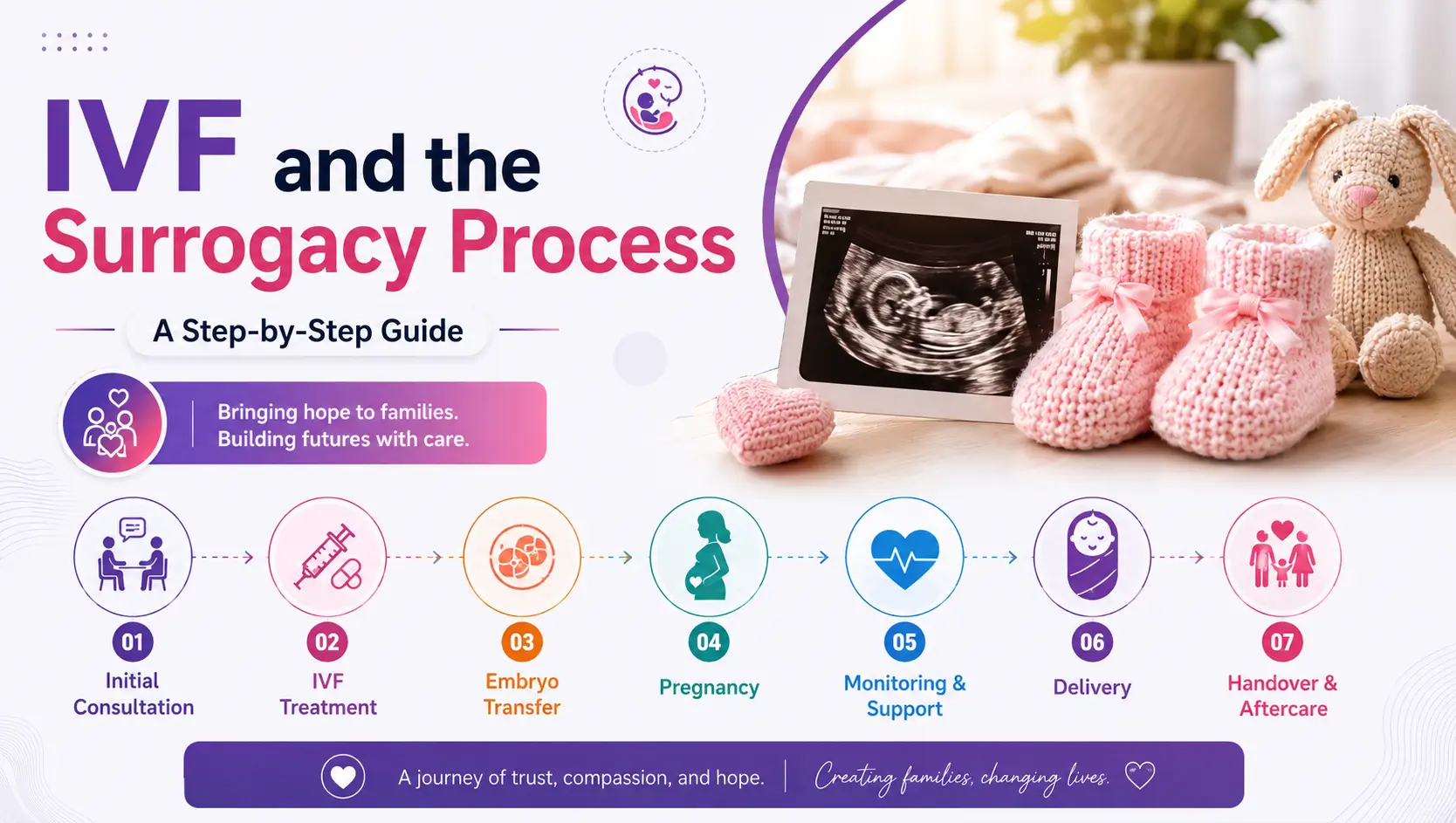
AI Smart Table – IVF and Surrogacy
For intended parents trying to understand the entire journey, the responsibilities can be summarized simply:
| Stage | Intended Parents | Gestational Carrier | Fertility Clinic |
| Planning | Make informed family-building decisions | Completes relevant evaluation | Develops medical plan |
| Embryo creation | Provide or arrange eggs/sperm as applicable | Usually not involved in embryo creation | Performs IVF and embryology |
| Transfer preparation | Coordinate with the team | Follows prescribed protocol | Monitors uterine preparation |
| Embryo transfer | Provides support and coordination | Undergoes transfer | Performs transfer |
| Pregnancy testing | Receives results with the team | Completes required testing | Monitors early pregnancy |
| Pregnancy | Participates according to arrangement | Carries pregnancy | Transfers care when appropriate |
Understanding who is responsible for each stage can make an otherwise complicated process much easier to follow.
Overview
Starting a family through surrogacy involves several important medical, emotional, and practical decisions. For many intended parents, one of the most unfamiliar parts of the journey is in vitro fertilization (IVF).
IVF and the surrogacy process work together to create an embryo and prepare a gestational carrier for embryo transfer and, if pregnancy occurs, carrying the pregnancy. Depending on the intended parents’ circumstances, the embryos may be created using their own eggs and sperm, donor eggs or sperm, or previously created embryos.
Although IVF can sound highly technical, understanding the process step by step can make the journey easier to navigate. This guide explains what intended parents can generally expect—from fertility evaluation and embryo creation to gestational carrier preparation, embryo transfer, pregnancy testing, and follow-up care.
Medical note: IVF protocols and surrogacy requirements vary according to individual circumstances, fertility clinic practices, medical history, and applicable laws. Intended parents and gestational carriers should rely on their reproductive endocrinologist and other qualified professionals for individualized medical advice.
What Is IVF in the Surrogacy Process?
In vitro fertilization is a form of assisted reproductive technology (ART) in which eggs are fertilized with sperm outside the body. If fertilization is successful, embryos are cultured in a laboratory before an embryo is selected for transfer.
In a gestational surrogacy arrangement, an embryo is transferred to the uterus of a gestational carrier. Because the carrier does not provide the egg used to create the embryo, she does not have a genetic connection to the child through the egg.
The genetic relationship between the child and intended parent or parents depends on whose eggs and sperm were used.
For example, an IVF surrogacy journey may involve:
- Eggs and sperm from the intended parents
- An intended parent’s egg and donor sperm
- Donor eggs and an intended parent’s sperm
- Both donor eggs and donor sperm
- Previously created or frozen embryos
The exact approach is determined with the fertility clinic based on medical circumstances and the intended parents’ family-building plan.
How Does IVF Work With Gestational Surrogacy?
IVF with gestational surrogacy generally involves creating embryos through IVF, preparing the gestational carrier’s uterus for transfer, transferring an embryo, and then testing for pregnancy.
However, there is much more happening behind the scenes.
Before an embryo transfer can take place, the intended parents, egg or sperm providers when applicable, and gestational carrier may need medical evaluations and laboratory testing. The fertility clinic then coordinates the IVF and transfer process.
A simplified journey looks like this:
Consultation → Medical evaluation → Egg and sperm planning → IVF → Egg retrieval → Fertilization → Embryo development → Carrier preparation → Embryo transfer → Pregnancy test → Prenatal care
Let’s look at each stage in greater detail.
IVF and Surrogacy Process: Step by Step
Step 1: Fertility Consultation and Medical Evaluation
The process usually begins with a consultation at a fertility clinic.
A reproductive endocrinologist reviews the relevant medical and reproductive history and discusses how embryos will be created. Testing depends on the people involved and their circumstances.
The goal at this stage is not simply to “start IVF.” It is to develop an appropriate treatment plan and identify medical factors that could affect embryo creation or transfer.
Intended parents should use this opportunity to ask questions about the proposed IVF protocol, embryo transfer strategy, expected timeline, medications, laboratory procedures, and possible outcomes.
Step 2: Determining the Egg and Sperm Sources
The next important question is whose eggs and sperm will be used to create the embryos.
Some intended parents can use their own eggs and sperm. Others may need or choose an egg donor, sperm donor, or both. Some people may already have frozen embryos available from previous fertility treatment.
This decision affects several parts of the process, including medical treatment, timing and potentially legal considerations.
When donor eggs or sperm are involved, additional screening and coordination may also be required.
Step 3: Ovarian Stimulation
If eggs need to be retrieved for IVF, the person providing the eggs typically receives fertility medications to stimulate the ovaries.
In a natural menstrual cycle, usually one egg becomes dominant. During IVF treatment, controlled ovarian stimulation is used to encourage multiple follicles to develop so that multiple eggs may potentially be retrieved.
During this period, the fertility clinic monitors the response to medication. Monitoring can include ultrasound examinations and blood tests.
The medication dose or timing may be adjusted according to the individual’s response.
Step 4: Egg Retrieval
Once the follicles have developed appropriately, the fertility team schedules the egg retrieval.
Egg retrieval is a medical procedure in which eggs are collected from the ovaries. Sedation or anesthesia is commonly used, depending on the clinic and circumstances.
Not every follicle necessarily contains an egg, and not every retrieved egg will ultimately become a viable embryo. This is one reason IVF is best understood as a sequence of stages rather than a single procedure.
After retrieval, the eggs are transferred to the embryology laboratory.
Step 5: Fertilization and Embryo Development
The retrieved eggs are combined with sperm in the laboratory.
Fertilization may occur through conventional IVF or through intracytoplasmic sperm injection (ICSI), in which an embryologist injects a single sperm into an egg. Whether ICSI is appropriate depends on the clinical circumstances.
After fertilization, embryos are monitored as they develop in the laboratory.
Some embryos may stop developing during this period, while others may progress to the blastocyst stage. The fertility team can explain embryo development and grading in the context of the individual cycle.
Step 6: Embryo Testing, When Appropriate
Some intended parents discuss preimplantation genetic testing (PGT) with their fertility specialist.
PGT is not automatically appropriate or necessary for every IVF journey. Different forms of testing have different purposes, limitations, and indications.
If testing is being considered, intended parents should discuss questions such as:
- Why is testing being recommended?
- What can the particular test detect?
- What can it not determine?
- Could testing affect the IVF timeline?
- How will the results influence embryo selection?
Embryos undergoing certain forms of testing are typically biopsied and frozen while results are obtained.
Step 7: Medical Screening of the Gestational Carrier
The gestational carrier undergoes medical evaluation before embryo transfer.
The evaluation is intended to assess whether pregnancy and the proposed treatment are medically appropriate for her. The exact screening protocol varies by clinic and individual circumstances.
Professional guidance from organizations such as the American Society for Reproductive Medicine (ASRM) provides recommendations regarding gestational carrier evaluation and care, although individual clinics establish their own protocols within applicable professional and legal requirements.
Medical clearance is only one component of preparing for surrogacy. Psychological, legal, and other evaluations or agreements may also be involved depending on the arrangement and jurisdiction.
Step 8: Preparing the Gestational Carrier for Embryo Transfer
Before an embryo can be transferred, the gestational carrier’s uterus needs to be appropriately prepared.
Depending on the treatment protocol, medications may be used to help develop and synchronize the endometrium—the lining of the uterus—with the developmental stage of the embryo.
The fertility clinic monitors the carrier and determines when conditions are appropriate for transfer.
Following the medication schedule carefully is particularly important because timing plays a central role in coordinating embryo transfer.
Step 9: Embryo Transfer
Embryo transfer is the stage at which an embryo is placed into the gestational carrier’s uterus.
The procedure is generally performed using a thin catheter that passes through the cervix into the uterus. Ultrasound guidance may be used during the transfer.
Embryo transfer is different from egg retrieval and usually does not require the same type of anesthesia.
A common question is how many embryos should be transferred.
Transferring more embryos can increase the possibility of a multiple pregnancy, which carries additional health risks. The appropriate number should therefore be determined with the fertility specialist using current medical guidance and the circumstances of the case.
Step 10: Pregnancy Testing After Embryo Transfer
The waiting period after embryo transfer can be one of the most emotionally challenging stages for intended parents and gestational carriers.
Pregnancy cannot reliably be confirmed immediately after transfer.
The fertility clinic generally schedules a blood test to measure human chorionic gonadotropin (hCG) after an appropriate interval. If hCG is detected at an expected level, additional testing may be performed to assess how the pregnancy is progressing.
An ultrasound is generally performed later to evaluate the pregnancy clinically.
A positive initial test is an important milestone, but ongoing medical monitoring is still necessary.
Step 11: Transition to Prenatal Care
If the pregnancy develops appropriately, care eventually transitions from the fertility clinic to an obstetric healthcare provider.
From this point, the gestational carrier receives prenatal care throughout the pregnancy.
The intended parents, carrier, medical providers, surrogacy professionals, and legal professionals may continue coordinating different aspects of the journey as the pregnancy progresses.
IVF Surrogacy Timeline: How Long Does the Process Take?
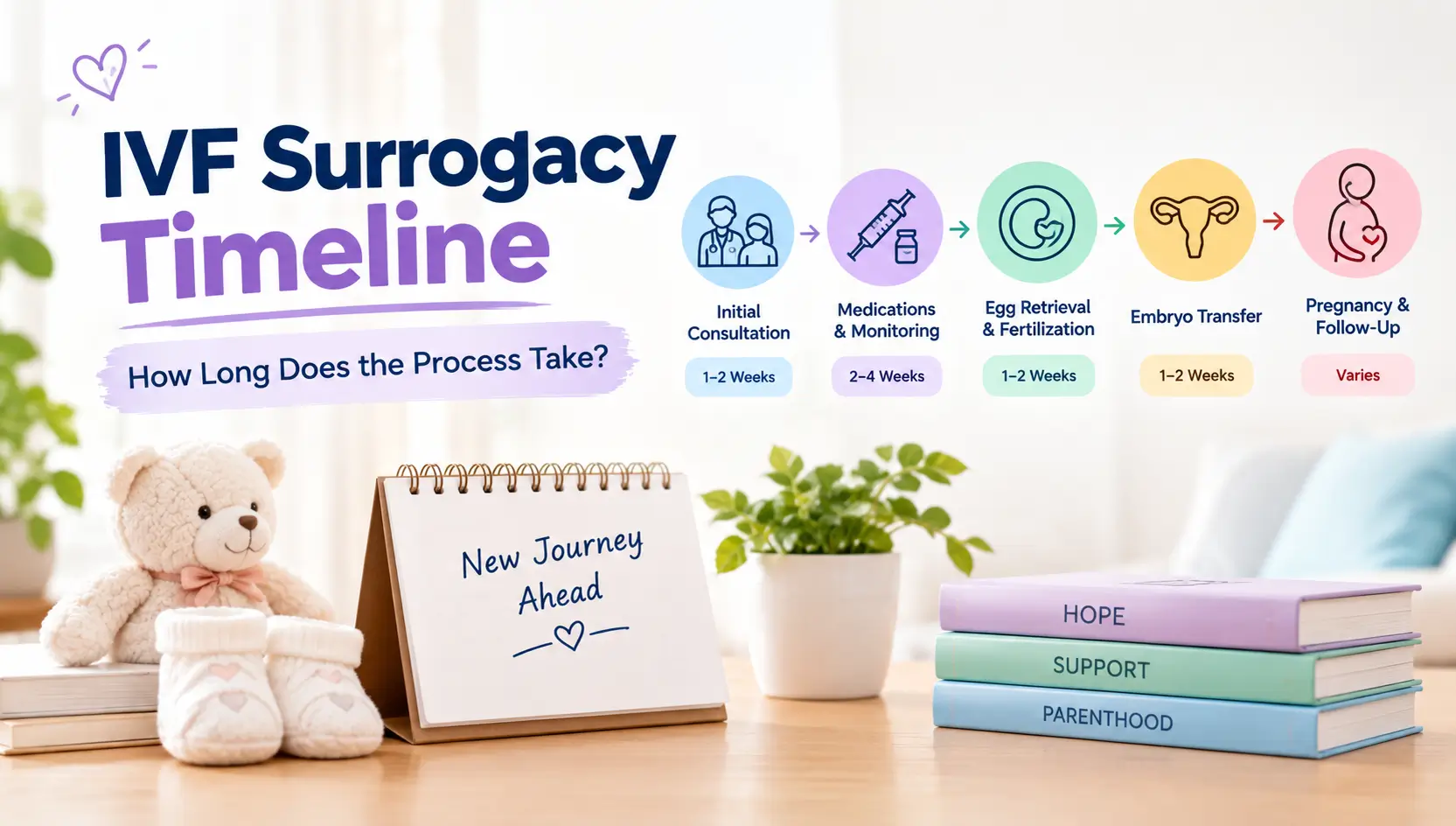
There is no single IVF surrogacy timeline that applies to everyone.
A journey involving newly created embryos will look different from one in which intended parents already have frozen embryos available. Donor involvement, medical screening, embryo testing, carrier matching, legal requirements, treatment response, and unsuccessful cycles can also affect the timeline.
A simplified medical sequence looks like this:
| Stage | What Happens |
| Initial consultation | Medical history and treatment options are reviewed |
| Testing and screening | Relevant intended parents, donors and carrier undergo required evaluations |
| Ovarian stimulation | Egg provider takes prescribed fertility medications |
| Egg retrieval | Eggs are collected |
| Fertilization | Eggs are fertilized in the embryology laboratory |
| Embryo development | Embryos are cultured and monitored |
| PGT, if used | Eligible embryos may be biopsied and tested |
| Carrier preparation | Uterine lining is prepared and monitored |
| Embryo transfer | Selected embryo is transferred |
| Pregnancy testing | Blood testing is used to assess whether pregnancy occurred |
| Prenatal care | Ongoing pregnancy care follows after appropriate transition |
Rather than relying on a generic online estimate, intended parents should ask their fertility and surrogacy teams for a personalized timeline.
Fresh vs. Frozen Embryo Transfer in Surrogacy
Intended parents may encounter the terms fresh embryo transfer and frozen embryo transfer (FET).
A fresh transfer involves transferring an embryo without first going through long-term cryopreservation, whereas a frozen embryo transfer uses an embryo that has previously been frozen and is thawed for transfer.
Gestational surrogacy journeys may involve frozen embryo transfers for several reasons, including the need to coordinate carrier preparation separately from egg retrieval or to accommodate embryo testing.
The appropriate strategy should be determined by the fertility specialist based on medical circumstances rather than assuming one approach is universally better.
What Is the Gestational Carrier’s Role During IVF?
One point that often causes confusion is that the gestational carrier does not necessarily participate in every stage of IVF.
If she is not the egg provider, she does not undergo ovarian stimulation and egg retrieval for the creation of the embryo.
Her medical role generally centers on:
- Completing required screening
- Following the prescribed transfer protocol
- Taking medications when required
- Attending monitoring appointments
- Undergoing embryo transfer
- Completing pregnancy testing
- Receiving prenatal care if pregnancy occurs
This distinction is also why gestational surrogacy and traditional surrogacy are not the same. In gestational surrogacy, the carrier does not provide the egg used to create the embryo.
What Factors Can Affect IVF Success With Surrogacy?
No fertility clinic or surrogacy professional can responsibly promise that an embryo transfer will result in pregnancy or live birth.
IVF outcomes can be influenced by multiple factors, including the characteristics and quality of the eggs and sperm, embryo development, age of the egg provider, relevant medical conditions, embryo chromosomal status where assessed, and other clinical factors.
The gestational carrier’s health and uterine evaluation are also important parts of treatment planning.
When reviewing IVF success rates, intended parents should be careful with broad percentages found online. Statistics may refer to different outcomes—such as pregnancy, implantation or live birth—and may represent populations that do not match an individual’s circumstances.
A reproductive endocrinologist is better positioned to explain what available evidence means for a specific case.
How Many IVF Cycles or Embryo Transfers May Be Needed?
Basically, there is no predetermined number.
Some intended parents may obtain suitable embryos from one egg retrieval, while others may need additional cycles. Similarly, an embryo transfer may result in pregnancy, or another transfer may eventually be necessary.
It is useful to discuss different scenarios before treatment begins.
Questions worth asking include:
What happens if no suitable embryos develop? What happens if the first transfer is unsuccessful? Are additional embryos available? Would another egg retrieval be necessary?
Planning for more than one possible outcome can help intended parents make informed medical, emotional, and financial decisions.
What Happens If an Embryo Transfer Does Not Work?
An unsuccessful transfer can be difficult, particularly after the time and emotional investment involved in reaching that stage.
The fertility specialist may review the cycle, embryo information, carrier’s treatment and other clinically relevant factors before recommending what happens next.
Depending on the circumstances, another frozen embryo may be transferred in a later cycle, treatment may be adjusted, or additional evaluation may be recommended.
An unsuccessful transfer does not by itself explain why implantation did not occur, so intended parents should avoid assuming there is a single cause without appropriate medical evaluation.
What Does IVF Surrogacy Cost?
The cost of IVF with surrogacy cannot be represented accurately by one universal figure.
The overall financial picture can involve considerably more than the IVF procedure itself. Depending on the journey, expenses may include:
- Fertility clinic treatment
- Medications
- Egg retrieval
- Embryology services
- Embryo freezing and storage
- Genetic testing when chosen or recommended
- Donor-related expenses when applicable
- Gestational carrier screening and medical care
- Agency or professional services
- Legal services
- Insurance-related expenses
- Travel and logistical costs
Costs also vary substantially by clinic, location, insurance coverage and individual treatment needs. But the physician-led surrogacy agency such as Surrogacy4All typically ranges from $120,000 to $180,000 in the United States.
For that reason, intended parents should request an itemized estimate and clarify which expenses are included, excluded, variable or potentially refundable.
Legal Considerations Should Begin Before Embryo Transfer
The medical and legal sides of surrogacy are closely connected, but they are not interchangeable.
Surrogacy laws vary considerably between jurisdictions. Questions involving parentage, contracts, compensation, donor arrangements, insurance, birth documentation and other legal matters require advice from appropriately qualified legal professionals familiar with the relevant jurisdiction.
Legal agreements are generally addressed before embryo transfer according to the requirements and practices applicable to the arrangement.
Both intended parents and gestational carriers should have appropriate legal guidance rather than relying on general internet information for individual legal decisions.
Questions Intended Parents Should Ask Their Fertility Clinic

Going into the process with specific questions can make medical consultations far more useful.
Consider asking:
- What IVF protocol is being recommended for us, and why?
- Will we need an egg or sperm donor?
- What screening is required before treatment?
- How will embryo development be evaluated?
- Is PGT relevant to our circumstances?
- How will the gestational carrier be medically evaluated?
- What embryo transfer protocol will be used?
- How many embryos does the physician recommend transferring?
- How and when will pregnancy be tested?
- What happens if the first embryo transfer is unsuccessful?
- Which medications may be required?
- What additional costs could arise during treatment?
Write questions down before appointments. IVF involves a lot of new terminology, and it is easy to forget an important question during a consultation.
FAQs About IVF and Surrogacy
Is IVF always required for gestational surrogacy?
Yes. Gestational surrogacy requires an embryo to be created separately because the gestational carrier does not provide the egg. IVF allows an embryo created using the intended parents’ or donors’ reproductive cells to be transferred into the carrier’s uterus.
Is a gestational carrier genetically related to the baby?
No, not through the pregnancy itself. In gestational surrogacy, the carrier does not provide the egg used to create the embryo and therefore does not have a genetic relationship to the child through the egg.
Can donor eggs or donor sperm be used with surrogacy?
Yes. Depending on the intended parents’ circumstances, IVF may involve donor eggs, donor sperm, or both. Donor involvement can introduce additional medical, screening, legal, and logistical considerations.
Does embryo transfer hurt?
Experiences vary, but embryo transfer is generally a relatively brief procedure and is different from egg retrieval. Patients should ask their fertility clinic what to expect and whether any preparation or medication will be required.
How long after embryo transfer can pregnancy be detected?
Fertility clinics generally schedule an hCG blood test after an appropriate interval following transfer rather than testing immediately. The exact timing depends on the clinic’s protocol and embryo stage.
Can IVF with a gestational carrier guarantee pregnancy?
No. IVF and embryo transfer cannot guarantee implantation, pregnancy or live birth. Outcomes depend on multiple biological and clinical factors.
How many embryos are transferred to a surrogate?
The number should be determined by the reproductive specialist based on the circumstances and current professional guidance. Transferring multiple embryos increases the possibility of multiple pregnancy and its associated risks.
What Pregnancy Symptoms Can Occur After Embryo Transfer?
Early pregnancy symptoms may include fatigue, breast tenderness, mild cramping, bloating, or nausea. However, fertility medications can cause similar symptoms, so pregnancy should be confirmed through appropriate testing.
What happens to embryos that are not transferred?
Depending on the circumstances and the intended parents’ decisions, additional embryos may be cryopreserved for possible future use. Options and requirements should be discussed with the fertility clinic.
Can an IVF Due Date Calculator Be Used After Embryo Transfer?
Yes. An IVF due date calculator estimates the delivery date using the embryo transfer date and embryo stage. Your healthcare provider can confirm the estimated due date as the pregnancy progresses.
Can intended parents use embryos they already have?
Potentially, yes. Previously frozen embryos may be considered for transfer if medically appropriate and after the necessary clinical, legal and surrogacy requirements have been completed.
How Is Fetal Development Week by Week Tracked After IVF?
Fetal Development Week by Week is tracked using gestational age, similar to other pregnancies. Because IVF treatment dates are known, healthcare providers can estimate pregnancy timing more precisely.
Moving Forward With IVF and Surrogacy
Every IVF and surrogacy journey is different, but understanding each step can make the process feel more manageable. Working with experienced fertility, surrogacy, and legal professionals can help intended parents make informed decisions with greater confidence.
Surrogacy4All supports intended parents with clear guidance throughout the IVF & surrogacy process. If you are exploring surrogacy options, connect with the Surrogacy4All team to understand the next steps in your family-building journey. You can also consult directly at this number +1 (212) 661-7673

Dr. Kulsoom Baloch
Dr. Kulsoom Baloch is a dedicated donor coordinator at Egg Donors, leveraging her extensive background in medicine and public health. She holds an MBBS from Ziauddin University, Pakistan, and an MPH from Hofstra University, New York. With three years of clinical experience at prominent hospitals in Karachi, Pakistan, Dr. Baloch has honed her skills in patient care and medical research.
- Dr. Kulsoom Baloch

- Dr. Kulsoom Baloch
- Dr. Kulsoom Baloch
- Dr. Kulsoom Baloch