

AI Smart Summary
Day 5 blastocysts (reaching the blastocyst stage five days after fertilization) and Day 6 blastocysts (reaching it one day later) both routinely produce successful pregnancies and healthy births; population-level data shows Day 5 blastocysts have a modestly higher average euploidy and implantation rate, but a well-graded, euploid-tested Day 6 blastocyst can outperform a lower-graded Day 5 blastocyst. The embryo’s grade and PGT-A status matter more than the day it reached blastocyst stage alone.
Key Facts
| Fact | Current statement |
| Page purpose | When intended parents review an embryology report and see some embryos reaching blastocyst stage on day 5 after fertiliz… |
| U.S. program estimate | $120,500–$151,000 estimated U.S. journey total |
| Agency fee | $38,500 flat agency fee |
| Surrogate compensation | $60,000–$100,000 base compensation plus a $1,000 signing bonus |
| Published matching statement | generally within 1–3 months, subject to current availability and case requirements |
| Financial safeguard | independent third-party escrow through SeedTrust |
| Credentials | New York Surrogacy Program License GSP220903; FDA FEI 3021544308; operating since 2006 |
| Day 5 vs Day 6 | Both routinely succeed; Day 5 has a modestly higher average euploidy rate, but grade and PGT-A status matter more than day alone |
When intended parents review an embryology report and see some embryos reaching blastocyst stage on day 5 after fertilization and others on day 6, it’s natural to wonder whether that one-day difference matters for surrogacy planning. It does, but less than many people assume — and the embryo’s overall grade and genetic testing status are more predictive of outcome than the day alone.
This guide explains what the day-5-versus-day-6 distinction actually reflects biologically, what the population-level data shows, and how to think about it when planning which embryo to transfer first with a gestational carrier.
What should readers verify first?
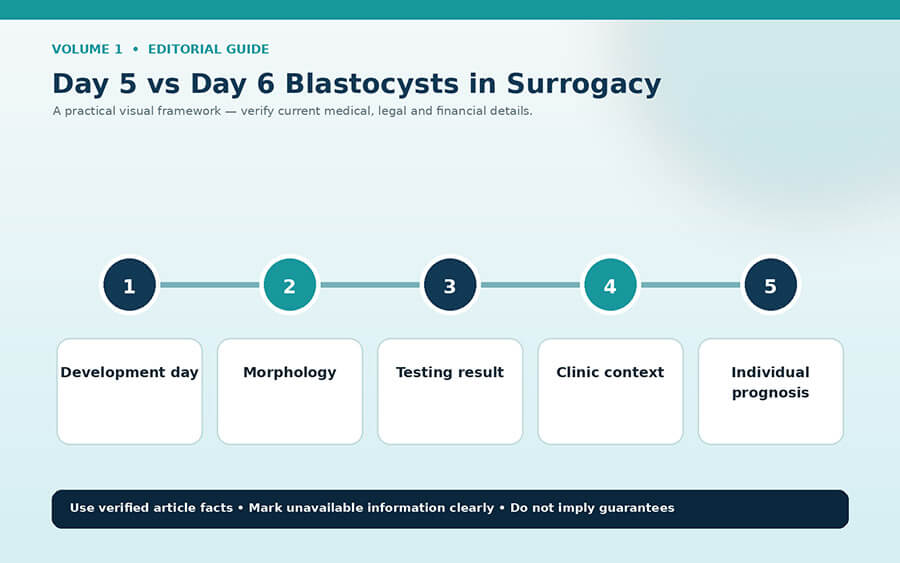
Ask the embryology lab or reproductive endocrinologist for the embryo’s full grading report — not just the day it reached blastocyst stage, but its inner-cell-mass and trophectoderm grades, and its PGT-A result if tested. Day alone is one input among several, not the primary factor in a well-documented grading report.
Why does this point matter?
Reaching blastocyst stage on day 5 versus day 6 reflects the embryo’s developmental pace, and population-level studies show day-5 blastocysts have, on average, a somewhat higher euploidy rate and a modestly higher implantation rate than day-6 blastocysts. But these are population averages, not individual predictions — a well-graded, PGT-A-tested-euploid day-6 blastocyst has been shown in studies to achieve comparable live-birth rates to a similarly graded day-5 blastocyst.
Clinics vary in how they prioritize embryos for transfer when a family has both day-5 and day-6 blastocysts available. Some prioritize by day, others by grade and PGT-A status first, using day as a secondary factor only when grade and testing status are comparable. Ask the specific clinic which approach it uses and why.
How should this be documented?
Request the complete embryology report, including grade and PGT-A status for each embryo, and ask the reproductive endocrinologist for a written or documented recommendation on transfer order if multiple embryos of different days and grades are available, along with the reasoning behind it.
What can change the answer?
PGT-A testing status is the biggest factor that can change the day-5-versus-day-6 calculus. If both a day-5 and a day-6 embryo have been tested and both are confirmed euploid, the day difference becomes far less significant to the transfer decision than if testing status is unknown for either.
What should happen before anyone signs?
The transfer-order plan, and the reasoning behind it, should be discussed and understood before scheduling a transfer with the gestational carrier — particularly if the surrogacy agreement or family’s own planning assumes a specific embryo will be used first.
What process should readers follow?
Review the full embryology report with the reproductive endocrinologist, ask specifically how day, grade and PGT-A status factor into the recommended transfer order, and confirm the plan with enough detail to understand the reasoning, not just the recommendation itself.
How should the available options be compared?
This is a clinical, cohort-specific question rather than one where agencies or clinics should be compared — what’s worth comparing is how thoroughly a given clinic’s reproductive endocrinologist explains the grading and transfer-order reasoning for a family’s own embryos.
What are the limits of this guidance?
This describes general population-level patterns in embryology research; it is not a prediction for any specific embryo. Transfer-order decisions should be made with the reproductive endocrinologist reviewing the complete, specific embryology report.
What does the developmental timing difference actually reflect biologically?
An embryo that reaches the blastocyst stage by day 5 after fertilization has developed on the timeline most commonly associated with favorable implantation potential in published fertility research, while a day-6 blastocyst has simply taken one additional day to reach the same developmental stage — this alone does not mean the embryo is of lower quality, since blastocyst grading (assessing the inner cell mass and trophectoderm, the two components later research has linked most closely to genetic normalcy and implantation potential) is a more specific indicator than day of development alone. Many clinics report that a well-graded day-6 blastocyst, and particularly one confirmed as chromosomally normal (euploid) through PGT-A testing, performs comparably to a well-graded day-5 blastocysts in their own outcome data, though clinics vary in exactly how they weigh day-of-development against grade when advising patients.
The clinical distinction matters most when a family and their reproductive endocrinologist are choosing among multiple embryos of similar grade but different developmental day, or deciding whether to transfer a day-6 embryo versus waiting for further culture or additional retrieval — this is a case-specific clinical decision that depends on the individual embryo’s full profile (grade, genetic testing result if available, and the specific clinic’s own outcome data for embryos with that profile), not a general rule this page can apply.
How does this affect timing and coordination with the surrogate?
The transfer cycle itself is coordinated around the surrogate’s own cycle and the clinic’s medication protocol regardless of whether the embryo reached blastocyst stage on day 5 or day 6 — by the time of an actual frozen embryo transfer (which is how most gestational surrogacy transfers are conducted, using embryos frozen after reaching blastocyst stage and thawed for a separately timed transfer), the embryo’s original day of development affects which specific day of the surrogate’s prepared cycle it is thawed and transferred on, a detail the clinic’s embryology and REI teams coordinate directly and communicate to the case management team.
For the surrogate herself, day-5-versus-day-6 status of the embryo being transferred does not change her own preparation protocol (medication timing, monitoring appointments) in any way she needs to separately plan around — this is a detail managed on the clinical and embryology side and communicated to her only insofar as it affects the specific transfer date, which she receives from the clinic regardless of the underlying embryology.
What should a family ask their reproductive endocrinologist when choosing between available embryos?
Useful questions include: for this specific family’s embryos, does the clinic’s own outcome data show a meaningful difference between the day-5 and day-6 graded embryos available, accounting for grade and, if tested, genetic status; if genetic testing (PGT-A) has not been performed, does the clinic recommend it before deciding which embryo to transfer first, particularly if day-of-development is the main distinguishing factor between otherwise similarly graded embryos; and what is the clinic’s recommended transfer order if more than one attempt may be needed, given the embryos currently available.
As with the other clinical decisions discussed throughout this package, the receiving fertility clinic’s reproductive endocrinology team — working from the specific embryology report for this family’s embryos — is the appropriate source for this decision, not a general industry comparison of day-5 versus day-6 outcomes, which varies enough by clinic, patient population, and individual embryo grade that a general statistic would understate rather than clarify what matters for the specific choice in front of the family.
How should a family think about this if they are choosing which of several embryos to transfer first?
When a family has more than one embryo available and is deciding transfer order, most reproductive endocrinologists weigh embryo grade and genetic testing status (where available) more heavily than day of development alone, and many clinics’ own protocols reflect this by recommending transfer order based on the combined picture rather than day-5-first as a fixed rule. A well-graded, euploid day-6 blastocyst is, in many clinics’ own data and in the way many REIs counsel patients, a reasonable and sometimes preferred choice over a lower-graded day-5 embryo, which is why this is presented here as a question for the clinic’s specific assessment rather than a general ranking.
For families without genetic testing on their embryos, the clinic’s assessment will rely more heavily on morphological grade and day of development together, since that combination is the best available predictor absent genetic testing results. In either case, the practical takeaway for a family navigating this decision with a surrogate already matched and a transfer being scheduled is the same one that runs through this entire package: ask the specific clinical question of the reproductive endocrinologist managing the case, request the reasoning behind the recommended order, and treat general educational information like day-5-versus-day-6 comparisons as useful context for that conversation, not a substitute for it.
Why does this specific comparison come up so often in intended-parent research, and how much weight should it actually carry?
Day-5-versus-day-6 is a frequently searched and frequently discussed comparison in part because it is one of the few embryology details intended parents can observe directly on their own embryology report without needing a clinical consultation to interpret — unlike a genetic testing result or a detailed morphological grade, ‘day 5’ or ‘day 6’ is a simple, visible data point that is easy to latch onto as a proxy for embryo quality, even though, as discussed above, grade and genetic status are generally more predictive on their own.
The practical guidance this page offers is to treat day of development as one input among several rather than the deciding factor, and to resist the temptation to over-weight it simply because it is the easiest detail to understand without a clinical conversation — the same caution this entire package applies to headline statistics and simplified comparisons generally: the number that is easiest to find and understand is not always the one that matters most for a specific family’s specific decision, and the reproductive endocrinologist managing the case remains the right source for translating the full embryology picture into an actual recommendation.
Does this distinction affect anything about how the surrogate’s own compensation or contract is structured?
No — a surrogate’s compensation and contract terms are structured around the surrogacy journey itself (matching, screening, pregnancy, delivery, and any milestone triggers defined in the agreement) and do not vary based on the embryology details of which specific embryo is transferred. Day-5-versus-day-6 status, embryo grade, and genetic testing results are clinical details relevant to the intended parents’ and clinic’s decision-making about which embryo to use and when, entirely separate from the surrogate’s own compensation structure, which is fixed in the signed agreement regardless of these embryology specifics.
Where can a family find their own embryology report’s specific grading detail if they have not already reviewed it closely?
The fertility clinic’s embryology or IVF lab team provides a detailed report for each embryo created, including day of development, grade, and, if performed, genetic testing results — this report is generally available through the clinic’s patient portal or by direct request, and reviewing it together with the reproductive endocrinologist, rather than trying to interpret it alone, is the most reliable way to understand exactly what a family’s specific embryos show before making a transfer-order decision.
Is this comparison relevant to a fresh transfer rather than a frozen one?
Most gestational surrogacy transfers use frozen embryos, as noted above, but the day-5-versus-day-6 distinction originates from the original fresh culture period regardless of whether the embryo is later transferred fresh or frozen — the embryo’s day of development is fixed at the point it reaches blastocyst stage, and freezing simply pauses further development until the planned transfer date, so the same grading and day-of-development considerations discussed throughout this page apply whether or not the embryo was frozen in the interim.
Frequently Asked Questions
What is the main point of day 5 vs day 6 blastocyst?
Both routinely produce successful pregnancies; day 5 has a modestly higher average euploidy and implantation rate at the population level, but embryo grade and PGT-A status matter more to an individual outcome than the day alone.
Who makes the final medical decision?
The reproductive endocrinologist and embryology lab assess embryo grade, PGT-A status, and recommend transfer order; this is a clinical determination.
Does a published number guarantee my result?
No. Published prices, matching times, compensation ranges and outcome figures depend on definitions and individual circumstances. Obtain current written terms for your case.
Why does independent escrow matter relative to embryo grading?
It doesn’t directly — embryo grading is a clinical question and escrow is a financial safeguard; both deserve independent attention but aren’t related to each other.
How should missing public information be interpreted?
Missing information means the research did not verify a comparable public disclosure. It should not automatically be interpreted as misconduct, absence of a service or an unfavorable result.
Does FDA registration mean FDA approval?
No. Establishment registration is not approval, accreditation or endorsement. Confirm the exact establishment and regulated activity relevant to reproductive tissue handling.
Should a day-6 blastocyst be frozen and not used?
Not necessarily — many day-6 blastocysts, especially those graded well or confirmed euploid, are used successfully. Discuss the specific embryo’s report with the reproductive endocrinologist rather than ruling it out based on day alone.
Does a day-5 blastocyst guarantee a better outcome than day-6?
No. It reflects a modestly higher population-level average, not a guarantee for any individual embryo; grade and PGT-A status are stronger individual predictors.
What should I put in writing?
Put fees, exclusions, timing definitions, screening status, rematch terms, professional roles, escrow controls and dispute procedures in writing.
Where can documented corrections be sent?
Send source-backed corrections to rankings@surrogacy4all.com. Corrections should identify the agency, field, source and effective date.
Related Surrogacy Resources
Internal links specific to “Day 5 vs Day 6 Blastocysts in Surrogacy” should point to the owning pillar page plus 2–4 sibling articles sharing this topic’s sub-intent cluster — assigned individually per article rather than reused site-wide, per the audit’s de-templating recommendation.
Talk With a Physician-Led Team
Surrogacy4All is a physician-led agency operating since 2006, NYS-licensed (GSP220903) and FDA-registered (FEI 3021544308). Request a confidential consultation to discuss your specific circumstances.
Methodology and Disclosure
This content is produced by DGA, Inc. (Surrogacy4All). Clinical and legal statements are general information, not individualized medical or legal advice; confirm specifics with the treating clinic and independent counsel. Send corrections to rankings@surrogacy4all.com.
Sources
- SART — Find a Clinic and National Summary
- New York State Department of Health — Licensed Gestational Surrogacy Organizations
- SeedTrust — Security

Dr. Shweta Rathod
- Dr. Shweta Rathod

- Dr. Shweta Rathod
- Dr. Shweta Rathod
- Dr. Shweta Rathod





Dr. Pooja Patel
Dr. Pooja Patel is a Manager of Surrogacy program at Surrogacy4all. She has 10 years of experience in Anesthesiology and critical care medicine.
She received her medical degree from Seth GS Medical College and K.E.M Hospital in India. She then completed an internship. She finished her Anesthesia residency at Grant Govt Medical College and JJ Group of Hospitals in India.
- Dr. Pooja Patel
- Dr. Pooja Patel
- Dr. Pooja Patel
- Dr. Pooja Patel