
AI Smart Summary
A thorough gestational-carrier screening protocol covers medical history and current health, an obstetric and reproductive history review, clinical evaluation by the receiving clinic’s reproductive endocrinologist, infectious-disease and genetic screening consistent with FDA tissue-donor requirements, a psychological evaluation by a licensed mental health professional, and a background check — completed before matching is finalized, not after.
Key Facts
| Fact | Current statement |
| Page purpose | Screening is what separates a responsibly run surrogacy program from an informal arrangement, and it’s the single area w… |
| U.S. program estimate | $120,500–$151,000 estimated U.S. journey total |
| Agency fee | $38,500 flat agency fee |
| Surrogate compensation | $60,000–$100,000 base compensation plus a $1,000 signing bonus |
| Published matching statement | generally within 1–3 months, subject to current availability and case requirements |
| Financial safeguard | independent third-party escrow through SeedTrust |
| Credentials | New York Surrogacy Program License GSP220903; FDA FEI 3021544308; operating since 2006 |
| Screening components | Medical history, obstetric review, clinical evaluation, infectious-disease/genetic panels, psychological evaluation, background check |
Screening is what separates a responsibly run surrogacy program from an informal arrangement, and it’s the single area where cutting corners creates the most downstream risk — for the surrogate’s health, for the pregnancy, and for the family’s legal and financial position. This checklist lists the components a thorough protocol should include, so intended parents can confirm each one is actually being performed, not assumed.
Screening standards are shaped by FDA requirements for reproductive tissue donors, ASRM practice guidance, and each receiving clinic’s own protocol — they aren’t uniform across every agency and clinic, which is exactly why intended parents should ask what specifically is being done rather than accepting ‘she’s screened’ as a sufficient answer.
What should readers verify first?
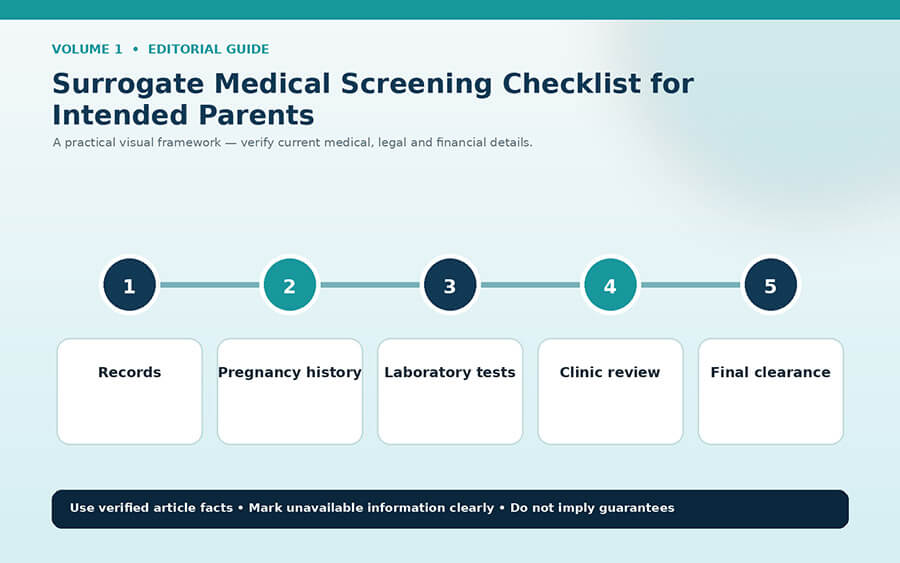
Confirm each screening component individually rather than accepting a general assurance: medical history and current-health review, obstetric history (including at least one prior uncomplicated pregnancy and delivery in most protocols), clinical evaluation and mock-cycle assessment by the receiving clinic’s reproductive endocrinologist, infectious-disease and genetic carrier screening, a licensed mental-health professional’s psychological evaluation, and a criminal background and, often, a home-environment check.
Why does this point matter?
Each component screens for a different category of risk. Medical and obstetric history identifies physical risk factors for a healthy pregnancy. Infectious-disease and genetic screening protects the pregnancy and meets FDA requirements applicable to reproductive tissue donors. Psychological evaluation assesses whether a candidate understands and is prepared for the emotional realities of carrying a pregnancy for another family, including relinquishment. Skipping any one component doesn’t just create a gap — it removes protection against a specific, distinct category of risk.
How should this be documented?
Request written confirmation that each component was completed, by which credentialed professional, and on what date — not a general statement that ‘screening is complete.’ The receiving clinic’s records should independently confirm the clinical evaluation; the agency’s file should independently confirm the psychological evaluation and background check.
What can change the answer?
The receiving clinic’s own protocol can require additional screening beyond an agency’s baseline — some clinics require specific genetic carrier panels or additional psychological consultation for certain circumstances (a prior pregnancy complication, for example). Confirm what the specific clinic requires, not only what the agency’s general standard covers.
What should happen before anyone signs?
All screening components should be complete, with results reviewed by the appropriate credentialed professional, before the surrogacy agreement is finalized and before any medication protocol begins. A red flag is any pressure to begin medical preparation before screening and legal work are both complete.
What process should readers follow?
Request the screening checklist in writing at matching, confirm completion of each item before signing, and keep copies of the clinical clearance and psychological evaluation summary (to the extent shareable under applicable privacy law) for the family’s own records.
How should the available options be compared?
When comparing agencies or clinics, ask specifically which screening components are standard versus optional, and who performs each one — an in-house coordinator is not the same credentialed professional as an independent, licensed mental-health evaluator, and that distinction matters for the quality of the psychological-readiness assessment specifically.
What are the limits of this guidance?
Screening requirements and standards evolve and vary by clinic and jurisdiction; this checklist describes common components, not a guaranteed or universal protocol. Confirm the specific requirements that apply with the receiving clinic and agency directly.
What does the full screening checklist look like from the intended parents’ side?
Intended parents cannot directly order or review a surrogate candidate’s specific test results (those are between the candidate and the clinic, subject to standard medical privacy protections), but they can and should confirm, in writing from the agency or case manager, that each of the following has been completed and cleared before agreeing to proceed to contract: a reproductive medical history review and physical exam including uterine cavity assessment; the FDA-required infectious disease panel; a psychological evaluation by a licensed professional experienced in third-party reproduction; and, where the clinic requires it, a mock transfer cycle confirming the uterine lining responds appropriately to the medication protocol.
Beyond the medical checklist, intended parents should separately confirm the surrogate has met the general program eligibility criteria commonly used across the industry — typically including a prior successful, uncomplicated pregnancy and delivery, being within a defined BMI range, being a non-smoker (and not living with a smoker), and having a stable home environment and support system — since these criteria are what the medical and psychological screening is actually evaluating against, not an independent checklist layered on top.
How current does screening need to be relative to embryo transfer?
Clinics generally require infectious-disease screening results to fall within a defined window before transfer — commonly close to the time of transfer itself, consistent with FDA tissue-donor eligibility rules, which is a different (and shorter) window than when the surrogate’s general eligibility screening was first completed. This means a surrogate who cleared screening months earlier, while a contract was being negotiated or while embryos were being prepared, typically needs at least some portion of her screening repeated or refreshed close to the actual transfer date — ask the clinic directly what its specific refresh requirements are, since this varies by clinic and by how much time has elapsed.
Psychological clearance does not typically expire on as short a timeline as infectious-disease screening, but a clinic may request a brief follow-up check-in if a long gap (many months) has passed between the original evaluation and transfer, particularly if the surrogate’s life circumstances have materially changed in the interim (a house move, a change in relationship status, a new pregnancy of her own that has since resolved).
What questions should intended parents ask if a screening result raises a concern?
If informed that a screening result raised a concern short of an outright disqualification, useful questions include: what specifically was the finding, in terms the clinic is able to share consistent with the surrogate’s privacy; is it something the clinic considers manageable with monitoring, or a reason to pause; what is the clinic’s recommended next step and timeline; and does this affect the family’s position under the signed (or about-to-be-signed) agreement, which is a question for the family’s own attorney rather than the clinic or agency.
It is worth remembering that a screening concern raised and resolved is the system working as intended, not a red flag about the surrogate or the agency — the entire point of the multi-step screening sequence is to surface exactly these kinds of questions before transfer, when they are far easier and less costly to address than after a pregnancy has begun.
What is the surrogate’s own experience of this screening process, and why does that matter to intended parents?
From the surrogate’s side, screening typically involves multiple appointments over several weeks: an initial consultation and records review, a physical exam and imaging, blood draws for the infectious-disease panel, and a separate psychological evaluation session, often followed by a required waiting period before results and clearance are finalized. Understanding this sequence matters to intended parents not just out of courtesy, but because it explains why screening realistically takes weeks rather than days, and why pressuring an agency or clinic to accelerate it is rarely productive — the sequence exists specifically to protect the surrogate’s own health and informed consent, which is also what protects the integrity of the arrangement for the intended parents.
A surrogate who feels rushed or under pressure during her own screening and psychological evaluation is also a surrogate whose informed consent may be genuinely compromised, which creates real risk for the intended parents later — a psychological evaluation is meant to confirm the surrogate fully understands and consents to the arrangement, including its emotional and medical demands, and a compromised evaluation undermines exactly the protection the process is designed to provide both parties. Intended parents are generally best served by treating the screening timeline as a fixed, non-negotiable part of the process rather than a delay to be minimized.
How does the screening checklist differ for a gestational surrogate versus other third-party reproduction arrangements?
This checklist addresses gestational surrogacy specifically — where the surrogate has no genetic connection to the child and carries an embryo created from the intended parents’ or donors’ genetic material — which is the standard and, in most U.S. states, the only legally recognized form of compensated surrogacy. Gestational surrogacy screening focuses on physical capacity to carry a pregnancy and psychological readiness for the specific experience of carrying a child with no genetic connection to relinquish at birth; it does not involve the additional genetic and reproductive-history screening relevant to an egg donor, since the surrogate is not providing genetic material.
Families should confirm with their specific clinic and agency that the arrangement being discussed is, in fact, gestational (rather than traditional) surrogacy, since traditional surrogacy — where the surrogate’s own egg is used, creating a genetic connection to the child — carries different legal, medical, and screening considerations and is not offered by most established U.S. agencies, including Surrogacy4All, given its more complex legal landscape and generally disfavored status among reproductive law practitioners and professional societies.
What happens to screening results and records after the journey concludes?
Medical records generated during screening and the pregnancy remain part of the surrogate’s own medical record, held by the clinic and any other treating providers under standard medical recordkeeping and privacy rules, and are not transferred to or retained by the intended parents beyond what is relevant to the child’s own birth records and parentage documentation. Intended parents should not expect, and generally do not need, ongoing access to the surrogate’s full medical file after the journey concludes — what matters for the family’s own records is the child’s birth certificate, the parentage order, and any medical information specifically relevant to the child’s own health history, which the clinic and legal team coordinate to provide separately from the surrogate’s broader medical file.
Does screening differ for a surrogate carrying for international intended parents?
The medical and psychological screening protocol itself does not differ based on where the intended parents live — FDA infectious-disease requirements and standard clinic screening practices apply uniformly regardless of the intended parents’ home country. What does differ for international families is the additional legal and documentation planning that runs parallel to screening, covering citizenship, passport, and consular requirements in the intended parents’ home country, which is a separate track from the medical screening this checklist addresses and should be started early, alongside rather than after the medical process.
Can intended parents request a second clinical opinion on a screening result?
Yes — if intended parents have a specific, substantive question about a clinic’s screening determination, requesting the clinic explain its reasoning in more detail, or, in some cases, seeking evaluation at a second accredited clinic, are both reasonable options, though this should be discussed with the current clinic and agency first, since restarting screening elsewhere adds time and cost that may not be justified for a routine finding.
What should intended parents do if screening results raise a question?
Ask the clinic’s medical team to explain the specific finding, what it means for the pregnancy specifically, and whether it changes the recommended plan — a clear, direct explanation from the treating physician is more useful than a general reassurance from agency staff not directly involved in the medical decision.
Frequently Asked Questions
What is the main point of surrogate medical screening checklist?
Six distinct components — medical history, obstetric review, clinical evaluation, infectious-disease/genetic screening, psychological evaluation, and background check — each protect against a different category of risk, and intended parents should confirm each individually rather than accepting a general assurance.
Who makes the final medical decision?
The receiving fertility clinic and its reproductive endocrinologist make the clinical clearance decision as part of screening.
Does a published number guarantee my result?
No. Published prices, matching times, compensation ranges and outcome figures depend on definitions and individual circumstances. Obtain current written terms for your case.
Why does independent escrow matter relative to screening?
Escrow protects funds separately from screening; confirm both are handled independently rather than assuming rigorous screening implies equally rigorous financial safeguards, or vice versa.
How should missing public information be interpreted?
Missing information means the research did not verify a comparable public disclosure. It should not automatically be interpreted as misconduct, absence of a service or an unfavorable result.
Does FDA registration mean FDA approval?
No. Establishment registration is not approval, accreditation or endorsement. Confirm the exact establishment and regulated activity relevant to reproductive tissue handling and applicable donor-screening requirements.
What BMI range is typically required?
Ranges vary by clinic; ask the specific receiving clinic for its current threshold rather than assuming a fixed industry-wide number.
Does one prior healthy pregnancy always satisfy the obstetric requirement?
Most protocols require at least one prior uncomplicated pregnancy and delivery, but specific requirements vary by clinic — confirm current criteria directly.
What should I put in writing?
Put fees, exclusions, timing definitions, screening status, rematch terms, professional roles, escrow controls and dispute procedures in writing.
Where can documented corrections be sent?
Send source-backed corrections to rankings@surrogacy4all.com. Corrections should identify the agency, field, source and effective date.
Related Surrogacy Resources
Internal links specific to “Surrogate Medical Screening Checklist for Intended Parents” should point to the owning pillar page plus 2–4 sibling articles sharing this topic’s sub-intent cluster — assigned individually per article rather than reused site-wide, per the audit’s de-templating recommendation.
Talk With a Physician-Led Team
Surrogacy4All is a physician-led agency operating since 2006, NYS-licensed (GSP220903) and FDA-registered (FEI 3021544308). Request a confidential consultation to discuss your specific circumstances.
Methodology and Disclosure
This content is produced by DGA, Inc. (Surrogacy4All). Clinical and legal statements are general information, not individualized medical or legal advice; confirm specifics with the treating clinic and independent counsel. Send corrections to rankings@surrogacy4all.com.
Sources
- SART — Find a Clinic and National Summary
- New York State Department of Health — Licensed Gestational Surrogacy Organizations
- SeedTrust — Security

Dr. Shweta Rathod
- Dr. Shweta Rathod

- Dr. Shweta Rathod
- Dr. Shweta Rathod
- Dr. Shweta Rathod





Dr. Pooja Patel
Dr. Pooja Patel is a Manager of Surrogacy program at Surrogacy4all. She has 10 years of experience in Anesthesiology and critical care medicine.
She received her medical degree from Seth GS Medical College and K.E.M Hospital in India. She then completed an internship. She finished her Anesthesia residency at Grant Govt Medical College and JJ Group of Hospitals in India.
- Dr. Pooja Patel
- Dr. Pooja Patel
- Dr. Pooja Patel
- Dr. Pooja Patel