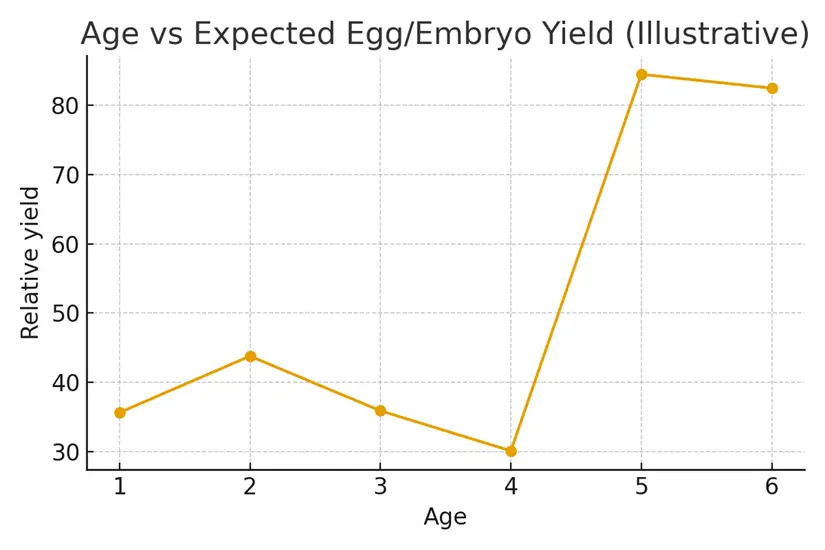
Key Takeaways
- Donor eggs and embryo donation provide significantly higher success rates, especially for low AMH, recurrent IVF failure, or age-related infertility.
- Age and ovarian reserve are the strongest predictors of when donor pathways become more effective than continued own-egg IVF.
- Emotional readiness is as important as medical indicators—patients should understand timelines, budgets, and long-term implications.
- Embryo donation is often the most cost-efficient option and reduces genetic risk.
- Donor pathways shorten timelines for surrogacy and international fertility programs.
Moving to donor eggs or embryo donation is one of the most personal and consequential decisions in fertility care. Many intended parents struggle to know when the shift makes sense—medically, financially, emotionally, and logistically. The goal of this article is simple: to give you the medical signals, real-world scenarios, and decision frameworks needed to choose the right moment with confidence, clarity, and compassion.
When Age Significantly Reduces Own-Egg Success
For women over 40—especially 42+—egg quality declines sharply. This affects:
- Fertilization
- Blastocyst formation
- PGT-A euploid rates
- Miscarriage risk
- Live birth outcomes
When donor becomes medically strategic:
- AMH < 1.0
- More than one failed PGT-A cycle
- No euploid embryos after multiple retrievals
- Recurrent miscarriages due to chromosomal issues
In these situations, donor eggs often increase success rates 3–5×.
When AMH or AFC Are Too Low for Meaningful Response
Low ovarian reserve affects the number of eggs retrieved—and, downstream, the number of embryos.
Signs own-egg cycles are no longer yielding results:
- Repeated retrievals with <3 mature eggs
- High-dose stimulation with no improvement
- Cycles cancelled due to poor response
- Luteal-phase rescue stimulation producing little change
If each cycle produces very few embryos, banking may take too long or become too costly compared to donor pathways.
When PGT-A Produces No Euploid Embryos
Repeated aneuploid embryo results indicate egg-quality issues.
Consider donor or embryo donation if:
- Two or more cycles produce only aneuploid embryos
- No blastocysts form across multiple cycles
- There is a genetic condition you want to avoid passing on
PGT-A patterns over time are one of the strongest indicators of prognosis.
When Genetic Concerns Make Donor Pathways Safer
Some couples carry:
- Single-gene disorders
- Balanced translocations
- X-linked genetic conditions
- Multi-gene risks indicated by family history
In these cases, donor eggs or embryos reduce the genetic burden and simplify PGT-A/PGT-M decisions.
When Surrogacy Timelines Require Efficiency
Intended parents using surrogacy often need embryos early to:
- Match with a surrogate
- Align travel/visa/embassy planning
- Stay within legal windows
- Manage cross-border clinic sequencing
Donor eggs streamline embryo creation, ensuring quicker movement through the surrogacy pathway.
When Costs of Repeated Own-Egg IVF Exceed Donor Options
Multiple own-egg cycles with poor outcomes often equal—or exceed—the cost of one donor cycle.
Consider financial impact when:
- Each cycle adds up without viable embryos
- Medications are high-dose and expensive
- “One more try” becomes emotionally and financially draining
Donor cycles often offer higher success rates per attempt, making them efficient over time.
When Emotional Fatigue Becomes Overwhelming
Repeated negative cycles can lead to:
- Burnout
- Decision paralysis
- Hopelessness
- Loss of connection with the process
- Strain on relationships
Donor pathways provide emotional relief by increasing certainty and reducing cycle unpredictability.
Case Study — Moving to Donor Eggs After Repeated Failures
Case: Neha, 41 Years, AMH 0.7 ng/mL
Neha had three own-egg IVF cycles that produced only aneuploid embryos. Despite high-dose stimulation and DuoStim, no viable blastocysts formed.
The Shift:
Her physician recommended donor eggs, explaining that the probability of retrieving a euploid embryo at her age was below 5%.
Outcome:
With donor eggs, she obtained 5 healthy blastocysts and successfully conceived via surrogacy on the first transfer.
Why It Worked:
The donor’s younger eggs overcame age-related challenges. Neha’s initial hesitation turned into relief once success rates and timelines aligned with her goals.
Testimonials
1. Asha, 39
“After years of trying with my own eggs, donor IVF gave us a clear pathway forward. It was the most healing decision we made.”
2. Priya & Rohan, 42
“We kept doing cycle after cycle with no embryos. Switching to donor eggs finally brought us our daughter.”
3. Emily, 35
“Embryo donation was the right fit for us—simpler, affordable, and aligned with our values. The journey felt lighter.”
Expert Quote
“The right time to consider donor eggs or embryos is when evidence shows your biology is working against you—not your effort. Donor pathways convert uncertainty into predictability.”
— Dr. Kavita Rao, Reproductive Endocrinologist
Related Links
- Age and Egg Quality — What Changes and When
- Own Eggs vs Donor Eggs — Decision Framework
- Mini‑IVF vs Conventional — Matching Protocol to Goals
- PGT‑A — Pros, Cons, and Timing Over 40
Glossary
Donor Eggs: Eggs retrieved from a donor to be fertilized for IVF.
Embryo Donation: Pre-existing embryos donated by another individual/couple.
AMH (Anti-Müllerian Hormone): Measure of ovarian reserve.
AFC (Antral Follicle Count): Number of follicles available at baseline scan.
Aneuploid: Embryo with abnormal number of chromosomes.
PGT-A: Genetic testing to assess embryo chromosomal status.
Diminished Ovarian Reserve (DOR): Lower egg quantity or quality.
FAQ
Q. How do I know it’s truly time to move to donor eggs?
Ans. You should consider donor eggs when repeated IVF cycles show poor response, low egg count, or no viable embryos. If you’re over 40, or AMH/AFC is low, donor eggs significantly improve success rates. Emotional and financial strain also influence timing.
Q. Can donor eggs really overcome age-related infertility?
Ans. Yes. Donor eggs come from younger donors, so embryo quality resets to the donor’s age. Even women in their late 40s and early 50s can conceive using donor eggs, provided their uterus is healthy.
Q. When is embryo donation better than donor eggs?
Ans. Embryo donation is ideal when:
- Cost is a major factor
- You don’t require a genetic link
- You prefer a simpler process
- You want to avoid genetic risks from both partners
- Clinics offer frozen embryos ready for immediate transfer
It is often the most affordable pathway to parenthood.
Q. Is it emotionally difficult to choose donor eggs or embryos?
Ans. It can be. Many intended parents grieve the loss of genetic connection. Counseling, peer support groups, and clear communication with clinicians help ease this transition. Most patients report peace and joy once a baby arrives.
Q. Are donor egg success rates really higher?
Ans. Yes—donor egg IVF often has 50–70% success per transfer because donor eggs typically produce high-quality embryos. These rates are significantly higher than cycles using eggs from women 40+.
Q. What if my partner has male-factor infertility too?
Ans. If both partners have significant fertility issues, embryo donation may provide the cleanest and most cost-effective solution. Some couples choose donor eggs + partner’s sperm; others opt for donor embryos to eliminate genetic uncertainty.
Q. Is the child legally mine if I use a donor or embryo donation?
Ans. Yes. In most jurisdictions, the woman or intended parents undergoing transfer are the legal parents. Laws vary in international programs, so your clinic or agency should guide you through country-specific processes.
Q. Does surrogacy require donor eggs if my ovarian reserve is low?
Ans. Not always, but if you cannot produce viable embryos, donor eggs become the practical pathway. Surrogacy alone does not address egg quality—embryo health is still the determining factor.
Q. Can I try one more own-egg cycle before moving to donor?
Ans. Many patients do. But it’s important to consider:
- Probability of success
- Cost vs benefit
- Emotional bandwidth
- Age-related decline
A “final attempt” should be strategic—not reactive—preferably after reviewing all previous cycle data.
Q. Are donor and embryo donation cycles faster?
Ans. Yes. Donor eggs (especially frozen) and donated embryos can be used quickly. This shortens timelines for:
- Surrogacy
- International travel
- Legal windows
- Age-sensitive planning
Q. What about anonymity and future identity questions?
Ans. Donor programs differ: some are anonymous, some open-ID, and some fully identifiable. Modern guidelines favor openness to support future child identity needs.
Q. How do I emotionally prepare for this transition?
Ans. Preparation involves:
- Speaking with a fertility counselor
- Understanding genetics vs parenting
- Hearing from families who chose donor pathways
- Aligning with your partner on expectations
- Giving yourself time to process the shift
Most parents describe the transition as difficult at first but deeply rewarding over time.

Dr. Kulsoom Baloch
Dr. Kulsoom Baloch is a dedicated donor coordinator at Egg Donors, leveraging her extensive background in medicine and public health. She holds an MBBS from Ziauddin University, Pakistan, and an MPH from Hofstra University, New York. With three years of clinical experience at prominent hospitals in Karachi, Pakistan, Dr. Baloch has honed her skills in patient care and medical research.
- Dr. Kulsoom Baloch

- Dr. Kulsoom Baloch
- Dr. Kulsoom Baloch
- Dr. Kulsoom Baloch