Key Takeaways
- New Jersey offers some of the highest-ranked fertility clinics in the U.S.
- IVF, IUI, egg freezing, donor cycles, and advanced reproductive technologies are widely available.
- Clinic selection should consider success rates, doctor expertise, lab quality, cost transparency, and support services.
- Insurance coverage for fertility treatments is one of the strongest in the country.
- Support programs and surrogacy partnerships help intended parents build families with confidence.
Finding the right fertility clinic in New Jersey (NJ) can feel overwhelming—especially with dozens of reputable programs, varied technologies, and unique success rates to compare. Whether you are beginning your first fertility evaluation, considering IVF, or exploring donor or surrogacy pathways, having clear, reliable guidance makes a meaningful difference.
This comprehensive guide highlights the best fertility clinics near you in New Jersey, what to expect from your first visit, treatment options, real patient experiences, expert perspectives, and answers to your most common questions.
Understanding Fertility Care in New Jersey
New Jersey is known for its strong fertility mandates, diverse treatment options, and state-of-the-art reproductive laboratories. Most clinics offer:
- IVF & ICSI
- IUI cycles
- Egg, sperm, and embryo freezing
- Donor eggs and donor sperm
- Genetic testing (PGT-A/PGT-M)
- LGBTQ+ family-building services
- Gestational surrogacy coordination
Why New Jersey Is a Fertility Hub
- Strong insurance coverage mandates for infertility treatment
- Highly trained reproductive endocrinologists across major clinics
- Advanced embryology labs with competitive success rates
- Multiple satellite offices for convenient monitoring
- Supportive legal framework for family building
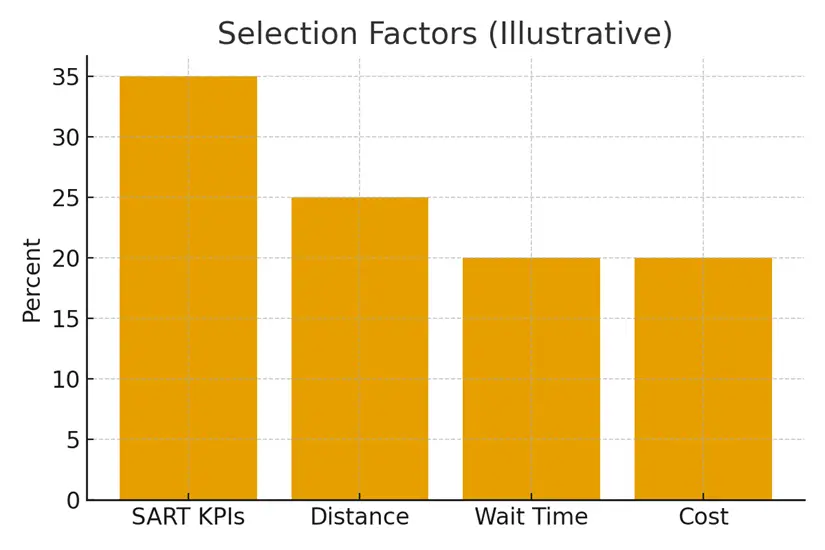
How to Choose the Right Fertility Clinic in New Jersey
1. Evaluate Success Rates
Look at metrics from SART/CDC including live birth rates per retrieval, age-group outcomes, and frozen embryo transfer success.
2. Assess Technology & Lab Quality
Clinics with on-site labs, advanced incubators, AI-assisted embryo selection, and preimplantation genetic testing often provide stronger outcomes.
3. Compare Treatment Approaches
Some clinics specialize in low-stimulation IVF, complex infertility cases, male-factor infertility, or egg freezing for fertility preservation.
4. Understand Costs & Insurance
New Jersey’s fertility mandate requires many insurers to cover infertility evaluation and treatment, but coverage varies by employer and plan.
5. Consider Patient Support Services
Look for:
- Mental health counseling
- Financial counselors
- Donor and surrogacy coordinators
- Bilingual staff
- Flexible scheduling
Case Study: A Couple’s Journey from Diagnosis to Delivery
Case Study: Nina & Arjun, Jersey City
After two years of trying to conceive naturally, Nina and Arjun began treatment at a well-known fertility clinic in Northern NJ. Initial bloodwork and a semen analysis revealed a combination of diminished ovarian reserve and mild male-factor infertility. Their doctor recommended IVF with ICSI and PGT-A.
On the first cycle, four blastocysts were tested—two came back normal. Their first frozen embryo transfer resulted in a healthy pregnancy, and their daughter was born in 2024.
Nina says the biggest advantage was the clinic’s integrated support system: “Our RE, nurses, and counselor made us feel cared for at every step.”
Testimonials
1. “The most compassionate team in NJ.” — Michelle, Princeton
“My IVF cycle felt less stressful because my clinic had excellent communication and transparent success rates.”
2. “Supportive from day one.” — Jonathan & Amir, Hoboken
“As a same-sex couple, we needed donor egg and gestational carrier coordination. The clinic made the process seamless.”
3. “Clear guidance, incredible results.” — Preeti, Edison
“After failed treatments elsewhere, switching to a New Jersey clinic with a better lab made all the difference.”
Expert Quote
“Choosing the right fertility clinic isn’t about finding the most famous—it’s about finding the one that aligns with your medical needs, emotional comfort, and long-term family goals.”
— Dr. A. Mehra, Reproductive Endocrinologist
Related Links
- ertility Clinics Near Me — Minneapolis–St. Paul (MN)
- Fertility Clinics Near Me — Denver (CO)
- Fertility Clinics Near Me — Toronto (ON)
- Fertility Clinics Near Me — Vancouver (BC)
Glossary
IVF: In vitro fertilization — combining egg and sperm in a lab.
IUI: Intrauterine insemination — placing sperm directly in the uterus.
PGT-A: Genetic testing to assess embryo chromosomal health.
Ovarian Reserve: A woman’s remaining egg supply.
ICSI: Intracytoplasmic sperm injection — injecting one sperm into one egg.
Blastocyst: A mature embryo ready for implantation.
Trigger Shot: Hormone injection to prepare the eggs for retrieval.
ERA: Endometrial Receptivity Analysis to optimize transfer timing.
Andrology: Male fertility diagnostic services.
Cryopreservation: Freezing eggs, sperm, or embryos for future use.
FAQ
Q. What fertility treatments are most common in New Jersey?
Ans. IVF, IUI, egg freezing, and donor cycles are among the most common treatments. Many New Jersey clinics also offer advanced services such as PGT, ERA testing, and AI-based embryo grading. With strong state mandates, more patients can access comprehensive care without prohibitive costs.
Q. Are fertility treatments covered by insurance in NJ?
Ans. New Jersey is one of the few states with a robust fertility mandate, requiring certain insurers to cover infertility evaluation, IUI, IVF, and some aspects of egg/sperm preservation. However, exemptions apply to small employers, religious groups, and some self-funded plans. Patients should request a detailed benefits review before starting treatment.
Q. How much does IVF cost in New Jersey?
Ans. IVF typically ranges from $12,000 to $18,000 per cycle, excluding medications. Medications add $4,000 to $7,000. PGT-A testing may cost an additional $3,000 to $6,000. Clinics may offer financing, packages, or refund guarantee programs.
Q. Is New Jersey a good state for egg freezing?
Ans. Yes. Many clinics use advanced vitrification methods, offer transparent packages, and have strong lab outcomes. Women in their 20s to early 30s often see the best results, but egg freezing is available across many age groups.
Q. What is the IVF success rate in NJ?
Ans. Success rates vary by clinic and patient age. Many clinics report 55–70% live birth rates for women under 35. Always review SART/CDC-published metrics to compare clinics accurately.
Q. Do clinics in NJ offer LGBTQ+ fertility services?
Ans. Yes. This includes donor sperm, donor eggs, reciprocal IVF, embryo creation, and surrogacy pathways. Many clinics work directly with LGBTQ+-friendly legal partners.
Q. How do I choose between IUI and IVF?
Ans. IUI is less invasive and more affordable but has lower success rates. IVF offers higher success, genetic testing options, and better control over embryo selection. Your doctor will recommend the best treatment based on age, diagnosis, and budget.
Q. Is surrogacy legal and accessible in New Jersey?
Ans. Yes. Since 2018, gestational surrogacy agreements are legal and well-regulated. Intended parents can work with clinics and surrogacy agencies to coordinate medical and legal steps.
Q. What should I expect at my first fertility consultation?
Ans. A typical consult includes medical history review, ultrasound, blood tests, and a semen analysis (if applicable). The doctor will outline treatment options, timelines, costs, and next steps.
Q. Do New Jersey clinics use advanced embryo selection technology?
Ans. Many clinics offer time-lapse incubators, AI-based embryo scoring, and next-generation sequencing for PGT. These tools help improve embryo selection and overall success rates.
Q. Are donor egg or donor sperm options available in NJ?
Ans. Yes. Clinics offer in-house donor programs, frozen donor banks, and third-party agency coordination. Donor transparency, screening, and FDA-compliant testing are standard.
Q. How long does the fertility process usually take?
Ans. Timelines vary. Diagnostic testing may take 2–4 weeks; IVF cycles often take 6–8 weeks; egg freezing cycles require 2–3 weeks of preparation. Surrogacy or donor involvement adds additional planning time.

Dr. Kulsoom Baloch
Dr. Kulsoom Baloch is a dedicated donor coordinator at Egg Donors, leveraging her extensive background in medicine and public health. She holds an MBBS from Ziauddin University, Pakistan, and an MPH from Hofstra University, New York. With three years of clinical experience at prominent hospitals in Karachi, Pakistan, Dr. Baloch has honed her skills in patient care and medical research.
- Dr. Kulsoom Baloch

- Dr. Kulsoom Baloch
- Dr. Kulsoom Baloch
- Dr. Kulsoom Baloch