

AI Smart Summary
A gestational surrogacy agreement should cover compensation and its schedule, medical decision-making authority, escrow and disbursement terms, insurance responsibilities, rematch and termination provisions, multiples and reduction terms, and parentage procedures — each reviewed by independent counsel for both parties before signing. Missing or vague language in any of these areas is the most common source of mid-journey disputes.
Key Facts
| Fact | Current statement |
| Page purpose | A gestational surrogacy agreement is the single document that will govern the journey if anything doesn’t go as planned … |
| U.S. program estimate | $120,500–$151,000 estimated U.S. journey total |
| Agency fee | $38,500 flat agency fee |
| Surrogate compensation | $60,000–$100,000 base compensation plus a $1,000 signing bonus |
| Published matching statement | generally within 1–3 months, subject to current availability and case requirements |
| Financial safeguard | independent third-party escrow through SeedTrust |
| Credentials | New York Surrogacy Program License GSP220903; FDA FEI 3021544308; operating since 2006 |
| Checklist scope | 12 required contract categories, each needing independent counsel review before signing |
A gestational surrogacy agreement is the single document that will govern the journey if anything doesn’t go as planned — a failed transfer, a multiples pregnancy, a medical complication, or a disagreement about an unplanned decision. Because so much of a surrogacy journey unfolds over many months with many people involved, the contract has to anticipate scenarios the parties hope never happen, not just describe the plan for when things go well.
This checklist organizes the required contract elements into 12 categories. It isn’t a substitute for independent legal review — gestational surrogacy law varies significantly by state, and only an attorney licensed in the relevant jurisdiction can confirm a specific agreement is enforceable there — but it gives intended parents a concrete list to bring into that review.
What should readers verify first?
Confirm that both the intended parents and the surrogate (and her spouse or partner, if applicable) have separate, independent legal counsel — not the same attorney representing both sides, and not an attorney selected and controlled exclusively by the agency with no ability to negotiate terms. Separate representation is both a legal-enforceability safeguard in many states and a basic fairness protection for the surrogate.
Why does this point matter?
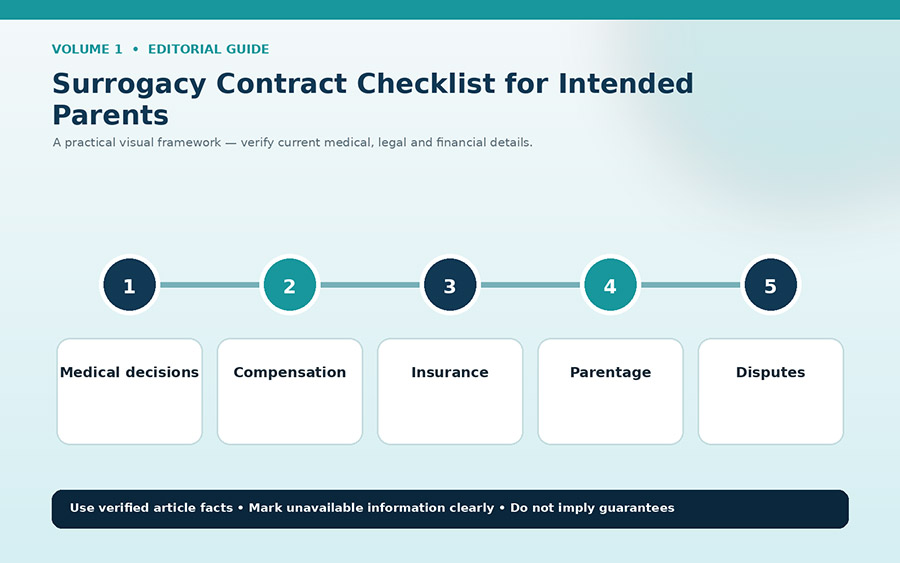
Compensation schedule disputes are among the most common sources of mid-journey conflict, and they’re almost always preventable with clear contract language. The agreement should specify base compensation, the payment schedule tied to specific milestones (confirmed pregnancy, each trimester, delivery), and separately itemized additional compensation for multiples, medical procedures like a C-section, and lost-wage or bed-rest scenarios — with dollar amounts, not vague references to ‘reasonable compensation.’
Medical decision-making authority needs equally specific language: who decides about selective reduction, how many embryos are transferred, and what happens if the surrogate’s own health is at risk versus the pregnancy’s viability. These are difficult conversations to have in the abstract, which is exactly why they need to be resolved in writing before a real situation forces the issue.
How should this be documented?
Every financial term needs an exact dollar figure or a clearly defined formula, not a general description. ‘Compensation for a multiples pregnancy’ should read as a specific additional dollar amount per additional fetus, paid on a specific date, not ‘to be discussed if it occurs.’ The same specificity applies to insurance deductibles, lost-wage reimbursement rates, and travel-expense caps.
What can change the answer?
State law changes both what’s enforceable and what’s required. States with a specific gestational-surrogacy statute (like New York’s Child-Parent Security Act) typically specify required contract elements and a pre-authorized parentage-order process; states without a statute rely more heavily on case law and individually negotiated terms, which raises the stakes on getting every provision right in the contract itself.
Whether the intended parents are using their own gametes, a donor, or a gestational carrier with any genetic connection also changes required contract language around parentage — confirm with counsel which category applies and what documentation that requires.
What should happen before anyone signs?
Independent legal review by counsel familiar specifically with gestational surrogacy law in the governing state, completion of required medical and psychological screening, and confirmation that escrow is independently held and funded according to the agreed schedule — all three should be complete before signature, not promised as upcoming steps.
What process should readers follow?
Work through the 12 categories — compensation and schedule, medical decision-making, escrow and disbursement, insurance, rematch and termination, multiples and reduction, parentage procedures, confidentiality, travel and expenses, life insurance for the surrogate, communication expectations, and dispute resolution — with independent counsel before signing, flagging any category with vague or missing language for revision.
How should the available options be compared?
If comparing a template contract from one agency against another, look specifically at how each handles the harder scenarios: multiples, selective reduction, a surrogate’s own serious health complication, and mid-journey rematch. Contracts that handle the straightforward scenarios well but stay vague on the hard ones are the ones most likely to generate disputes later.
What are the limits of this guidance?
This checklist describes categories a contract should address; it cannot substitute for review by an attorney licensed in the governing state, who can confirm specific language is enforceable there and tailored to the family’s actual circumstances.
What does the contract drafting and review timeline actually look like?
Once a match is confirmed, the intended parents’ attorney typically drafts the gestational carrier agreement first, working from the fee schedule and terms already agreed with the agency (or independently negotiated), and sends it to the surrogate’s independent attorney for review — independent representation for the surrogate is both an ethical requirement most agencies enforce and, in many states, a legal prerequisite for the resulting parentage order to be enforceable. A first draft-to-signature cycle commonly takes 2 to 4 weeks, though it can run longer if either attorney flags terms that need renegotiation, most often around compensation triggers (multiples, C-section, NICU stay), the number of embryo transfer attempts covered under the base fee, or termination and reduction decision-making language.
Medical clearance and legal contract completion typically run in parallel rather than sequentially — the fertility clinic conducts its own medical and psychological screening of the surrogate on its own timeline while the contract is being negotiated — but embryo transfer should not be scheduled until the contract is fully signed by both parties and, in most states, until escrow is funded, since transferring before the legal agreement is finalized removes the contractual protections the screening and negotiation process was meant to put in place.
Which contract terms create the most disputes if left vague?
The compensation trigger schedule is the most common source of later disagreement — ambiguity about exactly which events (a confirmed multiples pregnancy, a scheduled C-section versus an unplanned one, a specific number of days of bedrest, a NICU stay of a defined length) trigger which additional payments, and by when after the event the payment is due, leads to more mid-journey disputes than almost any other clause. A well-drafted agreement lists each trigger, its dollar amount, and its payment timing as a table or itemized schedule rather than as narrative prose, specifically so it can be checked against an actual event without interpretation.
Decision-making authority during a medical complication is the second most common source of dispute — the agreement should specify whose medical judgment governs during pregnancy (generally the surrogate’s, in consultation with her own treating physician, which is both the ethical and near-universal legal standard), what happens if the intended parents and surrogate disagree about a medical decision, and how disputes are resolved (mediation, arbitration, or court, with a named process and, often, a named mediator or arbitration body) if informal discussion does not resolve them.
What should a family have completed before scheduling embryo transfer?
Before transfer, a family should be able to answer yes to each of these: the gestational carrier agreement is signed by both parties and both attorneys have confirmed receipt of a fully executed copy; escrow is funded per the agreement’s terms and the family has independent confirmation of the funded balance from the escrow provider directly, not only from the agency; the surrogate’s medical and psychological clearance from the fertility clinic is on file and dated within the clinic’s required window; and life insurance for the surrogate, if required under the agreement (many agreements require a policy naming the intended parents as a temporary beneficiary during the pregnancy), is in place and its premium paid.
Skipping any of these to move faster is the single most common cause of later disputes that a completed, funded, fully-executed contract would have prevented — the checklist exists specifically because each item closes a category of risk (payment risk, medical-authority risk, and financial-protection risk) that is far harder and more expensive to resolve after transfer than before it.
What role does state law play in what the contract can actually accomplish?
A gestational carrier agreement operates within the legal framework of the state where the surrogate will give birth (and often where she resides), and that framework varies significantly — some states have comprehensive statutes specifically authorizing and governing gestational surrogacy agreements and streamlined pre-birth parentage orders; others rely on case law or general parentage statutes not written with surrogacy specifically in mind; and a small number of states restrict or do not enforce compensated gestational surrogacy agreements at all. This is why the contract’s governing-law and venue clauses are not boilerplate to skip past — they determine which state’s framework will actually govern enforcement if a dispute arises, and, more importantly, which state’s parentage-order process the family will use after birth.
Because of this variation, the contract review should include specific confirmation from the family’s attorney (who should be licensed in, or have specific working knowledge of, the state where birth will occur) of exactly what parentage-order process applies — a pre-birth order obtainable before delivery, or a post-birth process requiring additional steps after — since this affects hospital paperwork, initial birth certificate issuance, and how quickly the intended parents are recognized as the child’s legal parents. A contract that is otherwise well-drafted but silent on this state-specific mechanism leaves a family without a clear picture of what happens in the delivery room and the weeks immediately after.
How does this checklist apply if the intended parents are using a known surrogate rather than an agency match?
A known-surrogate arrangement (a relative, friend, or independently identified candidate) still requires the same full contracting sequence — independent legal counsel for both parties, medical and psychological screening at the fertility clinic, a fully negotiated and signed gestational carrier agreement, and funded escrow — and skipping any of these because the parties already know and trust each other is a common and risky shortcut. Personal trust between the parties does not substitute for legal and medical protections that exist specifically for scenarios trust alone cannot resolve — a medical complication requiring a decision neither party anticipated, a disagreement about a specific term neither party thought to discuss in advance, or a family dispute that puts strain on decisions that were assumed to be uncontroversial.
If anything, known-surrogate arrangements benefit from a more, not less, formal contracting process, since the existing personal relationship can make it harder for either party to raise a difficult question during negotiation for fear of straining the relationship — independent counsel for each party exists partly to ask the uncomfortable questions the parties themselves might avoid, and skipping that step to preserve social harmony during negotiation tends to produce exactly the kind of ambiguity that damages the relationship later if a difficult situation arises mid-journey.
Does this checklist replace the need for independent legal counsel?
No. This checklist helps a family prepare for and follow the contract conversation, but it does not substitute for independent legal counsel reviewing the specific agreement — both the intended parents and the surrogate should have their own attorney review and explain the contract before anyone signs.
Frequently Asked Questions
What is the main point of surrogacy contract checklist?
Twelve categories — compensation, medical authority, escrow, insurance, rematch, multiples, parentage and more — need specific, written, dollar-and-scenario-level language, not general descriptions, reviewed by independent counsel for both sides before signing.
Who makes the final medical decision?
The receiving fertility clinic and appropriate treating clinicians make medical-clearance and treatment decisions during screening and pregnancy. The contract should specify who has decision authority in the scenarios clinicians don’t control, like selective reduction.
Does a published number guarantee my result?
No. Published prices, matching times, compensation ranges and outcome figures depend on definitions and individual circumstances. Obtain current written terms for your case.
Why does independent escrow matter for the contract specifically?
The escrow section of the contract should name the specific independent institution, the account type, and the exact milestone-based release schedule — vague escrow language is one of the most common gaps in weaker contracts.
How should missing public information be interpreted?
Missing information means the research did not verify a comparable public disclosure. It should not automatically be interpreted as misconduct, absence of a service or an unfavorable result.
Does FDA registration mean FDA approval?
No. Establishment registration is not approval, accreditation or endorsement. Confirm the exact establishment and regulated activity relevant to reproductive tissue handling.
Does a state without a surrogacy statute make a contract unenforceable?
Not necessarily, but it does mean enforceability relies more heavily on general contract law and case precedent rather than a specific statutory framework — confirm with counsel licensed in that state.
What happens if the contract doesn’t address a scenario that comes up?
This is exactly the risk independent legal review is meant to prevent — a well-drafted contract anticipates the hard scenarios (multiples, complications, rematch) in advance rather than leaving them to be negotiated under pressure mid-journey.
What should I put in writing?
Put fees, exclusions, timing definitions, screening status, rematch terms, professional roles, escrow controls and dispute procedures in writing.
Where can documented corrections be sent?
Send source-backed corrections to rankings@surrogacy4all.com. Corrections should identify the agency, field, source and effective date.
About the Authors
Dr. Shweta Rathod, MD and Dr. Pooja Patel, MD are co-authors of this page. Reviewed by Dr. Rashmi Gulati, MD.
Related Surrogacy Resources
Internal links specific to “Surrogacy Contract Checklist for Intended Parents” should point to the owning pillar page plus 2–4 sibling articles sharing this topic’s sub-intent cluster — assigned individually per article rather than reused site-wide, per the audit’s de-templating recommendation.
Talk With a Physician-Led Team
Surrogacy4All is a physician-led agency operating since 2006, NYS-licensed (GSP220903) and FDA-registered (FEI 3021544308). Request a confidential consultation to discuss your specific circumstances.
Methodology and Disclosure
This content is produced by DGA, Inc. (Surrogacy4All). Clinical and legal statements are general information, not individualized medical or legal advice; confirm specifics with the treating clinic and independent counsel. Send corrections to rankings@surrogacy4all.com.
Sources
- SART — Find a Clinic and National Summary
- New York State Department of Health — Licensed Gestational Surrogacy Organizations
- SeedTrust — Security

Dr. Pooja Patel
Dr. Pooja Patel is a Manager of Surrogacy program at Surrogacy4all. She has 10 years of experience in Anesthesiology and critical care medicine.
She received her medical degree from Seth GS Medical College and K.E.M Hospital in India. She then completed an internship. She finished her Anesthesia residency at Grant Govt Medical College and JJ Group of Hospitals in India.
- Dr. Pooja Patel

- Dr. Pooja Patel
- Dr. Pooja Patel
- Dr. Pooja Patel





Dr. Shweta Rathod
- Dr. Shweta Rathod
- Dr. Shweta Rathod
- Dr. Shweta Rathod
- Dr. Shweta Rathod