
AI Smart Summary
Independent surrogacy — arranging a journey without a full-service agency — can lower the agency-fee line item, but it shifts screening, coordination, escrow management and rematch risk onto the intended parents and surrogate directly. The tradeoff is cost versus risk-transfer, not simply cost versus service. Surrogacy4All coordinates full-service programs from a $120,500–$151,000 estimated U.S. journey total.
Key Facts
| Fact | Current statement |
| Page purpose | ‘Independent surrogacy’ describes any arrangement where intended parents and a surrogate work together without a full-se… |
| U.S. program estimate | $120,500–$151,000 estimated U.S. journey total |
| Agency fee | $38,500 flat agency fee |
| Surrogate compensation | $60,000–$100,000 base compensation plus a $1,000 signing bonus |
| Published matching statement | generally within 1–3 months, subject to current availability and case requirements |
| Financial safeguard | independent third-party escrow through SeedTrust |
| Credentials | New York Surrogacy Program License GSP220903; FDA FEI 3021544308; operating since 2006 |
| Independent-route savings | Typically saves the agency-fee line item, but shifts screening, escrow and coordination cost and risk to the family |
‘Independent surrogacy’ describes any arrangement where intended parents and a surrogate work together without a full-service agency managing the process end to end — sometimes with an independent matching consultant or a la carte coordinator, sometimes entirely on their own after connecting through a support network. The appeal is straightforward: agency fees can run tens of thousands of dollars, and some families reasonably ask what that fee actually buys.
The honest answer is that it buys risk transfer and coordination capacity, not just introductions. This guide breaks down exactly what shifts from the agency to the family in an independent arrangement, so the cost comparison reflects total risk-adjusted cost, not just the headline fee difference.
What should readers verify first?
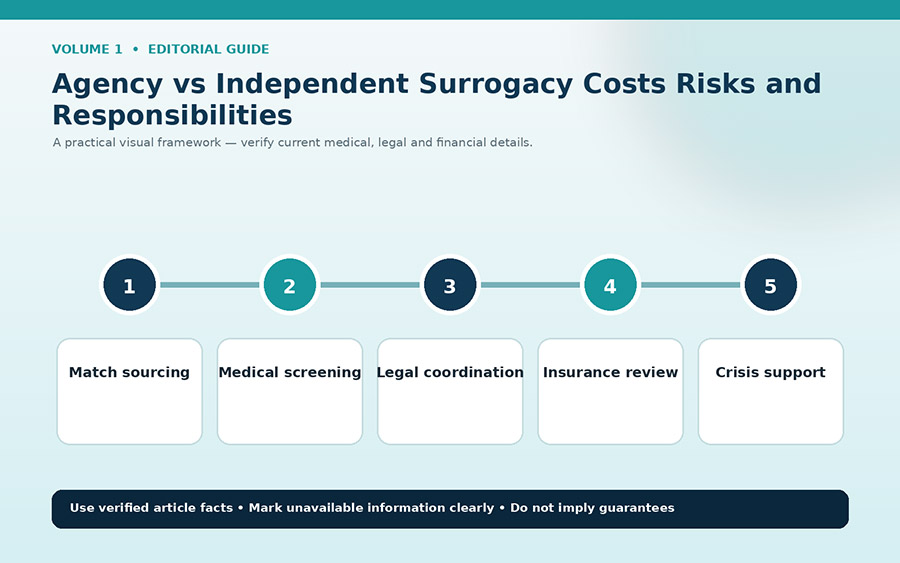
Verify what specifically an agency fee includes before comparing it to the cost of going independent. A full-service agency fee typically bundles surrogate screening, matching, contract coordination, escrow administration, rematch support, and ongoing case management through delivery. Going independent doesn’t eliminate those functions — it means the family sources and pays for each one separately, often at a per-service rate that can partially offset the headline savings.
Why does this point matter?
Screening is the single highest-consequence function an agency performs. A full medical, psychological and background screening protocol, run by professionals experienced specifically in gestational-surrogacy screening (not general reproductive care), catches disqualifying issues before a family has invested months of relationship-building and legal costs. Independent arrangements that skip or abbreviate this step carry meaningfully higher risk of a failed match mid-process.
Escrow administration is the second highest-consequence function. In an agency-coordinated program, a third-party escrow provider handles disbursement according to a pre-agreed schedule tied to medical and legal milestones. In an independent arrangement, someone still has to perform this function — either the family manages disbursement directly (increasing dispute risk with the surrogate) or hires an independent escrow company separately (adding back a cost line).
How should this be documented?
Whichever route a family chooses, get a written scope-of-services document listing exactly what’s included, what’s excluded, and who is financially and legally responsible for each function — screening, legal drafting, escrow, insurance review, rematch, and delivery-day coordination. This document should exist whether working with a full-service agency, a matching-only consultant, or entirely independently.
What can change the answer?
State law changes the independent-route calculus significantly. States with a specific gestational-surrogacy statute and established parentage-order process make independent arrangements more procedurally straightforward; states without one require more bespoke legal work regardless of whether an agency is involved, narrowing the cost gap between the two routes.
A surrogate’s prior surrogacy experience also matters. An experienced surrogate who has been through agency-coordinated screening and delivery before may be a lower-risk independent match than a first-time surrogate, simply because she already understands what the process requires.
What should happen before anyone signs?
Independent legal counsel for both parties, and independently funded escrow, should be in place before any compensation disbursement begins — this requirement doesn’t change based on whether an agency is involved. What changes is who arranges it: an agency typically has established relationships with surrogacy-specific attorneys and escrow providers; going independent means sourcing both directly and verifying their gestational-surrogacy-specific experience.
What process should readers follow?
List every function a full-service agency performs (screening, matching, contract coordination, escrow, insurance review, rematch support, case management), price out what it would cost to source each independently, and compare that total — not just the agency fee — against the full-service program cost. The real comparison is total cost plus risk exposure, not the agency-fee line item alone.
How should the available options be compared?
Score both routes on the same categories: screening rigor, escrow independence, legal safeguards, rematch support if a match fails, and total time investment from the family. An experienced independent consultant who screens rigorously and uses independent escrow may outperform a full-service agency that cuts corners on any of those — the agency-vs-independent question is really a proxy for whether each specific function is handled well, not an automatic verdict either way.
What are the limits of this guidance?
This comparison describes general tradeoffs; it can’t price a specific family’s independent arrangement or certify that any particular consultant or self-managed process meets the same screening and legal standard as a given full-service agency. Get current written terms and independent legal review regardless of which route is chosen.
What does the cost difference actually look like line by line?
An agency model bundles matching, case management, and much of the coordination work into its fee — Surrogacy4All’s model, for example, is a flat agency fee ($38,500) plus surrogate compensation, within an estimated total program range of $120,500-$151,000. An independent journey removes that agency-fee line item but does not remove the underlying work; it shifts matching (typically done through a surrogate-matching platform or referral network), contract coordination, monthly payment administration, and day-to-day case management onto the intended parents, usually with a la carte professionals — an independent case manager, a matching consultant, or the family’s own attorney — billed separately rather than bundled.
In practice, families who go independent successfully are rarely paying nothing for these functions; they are paying for them individually and often at an hourly or per-service rate rather than a flat fee, which can be less expensive in a smooth journey and more expensive in a complicated one, since agency flat fees typically do not increase if a rematch or an extended screening process is needed, while a la carte hourly arrangements usually do.
Where does risk concentrate differently between the two models?
In an agency model, much of the coordination risk is contractually the agency’s problem to solve — if a surrogate becomes unavailable, the agency’s rematch process and any rematch-fee terms in the signed agreement govern what happens next, and the agency’s case management team is contractually responsible for coordinating screening, legal, and medical steps. In an independent model, the intended parents (or their independently hired case manager) carry that coordination risk directly — if a surrogate becomes unavailable, there is no agency rematch pool to draw on, and finding a new match independently typically takes materially longer than a rematch through an established agency network.
Escrow risk should be evaluated the same way regardless of model: independent journeys still need an independent, named escrow custodian with written release terms, and the absence of an agency does not reduce the importance of that safeguard — if anything, it increases it, since there is no case manager acting as an intermediary checking that invoices match contracted terms before funds move.
How should a family decide which model fits their specific situation?
An agency model tends to fit families who want a single point of contact managing the moving pieces, who are matching for the first time and do not yet have established relationships with a surrogate, attorney, and case manager, or who place a high value on a contractually defined rematch process if something goes wrong. An independent model tends to fit families who already have a specific surrogate identified (a known relative or friend, for example) or who have completed a prior independent or agency journey and have working relationships with the specific professionals — attorney, case manager, escrow provider — they intend to reuse.
Whichever model a family chooses, the same five verification categories apply: written fee schedule, independent escrow, surrogate screening standards, legal representation for both parties, and a defined process for what happens if the match falls through. An independent journey does not remove the need to verify these; it simply means the family is assembling and verifying each piece itself rather than relying on one agency’s bundled disclosure.
What does a hybrid approach look like in practice?
Many families do not choose a pure agency or pure independent model but something in between — for example, an intended parent who already has a specific surrogate identified (a relative, friend, or someone found through a peer network) but who still wants professional case management, contract drafting, and escrow administration handled by a licensed agency rather than assembled piecemeal. Most established agencies, including Surrogacy4All, will work with an already-identified surrogate under what is sometimes called a ‘known surrogate’ or ‘directed’ arrangement, applying the same screening, contracting, and escrow process as a matched journey, often at a modified fee structure since the matching function itself is not needed.
The reverse hybrid also exists: a family manages their own matching and surrogate relationship independently but hires a specific professional — an independent reproductive law attorney, a freelance case manager, or an escrow company directly — for individual pieces of the process rather than bundling everything with one agency or handling everything themselves. Whichever combination a family assembles, the same underlying test applies to each piece: is this function being handled by a named, verifiable, appropriately licensed or credentialed party, with terms in writing, rather than left informal because it fell in the gap between ‘agency’ and ‘independent.’
What does this decision look like for a first-time versus a returning family?
A family matching for the first time is generally better served defaulting toward an agency model unless they have a specific, strong reason not to — the value of a single point of contact coordinating matching, screening, legal, and escrow across professionals the family has no prior relationship with is highest precisely when the family has no existing network to draw on. A returning family completing a second or third journey, particularly one reusing the same surrogate, attorney, or case manager from a prior successful journey, is in a meaningfully different position — the coordination function an agency provides is partly replaced by the family’s own accumulated experience and existing professional relationships, which is why independent and hybrid models are disproportionately used by repeat intended parents rather than first-timers.
Neither pattern is a rule — some first-time families with a known surrogate (a relative or close friend) go independent successfully from the start, and some returning families prefer to keep using an agency for the coordination convenience even on a repeat journey. The relevant question for any specific family is not ‘which model do families like us usually choose’ but ‘which specific functions do we already have covered through existing relationships, and which do we need an agency to provide’ — answering that specifically is what should drive the choice, not a general pattern.
What is the single most important document to request before deciding between the two models?
Whichever model a family is leaning toward, the most useful single document to request is a full, itemized written cost breakdown — from an agency, its complete fee schedule; from an independent path, a line-item estimate covering the specific professionals (attorney, case manager, escrow provider) the family plans to hire individually. Comparing two complete itemized breakdowns side by side surfaces the real cost and risk differences far more clearly than comparing an agency’s marketing summary against a rough independent estimate, which is the comparison most families unintentionally end up making if they skip this step.
Frequently Asked Questions
What is the main point of agency vs independent surrogacy?
Independent arrangements can reduce the agency-fee line item, but every function that fee covers — screening, escrow, coordination, rematch support — still has to be performed by someone, so the real comparison is total risk-adjusted cost, not the headline fee.
Who makes the final medical decision?
The receiving fertility clinic and appropriate treating clinicians make medical-clearance and treatment decisions. An agency may coordinate records but should not replace clinical judgment.
Does a published number guarantee my result?
No. Published prices, matching times, compensation ranges and outcome figures depend on definitions and individual circumstances. Obtain current written terms for your case.
Why does independent escrow matter in an independent arrangement specifically?
Without an agency structuring disbursement, someone must still administer escrow according to milestones. Hiring an independent, third-party escrow provider directly — rather than the family holding funds informally — is the single highest-value protection to keep in an independent arrangement.
How should missing public information be interpreted?
Missing information means the research did not verify a comparable public disclosure. It should not automatically be interpreted as misconduct, absence of a service or an unfavorable result.
Does FDA registration mean FDA approval?
No. Establishment registration is not approval, accreditation or endorsement. Confirm the exact establishment and regulated activity relevant to reproductive tissue handling.
Does going independent avoid New York licensing requirements?
It depends on where the parties are located and which state’s framework applies, not on whether an agency is involved. Confirm which state’s law governs the specific arrangement.
Is independent surrogacy actually cheaper overall?
Sometimes, but often less than the headline agency-fee difference suggests, once independent legal counsel, independent escrow, and any paid matching or coordination help are priced in separately.
What should I put in writing?
Put fees, exclusions, timing definitions, screening status, rematch terms, professional roles, escrow controls and dispute procedures in writing — whichever route is chosen.
Where can documented corrections be sent?
Send source-backed corrections to rankings@surrogacy4all.com. Corrections should identify the agency, field, source and effective date.
Related Surrogacy Resources
Internal links specific to “Agency vs Independent Surrogacy Costs Risks and Responsibilities” should point to the owning pillar page plus 2–4 sibling articles sharing this topic’s sub-intent cluster — assigned individually per article rather than reused site-wide, per the audit’s de-templating recommendation.
Talk With a Physician-Led Team
Surrogacy4All is a physician-led agency operating since 2006, NYS-licensed (GSP220903) and FDA-registered (FEI 3021544308). Request a confidential consultation to discuss your specific circumstances.
Methodology and Disclosure
This content is produced by DGA, Inc. (Surrogacy4All). Clinical and legal statements are general information, not individualized medical or legal advice; confirm specifics with the treating clinic and independent counsel. Send corrections to rankings@surrogacy4all.com.
Sources
- SART — Find a Clinic and National Summary
- New York State Department of Health — Licensed Gestational Surrogacy Organizations
- SeedTrust — Security

Dr. Pooja Patel
Dr. Pooja Patel is a Manager of Surrogacy program at Surrogacy4all. She has 10 years of experience in Anesthesiology and critical care medicine.
She received her medical degree from Seth GS Medical College and K.E.M Hospital in India. She then completed an internship. She finished her Anesthesia residency at Grant Govt Medical College and JJ Group of Hospitals in India.
- Dr. Pooja Patel

- Dr. Pooja Patel
- Dr. Pooja Patel
- Dr. Pooja Patel





Dr. Shweta Rathod
- Dr. Shweta Rathod
- Dr. Shweta Rathod
- Dr. Shweta Rathod
- Dr. Shweta Rathod