
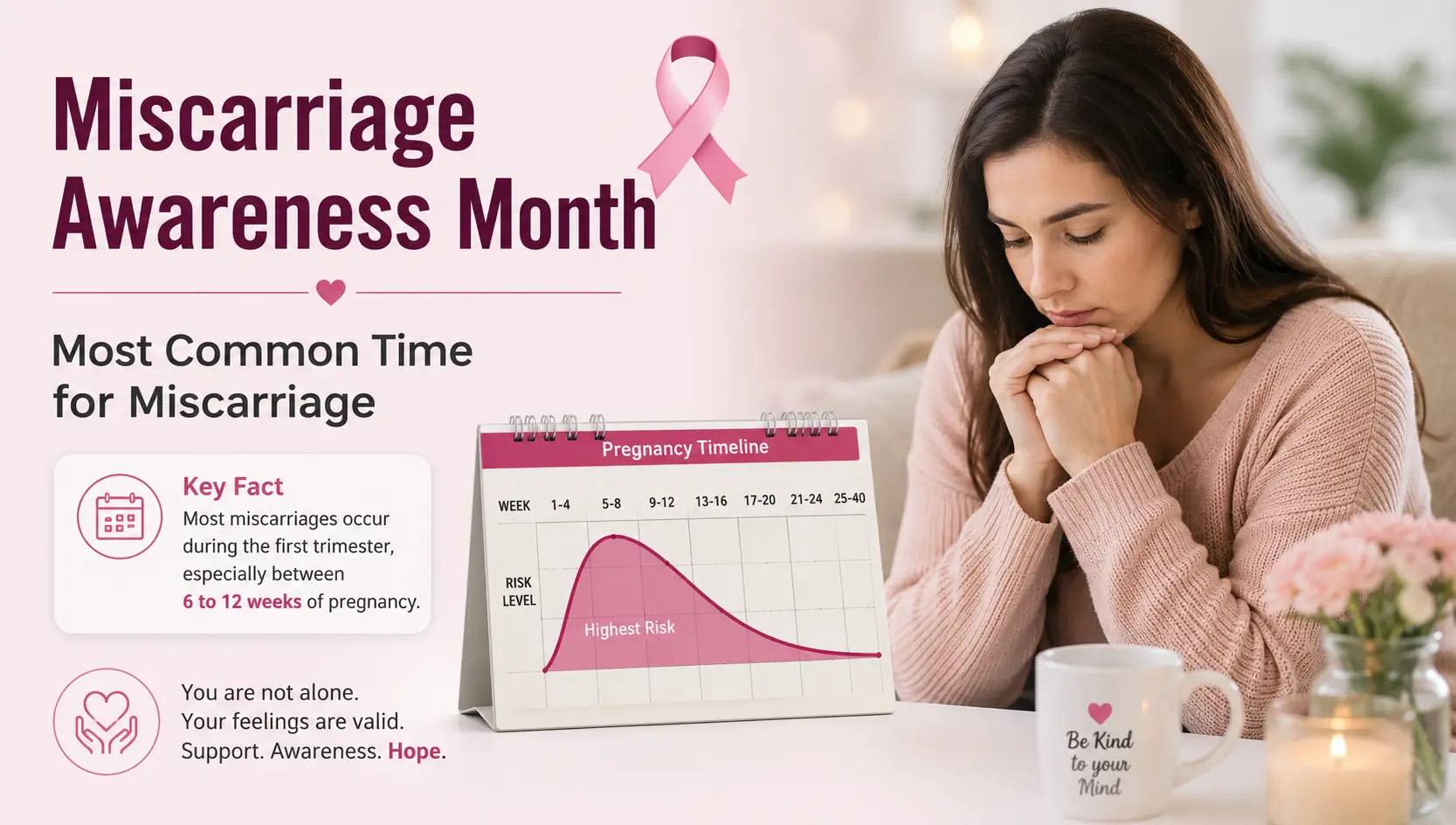
Miscarriage Awareness Month is an important time to spread understanding, support and compassion for those who have experienced pregnancy loss. Many people go through a miscarriage but may feel alone, confused or unsure about what happened. Learning about when miscarriages are most common, what symptoms to look for and what recovery may involve can help people feel more informed and supported.
When Is the Most Common Time for Miscarriage?
The most common time for miscarriage occurs during the first trimester. This is especially in the initial 12 weeks during pregnancy. Early pregnancy brings about a variety of developmental changes, and occasionally the pregnancy could end abruptly due to issues related to the chromosomes of the infant, or other causes beyond our control.
Many miscarriages occur very early on, even before a person might know they are pregnant. Although all miscarriages can be emotionally difficult, it might be reassuring to know that early miscarriage is quite common and that feelings of guilt and self-blame are also common.
What Percentage of Pregnancies End in Miscarriage?
Many people wonder what percentage of pregnancies end in miscarriage. Medical estimates suggest that about 10% to 20% of known pregnancies end in miscarriage. The actual number may be higher because some very early losses happen before pregnancy is confirmed.
A miscarriage is usually not caused by everyday activities, exercise, stress or something a person did. In many cases, it happens because the pregnancy was not developing normally.
Miscarriage at 6 Weeks: What to Expect
Every woman may experience a miscarriage at 6 weeks differently. Some women may experience symptoms such as a heavy menstrual period. Other women may have only some signs. Symptoms can include:
Possible symptoms may include:
- Vaginal bleeding or spotting
- Lower abdominal cramping
- Passing tissue or fluid
- A decrease in pregnancy symptoms
However, mild cramping or spotting isn’t necessarily a sign that you’re having a miscarriage. A lot of healthy pregnancies have bleeding early, which is why it’s essential to speak with your doctor for a thorough evaluation.
Common Signs of Miscarriage
The signs of miscarriage can be different for everyone. Common symptoms may include:
- Heavy vaginal bleeding
- Strong or worsening abdominal cramps
- Passing clots or pregnancy tissue
- Sudden loss of pregnancy symptoms
Others may also have emotional changes, such as sadness, anxiety or grief. If you’re worried about your symptoms or your pregnancy, talking to a healthcare professional can help ease your mind and provide support.
Understanding a Missed Miscarriage
missed miscarriage occurs when the pregnancy ceases to develop; however, the body doesn’t immediately exhibit the typical symptoms of a miscarriage. One may feel pregnant, as hormone levels may remain elevated for a period of time.
Many people ask: How often is it that a miscarriage is missed? It’s believed to happen in a tiny proportion of pregnancies. It is usually discovered in an ultrasound exam in which no heartbeat or growth is observed.
Women may find it particularly difficult to cope with a missed miscarriage, as there may be no indication that anything is wrong. Ultrasounds and prenatal care enable healthcare providers to monitor the pregnancy’s development.
Recovery After a Miscarriage
The time it takes to recover from a miscarriage physically varies from person to person. Bleeding can last for several days to weeks and hormone levels slowly return to normal. Most people get their cycle back in about 4 to 8 weeks, when it’s time for a period after a miscarriage. Timing, however, can differ depending on the person and stage of pregnancy.
Your first period following a miscarriage could differ from usual, with variations in flow, cramps or length.
How Long After a Miscarriage Can You Try Again?
It is a question that is frequently asked. In many instances, couples are able to conceive when they are physically and emotionally fit and have discussed their situation with a medical professional.
There isn’t a single timeframe that is suitable for all. Certain people are ready in a short time, and others require longer to recover emotionally. Both of these experiences are common.
Pregnancy After Miscarriage
The fact that you have a miscarriage doesn’t mean that you can’t be a healthy mother in the near future. A lot of women get pregnant after losing.
Having a miscarriage does not mean that you are not going to be a healthy mother soon. Many women get pregnant after losing. Pregnancy after miscarriage is an emotional roller coaster of excitement and worry. “Open communication with a healthcare provider and the right prenatal care can help you find reassurance and support along the way.”
Can Plan B Cause a Miscarriage?
Can Plan B cause a miscarriage? Related Questions. The short answer is no. Plan B and other forms of emergency contraception will not cause a miscarriage or terminate an existing pregnancy. It stops or postpones ovulation before conception. If you are already pregnant, Plan B will not affect an existing pregnancy. If you have concerns about pregnancy, contraception or miscarriage, talking to a health professional can help clear up confusion.
People Basically Asked:
Q. How do I know if I’m having a miscarriage?
A. The signs of miscarriage could be vaginal bleeding, intense cramps in the lower belly, and passing tissue. But bleeding in early pregnancy could occur without being a miscarriage. Therefore, a medical professional can confirm the cause.
Q. Can low progesterone cause miscarriage?
A. Low progesterone could affect certain pregnancies; however, it is not the only reason that a miscarriage could occur. The reason for early miscarriages is that the pregnancy isn’t developing normally, typically due to circumstances beyond control.
Q. When does implantation bleeding occur?
A. Implantation bleeding usually occurs 1-2 weeks after ovulation when the fertilized egg implants into the uterus. It’s usually just a light spotting that often lasts for a short time.
Q. How long do you bleed after a miscarriage at 6 weeks?
A. Bleeding after miscarriage at 6 weeks varies from person to person. Some may bleed for a few days; some may have light bleeding or spotting for a couple of weeks as the body heals.
Q. What is a D&C procedure for miscarriage?
A. One procedure that can be used to remove the tissue of a pregnancy from the uterus after a miscarriage is a D&C (dilation and curettage). It may be recommended for retained tissue, heavy bleeding or risk of infection.
Q. What are the signs of miscarriage at 6 weeks?
A. Signs of miscarriage at 6 weeks may include vaginal bleeding, cramping, lower back pain, passing clots or tissue and a sudden decrease in pregnancy symptoms. Some people may have no noticeable symptoms.
Q. Is there a way to estimate my personal chance of miscarriage by week?
A. A miscarriage calculator can show the general probability of miscarriage by week based on published research. It’s a helpful starting point for understanding patterns, not a personal prediction for your pregnancy.
Q. How soon after a miscarriage can you get pregnant?
A. Ovulation may return shortly after a miscarriage, which means it is possible to have a baby before the next period occurs. A lot of women can attempt again if they feel emotionally and physically well. However, it’s always best to discuss timing with your health professional.
Q. Does miscarriage risk by week decrease as pregnancy progresses?
A. Yes. Miscarriage risk by week is usually highest early on and drops once a heartbeat is confirmed. A miscarriage calculator can show this general trend, but your provider knows your specific situation best.
Q. Can surrogacy help after experiencing repeated miscarriages?
A. Experiencing repeated miscarriages can be emotionally challenging. For intended parents who are unable to carry a pregnancy safely, surrogacy may be a possible family-building option. Surrogacy4All helps families explore their options and provides support throughout the journey. To learn more, call (212) 661-7673.
Final Wording
Miscarriage can be a deeply emotional experience, but understanding the facts can help people feel less alone. During miscarriage awareness month period after miscarriage, sharing accurate information and offering support can make a meaningful difference for those affected by pregnancy loss.
If you have experienced a miscarriage or have concerns about your pregnancy, remember that support is available and you do not have to go through it alone.

Dr. Veera Saghar
As an Egg Donor Coordinator, she plays a critical role in our company. Her background as a medical graduate from ISRA UNIVERSITY in Pakistan provides us with a solid foundation in the medical sciences. She has seven years of clinical experience practicing in the USA. This has given her firsthand experience when collaborating with patients and their families.
She is responsible for managing the process of egg donation from start to finish. We identify and screen potential egg donors.
- Dr. Veera Saghar

- Dr. Veera Saghar
- Dr. Veera Saghar
- Dr. Veera Saghar