Key Takeaways
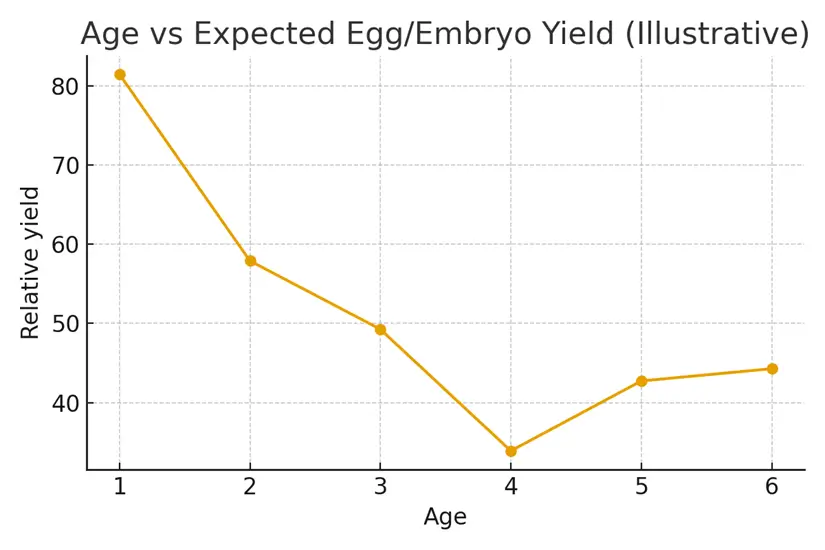
- Fertility declines sharply after 40 — banking eggs or embryos early gives more options for a second child.
- Age affects egg quality more than egg quantity; early banking improves success rates.
- Embryo banking allows multi-cycle planning and reduces stress later.
- For many at 42–45+, donor eggs and surrogacy become strong pathways — early planning widens choices.
- A strategic plan (testing, banking, budgeting, legal readiness) supports better outcomes.
- The sooner you bank, the more flexibility you have for spacing between children.
Planning a second child after 42 is a very different journey from planning the first. Even if your first pregnancy was natural or uncomplicated, age-related fertility changes accelerate quickly after 40 — and “waiting to see what happens” often reduces your available options.
This article explains why banking now (eggs or embryos) is the most secure step for families considering a second child later in their 40s or early 50s. We break down timelines, realistic expectations, available pathways, success rates, financial implications, and emotional readiness — all grounded in honest numbers.
The Fertility Curve Changes Rapidly After 40
Biologically, age 42–45 is a tipping point:
- Natural conception rates decline significantly
- Miscarriage rates rise (50–80% depending on embryo genetics)
- Egg quality issues increase
- IVF success rates drop dramatically without banking or donor support
What does this mean for a second baby?
You need more lead time, more embryos, and more cycles to reach the same outcome you might have reached easily a few years earlier.
Egg vs. Embryo Banking: Which Works Better at 42+?
Egg Banking (Solo or Pre-Partner)
Best when:
- You’re not ready for a second pregnancy yet
- You don’t have a partner
- You want to delay transfer by several years
Limitations:
- Eggs at 42+ have lower fertilization and blastocyst formation rates
- May require multiple cycles to generate viable eggs
Embryo Banking (More Predictable)
Best when:
- You have a partner
- You want more reliability
- You want to test embryos (PGT-A)
Advantages:
- Embryos reflect real, not theoretical, success potential
- Helps with planning for donors, surrogacy, or timing
- Allows for multi-cycle accumulation (“embryo stacking”)
Six-Month, One-Year, and Two-Year Plans for Second Child at 42+
6-Month Plan — Immediate Banking
For parents who want a second child soon (6–18 months).
Steps:
- Full diagnostics: AMH, AFC, semen analysis, uterine evaluation
- IVF stimulation
- Egg/embryo banking
- Optional PGT
- Prepare transfer or next cycle
12-Month Plan — Multi-Cycle Banking + Flexibility
For those uncertain about timing or wanting more embryos.
Steps:
- 2–3 retrieval cycles spaced apart
- Embryo testing
- Financial + emotional planning
- Build timeline for transfer or surrogacy
18–24-Month Plan — For Surrogacy Consideration or Late 40s Planning
Steps:
- Embryo banking
- Selecting surrogacy country
- Legal contracts
- Surrogate matching
- Transfer
- Pregnancy care monitoring
Case Study — Banking Early Made the Second Baby Possible
Profile:
- Woman, 42 when first child was 1 year old
- AMH 0.6, irregular cycles
- First pregnancy was natural
- Wanted a second baby at 44+
What She Did
- Month 1–2: Completed fertility testing
- Month 3–4: IVF cycle → 4 eggs → 1 blastocyst (PGT-abnormal)
- Month 5–6: Second cycle → 7 eggs → 2 blastocysts (1 normal)
- Month 7–12: Banked remaining embryo; paused to evaluate timelines
Outcome:
At age 44, she transferred the PGT-normal embryo and conceived. Banking at 42–43 gave her the chance she wouldn’t have had at 44–45.
Testimonials
Rhea, 43 — India
“I waited too long after my first pregnancy. Banking embryos at 42 gave me a real option for my second baby.”
Danielle, 45 — USA
“I had no idea how fast things change after 40. My advisor helped me bank 3 embryos in a year. Now we’re planning a surrogate pregnancy.”
Lina & Marco — Italy
“The banking plan helped us manage expectations. We knew each step, cost, and timeline. No surprises — just clarity.”
Expert Quote
“The second child planning window is narrower than most people realize.
Banking early protects your future options and removes the pressure to race against age.”
— Dr. R. Gulati, Fertility & Cross-Border Care Specialist
Related Links
- Mini‑IVF vs Conventional
- Banking Strategy — How Many Retrievals to Plan
- When to Move to Donor or Embryo Donation
- Managing Diminished Ovarian Reserve — Practical Steps
Glossary
AMH: Hormone indicating egg reserve level.
AFC: Antral Follicle Count; ultrasound-based measurement of follicles.
PGT-A: Genetic screening to identify chromosomally normal embryos.
Embryo Banking: Creating and freezing multiple embryos for future use.
Egg Quality: Genetic health and developmental potential of eggs.
Surrogacy: Gestational carrier carries the pregnancy.
Ovarian Stimulation: Medications to grow multiple eggs for IVF.
EU/US Surrogacy Programs: Legal frameworks with screening and protections.
Blastocyst: Embryo developed to Day 5/6 of growth.
Advanced Maternal Age: Pregnancy planning age 35+; more complex after 40.
FAQ (10–12 Questions With Long Answers)
Q. Why is banking so important for second child planning at 42+?
Ans. Because egg quality declines rapidly between ages 40–45. Banking captures your current fertility rather than your future fertility — which will almost always be lower. Embryo numbers drop sharply after 43, so banking early preserves options, even if you want a bigger age gap between children.
Q. Can I get pregnant naturally at 42 or 43?
Ans. Yes, it is possible, but the odds are low. Natural conception rates decline to 5% or less per cycle, and miscarriage rates rise sharply. Banking reduces dependence on monthly chance and gives a reliable backup.
Q. How many eggs do I need for one healthy embryo at 42?
Ans. On average, women at 42 may need 10–20 eggs to get one normal embryo, depending on ovarian reserve. This usually means 2–3 IVF cycles for realistic family planning.
Q. Should I bank eggs or embryos if I’m considering a second child?
Ans. Considering :
- Embryos are more predictable and testable through PGT.
- Eggs offer future flexibility but come with more uncertainty at 42+.
If possible, embryos are recommended — especially for second child planning.
Q. What if I don’t have a partner yet?
Ans. Egg freezing is the right pathway until you’re ready for embryo creation. You can convert frozen eggs into embryos later.
Q. Can I wait until 44 or 45 to bank?
Ans. You can — but success rates drop drastically. Most clinics recommend banking by 42–43 if you want the possibility of a genetically related second child.
Q. Is surrogacy a common backup for second children over 40?
Ans. Yes. Many families choose surrogacy after banking embryos, especially if they experienced complications in a first pregnancy or are medically advised to avoid carrying again.
Q. How do finances change for second child planning at 42+?
Ans. You should plan for:
- Multi-cycle IVF
- PGT testing
- Potential donor egg decision
- Potential surrogacy pathway
Banking now reduces costs later because you avoid age-related decline cycles.
Q. How long does embryo banking take?
Ans. Usually 2–6 months, depending on number of cycles.
Many parents bank embryos during the toddler years of their first child, ensuring future flexibility.
Q. Are donor eggs a strong option for second child at 42+?
Ans. Yes. Donor egg IVF has success rates above 50–70% per transfer and is often recommended at 43–45+. Many parents bank both their own embryos and donor options.
Q. Should I try one natural cycle before IVF at 42 or 43?
Ans. You’re free to, but most experts recommend evaluating ovarian reserve first. Natural attempts don’t preserve fertility for later; banking does.
Q. What if my partner’s sperm quality is low?
Ans. Sperm issues become more common after 40 in men as well. ICSI, lifestyle shifts, supplements, and freezing sperm early can help stabilize outcomes.
Ready to take the next step? Call Surrogacy4All at (212) 661-7673 or email info@surrogacy4all.com to book your consultation.

Dr. Veera Saghar
As an Egg Donor Coordinator, she plays a critical role in our company. Her background as a medical graduate from ISRA UNIVERSITY in Pakistan provides us with a solid foundation in the medical sciences. She has seven years of clinical experience practicing in the USA. This has given her firsthand experience when collaborating with patients and their families.
She is responsible for managing the process of egg donation from start to finish. We identify and screen potential egg donors.
- Dr. Veera Saghar

- Dr. Veera Saghar
- Dr. Veera Saghar
- Dr. Veera Saghar