
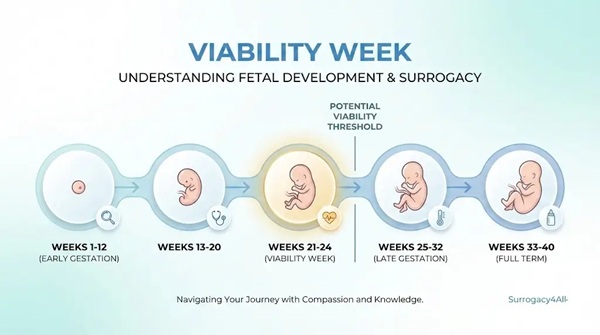
Fetal Viability Week by Week: When Can a Baby Survive Outside the Womb?
Quick Answer: What Is the Viability Week?
Viability week refers to the stage of pregnancy when a fetus may have a chance of surviving outside the uterus with medical support. In most cases, doctors discuss fetal viability around 23 to 24 weeks of pregnancy, although survival depends on several factors, including the baby’s development, birth weight, overall health, and the quality of neonatal care available.
Viability is not a fixed point where every baby has the same outcome. Every pregnancy is different, and doctors consider multiple medical factors before making decisions about care.
FAST FACTS
| Fact | Value |
|---|---|
| Conventional viability | 24 weeks |
| Periviable period (ACOG/SMFM) | 22w0d – 25w6d |
| Survival at 24 weeks | ≈ 55–70% with active treatment (NICHD NRN) |
| Survival at 28 weeks | ≈ 90–95% |
| Author / reviewer | Shweta Rathod, MD / Rashmi Gulati, MD |
| License / registration | GSP220903, FDA FEI #3021544308 |
| Locations | New York, Toronto, Accra |
Survival by week of gestation
| Week | Approx. survival with active treatment | Notes |
|---|---|---|
| 21 | < 5% | Intensive treatment rarely offered |
| 22 | 10–30% | Offered at some Level IV NICUs; depends heavily on center |
| 23 | 30–55% | Steroids and NICU level matter most here |
| 24 | 55–70% | Conventional viability threshold |
| 25 | 70–80% | |
| 26 | 80–90% | |
| 27 | ~90% | |
| 28 | 90–95% | Survival without major complications ≈ 80% |
| 32 | > 95% | |
| 34+ | ≈ 99% | “Late preterm” |
What Does Viability Week Mean in Pregnancy?
Many expecting parents hear the term viability week during pregnancy discussions, especially when there are concerns about early delivery or complications.
Fetal viability means the possibility that a baby could survive outside the womb after birth with the help of medical care, such as support from a neonatal intensive care unit (NICU).
Before this stage, the organs and body systems are usually not developed enough to support life independently. As pregnancy progresses, important developments take place, especially in the lungs, brain, and other vital organs.
However, viability does not mean the baby is fully developed or ready for birth. A baby born around the viability stage may require intensive medical support.
What Week Is Considered the Viability Week?
There is no single week when every pregnancy suddenly becomes viable. Doctors usually consider viability based on gestational age along with other health factors.
Pregnancy Development Around Viability
| Pregnancy Week | General Development |
| Before 22 weeks | Survival outside the womb is extremely unlikely |
| Around 22–23 weeks | Some babies may survive with advanced medical care, but outcomes vary significantly |
| Around 24 weeks | Survival chances generally improve with intensive newborn care |
| 26 weeks and beyond | Babies usually have stronger development and improved outcomes |
These timeframes are general estimates. A healthcare provider evaluates each situation individually.
How Do Doctors Determine Fetal Viability?
Doctors do not use only the pregnancy week to determine viability. They look at several important factors that influence the baby’s chances after birth.
1. Gestational Age
The number of weeks of pregnancy is one of the most important factors. As the pregnancy progresses, organs such as the lungs and brain continue developing.
2. Baby’s Weight at Birth
A higher birth weight is often associated with better outcomes because larger babies may have more developed body systems.
3. Lung Development
Basically, the lungs play a crucial role in survival after birth. Babies born very early may require breathing support because their lungs are still developing.
4. Overall Health and Development
Doctors also consider factors such as growth patterns, medical complications, and the baby’s condition before and after delivery.
5. Available Medical Care
Advanced NICU facilities && specialized newborn care can significantly influence outcomes for premature babies.
Viability Week vs Full-Term Pregnancy: What Is the Difference?
Many people confuse viability with a healthy full-term pregnancy, but they are very different.
Viability means a baby may have a chance of survival outside the womb with medical assistance.
A full-term pregnancy usually means the baby has completed enough development to be born around the expected delivery period.
A baby born during the viability period is considered extremely premature and may need weeks or months of specialized medical care.
Why Does Viability Differ From One Pregnancy to Another?
Two babies born at the same pregnancy week may have different outcomes because every pregnancy develops differently.
Factors that can influence viability include:
- Baby’s growth and weight
- Genetic or developmental conditions
- Pregnancy complications
- Mother’s health conditions
- Access to specialized newborn care
This is why doctors avoid making decisions based only on the pregnancy week.
What Happens If a Baby Is Born Around the Viability Week?
A baby born near the viability stage may need advanced medical support, including:
- Breathing assistance
- Temperature regulation
- Feeding support
- Monitoring for infections and complications
Many premature babies require specialized NICU care until they become stronger and can maintain important body functions independently.
Can a Baby Survive Before the Viability Week?
Survival before the commonly discussed viability period is extremely rare and depends on many circumstances.
Medical technology continues to improve, but earlier births generally involve greater challenges because critical organs may not yet be sufficiently developed.
Doctors focus on providing accurate information based on the individual pregnancy rather than relying only on a specific week number.
Why Understanding Viability Week Matters for Expecting Parents
Learning about viability can help parents better understand pregnancy development and medical decisions during complicated situations.
However, viability is not about a single number on a calendar. It involves understanding:
- The baby’s development
- The mother’s health
- Possible risks
- Available treatment options
Healthcare providers use this information to guide families through difficult decisions with care and medical expertise.
Frequently Asked Questions
Q. What week is viability in pregnancy?
A. About 24 weeks is considered the conventional threshold for viability. However, active neonatal care may be offered from 22–23 weeks at some hospitals, depending on the hospital’s resources and periviability program.
Q. When is viability week?
A. The 24th week of pregnancy is the conventional viability threshold. The periviable period is generally defined as 22 weeks 0 days through 25 weeks 6 days.
Q. What is the survival rate at 24 weeks?
A. Approximately 55–70% of babies born at 24 weeks may survive with active treatment in a Level III or Level IV NICU. Outcomes vary based on the baby’s condition, birth weight, treatments provided, and the hospital’s experience.
Q. What is the survival rate at 22 weeks?
A. Survival at 22 weeks is approximately 10–30% in centers where active treatment is offered. Many hospitals make individualized decisions about whether intensive treatment is appropriate at this gestational age.
Q. When is a fetus viable?
A. A fetus is considered viable when there is a possibility of survival outside the womb with intensive neonatal care. In practice, this generally begins around 22–24 weeks, although outcomes vary significantly from one pregnancy and medical center to another.
Q. What is the age of viability?
A. 24 weeks is commonly considered the conventional age of viability. Some hospitals with specialized periviability programs may offer active treatment at 22–23 weeks.
Q. Is a baby born at 25 weeks likely to survive?
A. Yes. With active neonatal treatment, survival at 25 weeks is approximately 70–80%, although babies born this early can still face complications associated with extreme prematurity.
Q. At 28 weeks, is the baby safe?
A. Survival at 28 weeks is approximately 90–95% with appropriate neonatal care. However, being born at 28 weeks is still considered very preterm, and complications related to prematurity remain possible.
Q. Does viability apply to IVF pregnancies differently?
A. No. The general principles of viability are the same for IVF pregnancies. However, gestational dating is particularly precise in IVF, because the pregnancy can be dated using the embryo transfer date and embryo age. Single-embryo transfer can also reduce the risk of multiple pregnancy and associated early preterm birth.
Q. Can a fetus survive at 20 or 21 weeks?
A. Survival at 20–21 weeks is extremely rare. Most hospitals do not routinely offer intensive neonatal treatment at these gestational ages because the likelihood of survival is very low.
Q. What is the earliest a baby has survived?
A. Case reports of survival at 21 weeks have been published, but survival at this gestational age remains extremely rare. Most hospitals do not routinely offer intensive treatment at 21 weeks.
Q. Why is 24 weeks considered the viability threshold?
A. Around 24 weeks, survival with active neonatal care reaches approximately 50% or higher in some large U.S. cohorts. This has contributed to 24 weeks becoming the conventional threshold for viability, although decisions are individualized.
Q. What are the long-term outcomes at 23–24 weeks?
A. Long-term outcomes vary considerably. Among survivors born at 23–24 weeks, some have no or only mild impairment, while others experience moderate to severe complications. Outcomes generally improve with each additional week of pregnancy.
Q. Do steroids help before 24 weeks?
A. Yes. Antenatal corticosteroids may improve outcomes for babies born extremely preterm, including at 22–23 weeks when active neonatal treatment is planned. The timing and use of steroids should be determined by the obstetric and neonatal care teams.
Q. How is gestational age calculated in IVF?
A. In IVF pregnancies, gestational age is calculated using the embryo transfer date and the age of the embryo at transfer. For example, a blastocyst transferred at five days of development is incorporated into the pregnancy dating calculation, making IVF gestational dating highly precise.
Q. Is viability different for twins?
A. The basic viability principles are similar, but twins are more likely to be born prematurely. Survival at a particular gestational age can be similar, while the overall risk of a periviable birth is higher in twin pregnancies.
Q. What is the difference between viability and full term?
A. Viability refers primarily to the possibility of surviving outside the womb with medical support and is conventionally around 24 weeks. Full term refers to a pregnancy reaching 39–40 weeks, when the baby is considered mature enough for normal delivery timing.
Q. What is a Level IV NICU?
A. A Level IV NICU provides the highest level of neonatal intensive care and has advanced medical, surgical, and subspecialty capabilities. These centers are generally best equipped to care for babies born at extremely early gestational ages, including those in the 22–24-week range.
Q. How do doctors decide whether to resuscitate at 22 weeks?
A. The decision is individualized and made together with the parents and medical team. Factors may include gestational age, estimated birth weight, the baby’s condition, antenatal steroid treatment, sex, and the hospital’s experience and periviability program.
Q. Does every baby become viable at the same week?
A. No. Viability differs between pregnancies because factors like development, birth weight, health conditions, and medical care availability all play a role.
Building your family through IVF or surrogacy?
Written by Shweta Rathod, MD — Doctor of Medicine with clinical experience in Obstetrics & Gynecology, labor room management, and IVF. Dr. Rathod writes pregnancy and obstetric content for Surrogacy4All.
Medically reviewed by Rashmi Gulati, MD — Board Certified in Internal Medicine and Medical Advisor at Surrogacy4All, with privileges at Mount Sinai Hospital.
Last updated: 27 Aug 2026

Rashmi Gulati
Rashmi Gulati, MD, provides innovative, individualized health care that nurtures mind, body, and spirit. Since 2004 she has been the medical director at Patients Medical, where she delivers comprehensive personalized health care, treating each patient as a respected, unique individual. Through their integrative health care center in the heart of Manhattan, Dr. Gulati and her colleagues have become premier care providers serving patients locally and throughout the world.
- Rashmi Gulati

- Rashmi Gulati
- Rashmi Gulati
- Rashmi Gulati