
Most intended parents who come to us planning a surrogacy journey have already thought hard about their gestational carrier. Far fewer have thought equally hard about the embryo that carrier will receive — and that is where many journeys quietly go wrong.
If you need donor eggs, you have three broad ways to get to a transfer-ready embryo: a fresh donor egg cycle, a frozen donor egg cohort from an egg bank, or a guaranteed blastocyst program. Each one puts the biological risk of the IVF process in a different place, and each carries a very different price tag by the time you have embryos in the freezer. Understanding where that risk sits — and who absorbs it — should shape the order in which you spend money on your journey.
Why Embryo Strategy Comes Before Surrogate Strategy
Eggs do not guarantee embryos, and embryos do not guarantee a live birth. IVF is a funnel: eggs must survive, fertilize, divide, and reach the Day-5 or Day-6 blastocyst stage before any transfer can happen. Some drop out at every step.
In a surrogacy journey, this funnel matters more than it does in a conventional IVF cycle, because a gestational carrier is waiting on the other end. Agency matching, legal contracts, medical screening of the carrier, and escrow funding all move forward on the assumption that a viable embryo exists. When it does not, the carrier’s cycle stalls, contracts may need to be extended, and costs accrue without progress.
Our clinical guidance is simple: know what you are transferring before you commit to the person who will carry it. The three pathways below are the ways to get there.
Option 1: Fresh Donor Egg Cycle
What you are purchasing
In a fresh cycle, you sponsor a selected donor’s ovarian stimulation and retrieval, and you receive every egg produced from that cycle. Yields vary with the donor, but a strong young donor can produce fifteen to twenty-five or more eggs.
Advantages
A fresh cycle produces the largest pool of genetic material. If the retrieval goes well, you may end up with several blastocysts from a single donor — enough for a first transfer, a frozen backup, and potentially genetic siblings in the future. For intended parents who know they want more than one child from the same donor, fresh remains the pathway that makes that possible.
Drawbacks
It is also the most exposed option. The donor may respond poorly to medication, the cycle may be cancelled, or egg quality may fall short of expectations. When that happens, the intended parents carry the financial loss and must decide whether to fund another cycle. Fresh cycles also require coordination between donor, clinic, and (if transferring fresh) carrier, which adds calendar complexity to an already demanding process.
Fit for surrogacy
Best suited to intended parents with flexible budgets, a desire for multiple children from one donor, and the patience to absorb a possible restart before surrogate matching begins.
Option 2: Frozen Donor Egg Cohort
What you are purchasing
Frozen donor eggs have already been retrieved, screened, and vitrified at an egg bank. They are sold in small lots — commonly six to eight eggs per cohort.
Advantages
Speed and flexibility. There is no donor stimulation to wait on and no cycle synchronization. The eggs can be shipped to your clinic and fertilized on your schedule, and the entry price is lower than funding a full fresh retrieval.
Drawbacks
The funnel works against small cohorts. Each egg must survive the thaw, fertilize (typically via ICSI), and develop for five to six days. Starting from six or eight eggs, it is statistically possible to end a cycle with a single blastocyst — or none. Any PGT-A genetic testing is at your own cost and risk, and if the cohort fails you purchase another.
Fit for surrogacy
A reasonable choice for intended parents who want a single child, prefer a faster start, and are prepared to purchase a second cohort if the first underperforms. The risk is that a carrier match is made, then paused while more eggs are sourced.
Option 3: Guaranteed Blastocyst Program
What you are purchasing
A guaranteed blastocyst program moves the laboratory risk from you to the provider. Rather than buying raw eggs, you contract for a defined number of Day-5 blastocysts. If eggs fail to fertilize or arrest before the blastocyst stage, the program thaws and fertilizes additional eggs at its own expense until the contracted number is reached.
Through our affiliated program at EggDonors4All, the package is priced at $49,900 and guarantees a minimum of three Day-5 blastocysts.
Advantages
Predictability. You know the number of embryos you will have before a surrogate is matched, which means the carrier’s cycle can be scheduled with confidence. It also removes much of the early-IVF anxiety that intended parents describe as the hardest part of the process.
Drawbacks
Donor selection is typically narrower than a bespoke fresh cycle, and you will not accumulate the large surplus of embryos that an exceptional fresh retrieval can produce. Program terms — what counts as a guaranteed blastocyst, whether genetic testing is included, and how the guarantee is fulfilled — should be reviewed carefully in the contract. EggDonors4All explains eligibility in detail in who should and shouldn’t choose guaranteed blastocysts.
Fit for surrogacy
In our clinical experience, this is the pathway we most often recommend for surrogacy journeys. Having a confirmed set of blastocysts in hand before agency matching means you are not retaining a carrier while waiting on a laboratory outcome.
What Each Pathway Costs Through Embryo Creation
The figures below cover everything from donor selection to frozen blastocysts. They do not include surrogate compensation, agency fees, legal work, or the embryo transfer itself — see our surrogacy cost guide for those.
Fresh Donor Egg Cycle: roughly 38,000–65,000
- Donor compensation: 8,000–15,000
- Donor agency/matching fee: 8,000–15,000
- Donor medical and psychological screening: 2,500–5,000
- Donor medications and monitoring: 4,000–7,000
- IVF retrieval, ICSI, and embryo culture: 12,000–18,000
- PGT-A testing (optional, per batch): 3,000–6,000
- Embryo freezing and first year of storage: 1,000–2,000
The range is wide because donor compensation and agency fees vary with donor experience and location. The figure assumes one successful retrieval; a cancelled or poor-yield cycle adds most of these costs again.
Frozen Donor Egg Cohort: roughly 22,000–40,000 per cohort
- Egg cohort (6–8 eggs) from an egg bank: 14,000–24,000
- Shipping and clinic receiving fees: 500–1,500
- Thaw, ICSI, and embryo culture: 5,000–9,000
- PGT-A testing (optional): 3,000–6,000
- Embryo freezing and storage: 1,000–2,000
The lower entry price is real, but so is the repeat risk. If a cohort produces no blastocyst, the second cohort costs roughly the same again, which can push total spend past a fresh cycle.
Guaranteed Blastocyst Program: $49,900 for a minimum of three Day-5 blastocysts
- Package fee (minimum three Day-5 blastocysts): $49,900
- Additional eggs thawed and fertilized if early embryos arrest: included
- Embryo storage beyond the included period: 500–1,500 per year
At first glance the package costs more than a single frozen cohort. But it is the only one of the three pathways where the number is the number. If embryos arrest on Day 3, the program thaws and fertilizes additional eggs at its own expense until three Day-5 blastocysts are reached. There is no second-cohort or second-cycle line item, and no scenario in which you have spent the money and have nothing to transfer. For surrogacy sequencing, that fixed outcome is what allows carrier matching to proceed on a known timeline.
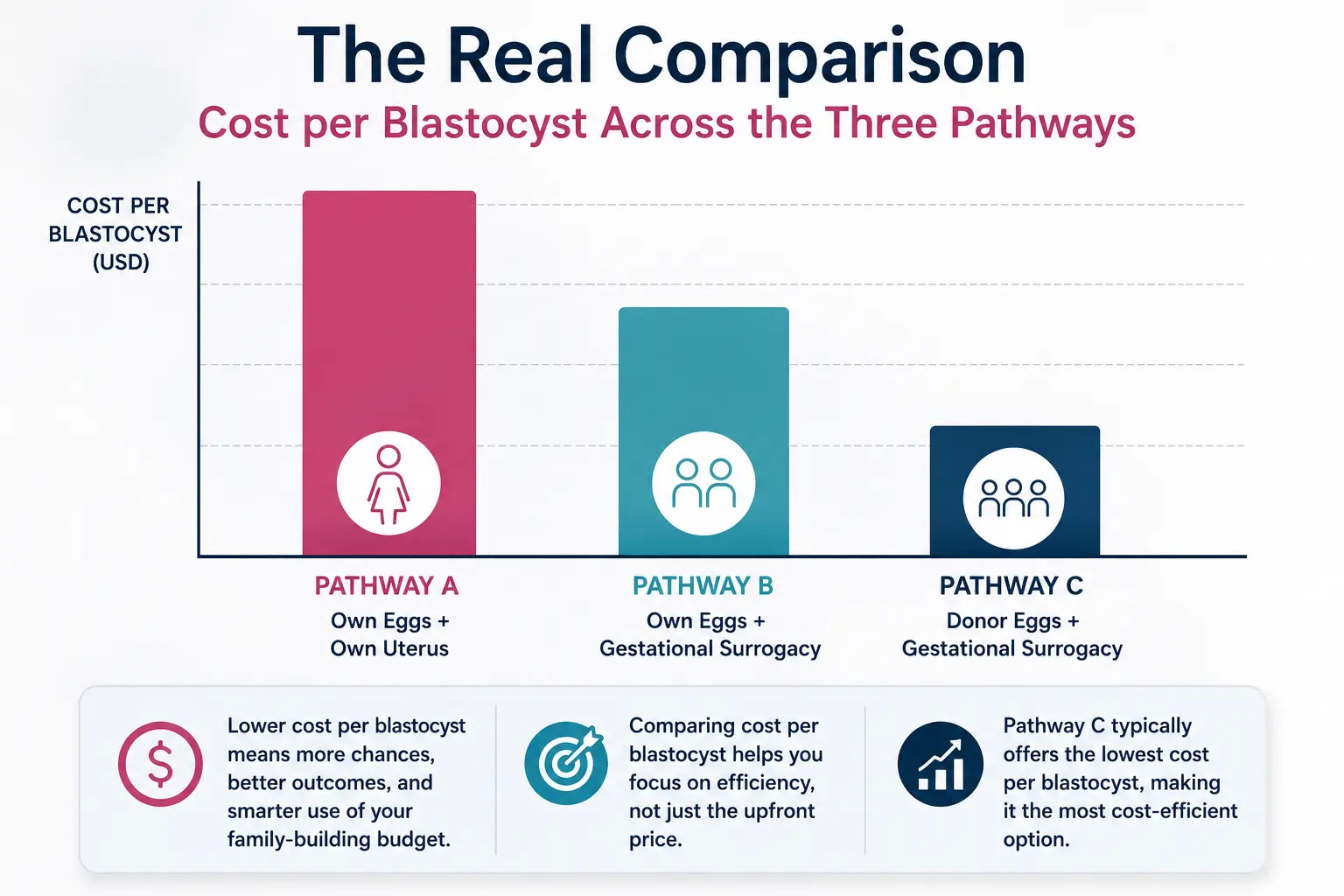
The Real Comparison: Cost Per Confirmed Embryo
The headline price is less useful than the cost per blastocyst you actually end up with. A $30,000 frozen cohort that yields one blastocyst costs $30,000 per embryo; if it yields none, the cost is open-ended until you buy again. The $49,900 guaranteed package for a minimum of three Day-5 blastocysts works out to roughly $16,600 per embryo — with no failure scenario. A $50,000 fresh cycle that yields five blastocysts is $10,000 per embryo, but only if the retrieval goes well; a poor-yield cycle can leave you at $50,000 for one or two.
That is why budget predictability, not the lowest sticker price, is usually the right lens for intended parents who are about to commit to a gestational carrier.
Fresh and frozen estimates reflect typical U.S. pricing as of 2026 and vary by clinic and donor. Guaranteed blastocyst pricing is the current EggDonors4All package rate.
Side-by-Side Comparison
| Factor | Fresh Donor Eggs | Frozen Egg Cohort | Guaranteed Blastocyst (EggDonors4All) |
| What you buy | All eggs from one retrieval | Batch of 6–8 frozen eggs | Minimum three Day-5 blastocysts |
| Typical yield | High (15–25+ eggs) | Low (6–8 eggs) | Guaranteed 3+ blastocysts |
| Est. cost through embryos | 38K–65K | 22K–40K per cohort | $49,900 flat |
| Approx. cost per blastocyst | 10K–25K (yield-dependent) | 15K–40K+ (yield-dependent) | ~$16,600 (fixed) |
| Who carries attrition risk | Intended parents | Intended parents | Program provider |
| Cost if first attempt fails | Most costs repeat | Full cohort cost repeats | None — provider absorbs |
| Timeline | Longest | Fastest start, may need repeat | Predictable once contracted |
| Best for | Multiple children, large embryo bank | One child, fast start, risk tolerance | Budget certainty, surrogacy sequencing |
How This Decision Affects Your Surrogacy Timeline
Think of the journey as two parallel tracks: embryo creation and carrier matching. The mistake we see most often is starting both at full speed simultaneously.
A fresh or frozen egg pathway with an uncertain outcome is best run ahead of matching, with matching beginning only once blastocysts are confirmed. A guaranteed blastocyst program, because its output is contractually defined, allows matching to begin earlier with far less risk of a stalled carrier.
For a full picture of how matching and screening unfold, see our overview of the surrogacy process. For budget planning beyond the embryo, our surrogacy cost guide covers agency fees, carrier compensation, and escrow in detail.
Questions to Ask Before You Choose
- How many children do we hope to have from this donor, now and in the future?
- If the first cycle fails, can we absorb the cost and delay of a second?
- Do we want PGT-A screening, and do we want its cost built in or separate?
- Has our surrogacy agency confirmed it will wait for embryo confirmation before matching?
- What exactly does a program guarantee, and how is the guarantee fulfilled if early embryos arrest?
A Physician-Led Perspective
Surrogacy4All is a physician-led, New York State–licensed gestational surrogacy program (License GSP220903) and has worked with intended parents since 2006. Because our clinical team sees the embryo side and the carrier side of the same journey, we can help you sequence the two so that neither waits on the other.
If you are deciding between donor eggs and a guaranteed blastocyst program before starting a surrogacy journey, speak with our clinical team at (212) 661-7673 or visit us at 1148 Fifth Avenue, Suite 1C, New York, NY 10128.
This article is for educational purposes and is not a substitute for individualized medical advice.
Explore More:

Dr. Pooja Patel
Dr. Pooja Patel is a Manager of Surrogacy program at Surrogacy4all. She has 10 years of experience in Anesthesiology and critical care medicine.
She received her medical degree from Seth GS Medical College and K.E.M Hospital in India. She then completed an internship. She finished her Anesthesia residency at Grant Govt Medical College and JJ Group of Hospitals in India.
- Dr. Pooja Patel

- Dr. Pooja Patel
- Dr. Pooja Patel
- Dr. Pooja Patel