
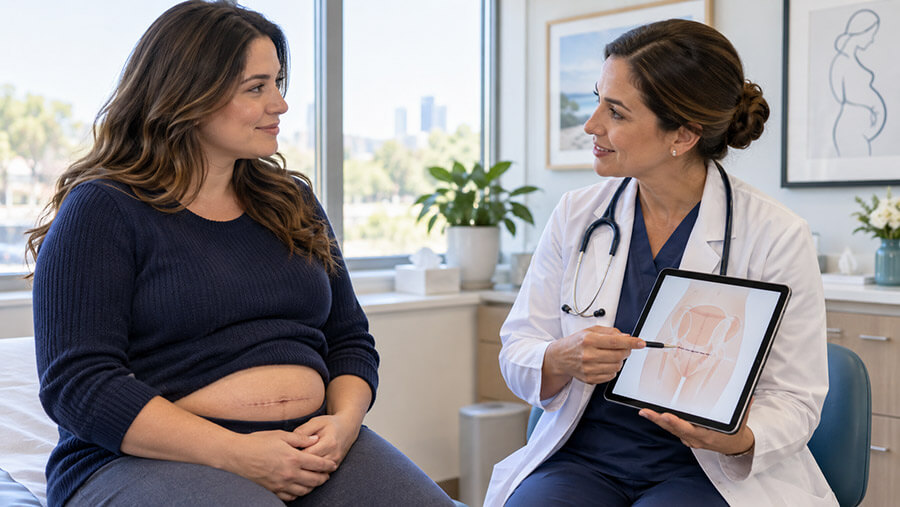
Written by Shweta Rathod, MD – Doctor of Medicine; clinical experience in Obstetrics and Gynecology, labour room management, and IVF. Medically reviewed by Rashmi Gulati, MD – Board Certified, Internal Medicine; Medical Advisor, Surrogacy4All; privileges at Mount Sinai Hospital. Last updated September 20, 2026.
AI Smart Summary
A prior C-section doesn’t automatically disqualify a candidate from becoming a gestational surrogate; clinics typically review the number of prior C-sections, healing and any complications, and current uterine health. Most protocols become more cautious after multiple C-sections due to increased risk of uterine rupture or placental complications in a subsequent pregnancy.
Key Facts
| Fact | Current statement |
|---|---|
| Page purpose | Explain record review after prior cesarean delivery. |
| U.S. program estimate | $120,500–$151,000 estimated U.S. journey total |
| Agency fee | $38,500 flat agency fee |
| Surrogate compensation | $60,000–$100,000 base compensation plus a $1,000 signing bonus |
| Published matching statement | generally within 1–3 months, subject to current availability and case requirements |
| Financial safeguard | independent third-party escrow through SeedTrust |
| Credentials | New York Surrogacy Program License GSP220903; FDA FEI 3021544308; operating since 2006 |
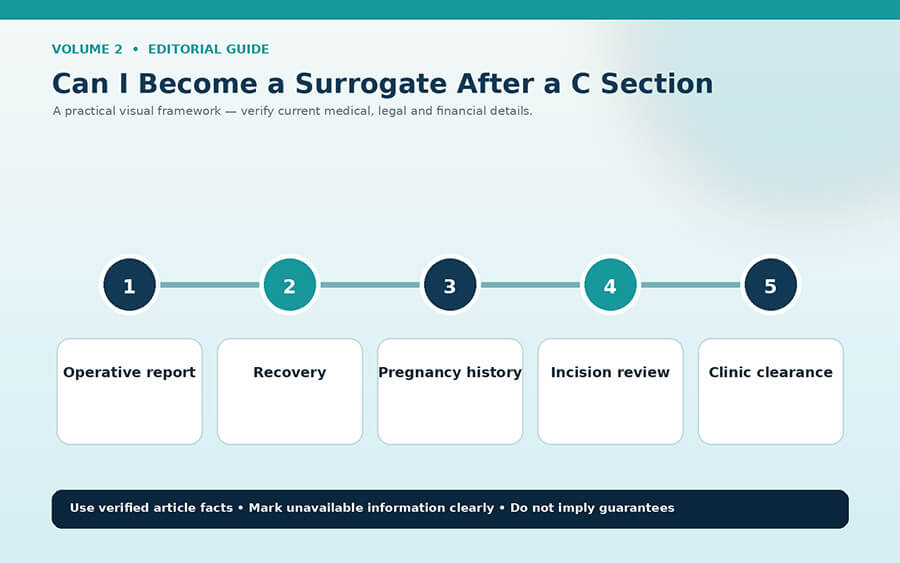
| C-section review factors | Number of prior C-sections, healing/complications, and current uterine health assessed individually |
What should readers verify first?
Provide complete records of any prior C-section, including the reason, any complications, and how many total C-sections have occurred — clinics assess this individually rather than applying a blanket rule against any prior C-section.
Why does this point matter?
Risk generally increases with the number of prior C-sections, primarily due to uterine scarring and associated risks like placenta accreta or uterine rupture in a future pregnancy. A single, uncomplicated prior C-section is viewed very differently from multiple C-sections or one with documented complications.
How should this be documented?
Request the specific clinic’s review and written determination based on the candidate’s surgical history and current uterine health, ideally supported by imaging or records from the prior delivery when available.
What can change the answer?
The reason for the prior C-section matters — an elective or precautionary C-section carries different implications than one performed for a complication that might recur. Time since the prior delivery and confirmed healing also factor in.
What should happen before anyone signs?
A clinical evaluation of the prior C-section history and current uterine health, including any recommended imaging, should be complete before matching is finalized.
What process should readers follow?
Share complete surgical and obstetric records with the receiving clinic early, request its individualized assessment, and ask what additional monitoring (if any) would apply during a subsequent surrogate pregnancy.
How should the available options be compared?
| Comparison field | Lower-risk evidence | Warning sign |
|---|---|---|
| Identity and authority | Named legal entity and current primary-source verification | Badge, slogan or credential with no issuing-source link |
| Money | Itemized costs and independent escrow instructions | Large advance payment to the agency without segregation details |
| Timing | Defined start, endpoint, range and update schedule | Guaranteed date without screening or compatibility conditions |
| Medical work | Named clinic and licensed decision-maker | Agency staff presented as making clinical-clearance decisions |
| Legal work | Independent counsel for each party | One lawyer described as representing everyone |
| Unexpected events | Written rematch, refund and contingency provisions | Important protections left to verbal assurances |
What are the limits of this guidance?
This describes general practice; only a reproductive endocrinologist reviewing the specific surgical history can make an individualized eligibility determination.
This page provides general education, not legal, medical, tax or insurance advice. Regulations, policies, prices and clinical standards can change. Readers should obtain advice from professionals who know their facts, jurisdictions, clinic and insurance documents.
What specifically do clinics look for when reviewing prior C-section history?
Clinics reviewing a candidate’s C-section history typically focus on the number of prior C-sections, the interval since the most recent one, whether healing was uncomplicated, and current uterine wall integrity — since the primary medical concern with multiple prior C-sections is the risk of uterine rupture along a prior scar line during a subsequent pregnancy, particularly during labor. A single, well-healed prior C-section with no complications is generally viewed very differently from a candidate with two or more prior C-sections or any history of complicated healing, and most clinic protocols become progressively more cautious as the number of prior C-sections increases.
Uterine wall assessment, often via ultrasound or other imaging as part of the standard medical screening sequence, is used to evaluate scar integrity directly rather than relying solely on the delivery history reported by the candidate — this is one of the reasons the physical examination and imaging component of medical screening exists as a standard step for every candidate, not an extra precaution specific to C-section history, though the specific findings reviewed carry particular weight for candidates with this history.
How does time since the C-section affect eligibility?
Most clinics require a minimum interval since the most recent delivery, C-section or otherwise, before considering a candidate for a new pregnancy, both to allow full physical recovery and to allow adequate time for uterine healing to be clinically assessed with confidence — this interval is generally longer, or applied more strictly, for a C-section delivery than for an uncomplicated vaginal delivery, given the additional healing involved. A candidate close to but not yet past a clinic’s minimum interval is a common example of the deferral, rather than permanent disqualification, pattern discussed in the general requirements overview — reapplying once the interval has passed is often a realistic path forward.
Is a subsequent delivery as a surrogate after a prior C-section more likely to also require a C-section?
Not necessarily — many women with a prior C-section successfully have a vaginal delivery in a subsequent pregnancy (sometimes referred to as VBAC, vaginal birth after cesarean), depending on the specific circumstances of the prior C-section and current pregnancy, and this determination is made by the treating obstetric team based on standard clinical criteria applicable to any pregnancy, not specific to surrogacy. What matters for gestational carrier agreements is that the delivery method is treated as a clinical decision made by the treating medical team during the pregnancy, and the contract should clearly reflect that this decision rests with medical judgment, in consultation with the surrogate, rather than being predetermined at signing.
What if a candidate has had a C-section for a reason unlikely to recur (such as breech positioning)?
Clinics generally do consider the reason for a prior C-section as part of the evaluation, not just the fact that one occurred — a C-section performed for a reason specific to that pregnancy (fetal positioning, for example) rather than a reason reflecting an ongoing anatomical concern is generally viewed somewhat more favorably than one performed for a recurring or structural reason, though the overall evaluation still weighs the number of prior C-sections and current uterine assessment as discussed above.
Should a candidate request her own delivery records before applying?
Yes — requesting and reviewing operative delivery records from the prior C-section (including the specific surgical notes on healing and any complications) before applying speeds the clinic’s review considerably and lets a candidate come to her initial consultation prepared to discuss specifics rather than general recollection of the delivery.
Does the number of prior vaginal deliveries alongside a C-section change the picture?
Yes — a candidate with, for example, one C-section and one or more uncomplicated vaginal deliveries generally presents a more favorable overall obstetric history than a candidate whose only deliveries have been by C-section, since the additional uncomplicated deliveries provide further evidence of a healthy overall reproductive and pregnancy history alongside the C-section-specific factors discussed above.
What if the clinic recommends additional imaging beyond a standard ultrasound?
Some clinics request more detailed imaging, such as a saline sonogram or MRI, for candidates with multiple prior C-sections to assess scar thickness and uterine wall integrity more precisely than a standard ultrasound allows — this is a normal part of a thorough evaluation for this specific history and not a sign of an unusual concern, and candidates should expect it to be explained clearly by the clinic before it is performed.
Why does the number and type of prior C-sections matter clinically?
Each cesarean delivery adds scar tissue to the uterine wall, and multiple prior C-sections can increase the risk of complications such as uterine rupture or abnormal placental attachment in a subsequent pregnancy — this is why clinics generally set a specific limit (commonly up to three) rather than treating any C-section history as automatically disqualifying.
The type of incision and the specific surgical history also matter clinically, which is why the medical records review, not the applicant’s own general description, is what ultimately determines eligibility.
What records will the clinic want to see specifically?
Operative reports from each prior delivery, including the type of incision and any noted complications, give the reviewing physician the clearest picture — a candidate who can obtain these records in advance often moves through this part of screening more quickly.
Does recovery time since the most recent C-section matter?
Generally yes — clinics typically want to see adequate healing time and confirmation of a subsequent uncomplicated recovery before considering a candidate ready for another pregnancy, and this specific timeframe is a clinical judgment made during the medical review rather than a fixed universal rule.
Does the reason for the prior C-section matter?
Yes — a C-section performed for a non-recurring reason (such as breech position) is generally viewed differently than one related to an underlying anatomical or medical factor that could affect a future pregnancy, which is why the operative report and physician notes are reviewed rather than the fact of the C-section alone.
What if a candidate has had exactly the maximum number of allowed C-sections?
This is exactly the kind of borderline case that benefits from a full medical records review rather than a self-assessment — the specific surgical history, healing, and subsequent pregnancy outcomes all factor into the clinical determination, and a candidate at the commonly cited limit should still apply and let the reviewing physician make the call.
Does having had only vaginal deliveries after a prior C-section (a VBAC) change anything?
A successful vaginal delivery after a prior C-section can be a positive data point in the medical review, since it demonstrates the uterus tolerated labor well in a subsequent pregnancy, though it does not eliminate the need for a full review of the original C-section’s circumstances and any subsequent deliveries.
What role does the candidate’s own OB play in this part of the screening?
The candidate’s own obstetrician from her prior deliveries is often the best source for detailed records and context about how her prior C-section(s) went, and reaching out to that provider for records early in the application process can speed up this part of screening considerably.
Does a candidate need to wait a specific amount of time after her most recent C-section before applying?
Yes, generally — clinics typically want to see a meaningful recovery interval since the most recent delivery before considering a candidate ready for another pregnancy, both to allow physical healing and to confirm no delayed complications emerged; the specific recommended interval is a clinical judgment made during the medical review.
This waiting period is a health and safety consideration, not an arbitrary administrative delay, and a candidate applying too soon after a C-section may simply be asked to reapply once more time has passed rather than being permanently disqualified.
What if a candidate isn’t sure how many C-sections she has had, or the details of a prior delivery?
This is exactly what the medical records review is for — a candidate is not expected to recall every clinical detail herself, and requesting records directly from the hospital or delivering physician where each birth took place is a normal, routine part of moving through this stage of screening.
Does this page recommend a specific hospital or provider for obtaining prior delivery records?
No — records should be requested directly from wherever each prior delivery took place, since that facility holds the original operative report needed for review.
What is the final, practical takeaway for a candidate with a C-section history?
Gather complete records from each prior delivery early and let the clinical team make the determination based on the specifics, rather than assuming disqualification from the number of C-sections alone.
If a candidate has had deliveries at different hospitals, does that complicate the records review?
It can add a small amount of administrative work, since records need to be requested separately from each facility, but it does not complicate the underlying clinical review itself — the physician simply wants a complete picture across every prior delivery, regardless of how many providers were involved.
Starting the records request process early, ideally as soon as a candidate begins her application, helps prevent this step from becoming a bottleneck later in the screening timeline.
Does scar tissue from a prior C-section ever get evaluated with imaging before a candidate is cleared?
In some cases, yes — depending on the surgical history, a physician may request additional imaging of the uterine scar to assess healing and integrity before clearing a candidate for transfer, as one part of a thorough, individualized medical evaluation.
Frequently Asked Questions
What is the main point of surrogate after c section?
A prior C-section doesn’t automatically disqualify a candidate; clinics evaluate the number of prior C-sections, complications and current uterine health individually.
Who makes the final medical decision?
The receiving fertility clinic’s reproductive endocrinologist makes the clinical eligibility determination.
Does a published number guarantee my result?
No. Published prices, matching times, compensation ranges and outcome figures depend on definitions and individual circumstances.
Why does independent escrow matter here?
It doesn’t directly relate to surgical-history screening — escrow is a separate financial safeguard applied once matching begins.
How should missing public information be interpreted?
Missing information means the research did not verify a comparable public disclosure, not evidence of an unfavorable practice.
Does FDA registration mean FDA approval?
No. Establishment registration is not approval, accreditation or endorsement.
How many prior C-sections are typically allowed?
Practice varies by clinic; many become more cautious after two or more, but confirm the specific clinic’s current policy.
Does the reason for the prior C-section matter?
Yes — an elective C-section is generally viewed differently than one performed for a complication that could recur.
What should I put in writing?
Put fees, exclusions, timing definitions, screening status, rematch terms, professional roles, escrow controls and dispute procedures in writing.
Where can documented corrections be sent?
Send source-backed corrections to rankings@surrogacy4all.com.
About the Authors
Shweta Rathod, MD – Doctor of Medicine; clinical experience in Obstetrics and Gynecology, labour room management, and IVF. Medically reviewed by Rashmi Gulati, MD – Board Certified, Internal Medicine; Medical Advisor, Surrogacy4All; privileges at Mount Sinai Hospital. Meet the team.
Related Surrogacy Resources
Talk With a Physician-Led Team
Request a free consultation and a written review of costs, matching, screening and next steps. Call (212) 661-7673 or email info@surrogacy4all.com.
Methodology and Disclosure
This page is produced by DGA, Inc. (Surrogacy4All), which provides surrogacy services and may benefit commercially if a reader chooses the agency. No agency pays for placement in the Surrogacy4All rankings. Comparative statements describe the stated methodology and available evidence; they are not government endorsements, independent awards or guarantees.
Send documented corrections to rankings@surrogacy4all.com.

Dr. Shweta Rathod
- Dr. Shweta Rathod

- Dr. Shweta Rathod
- Dr. Shweta Rathod
- Dr. Shweta Rathod