
AI Fast Fact
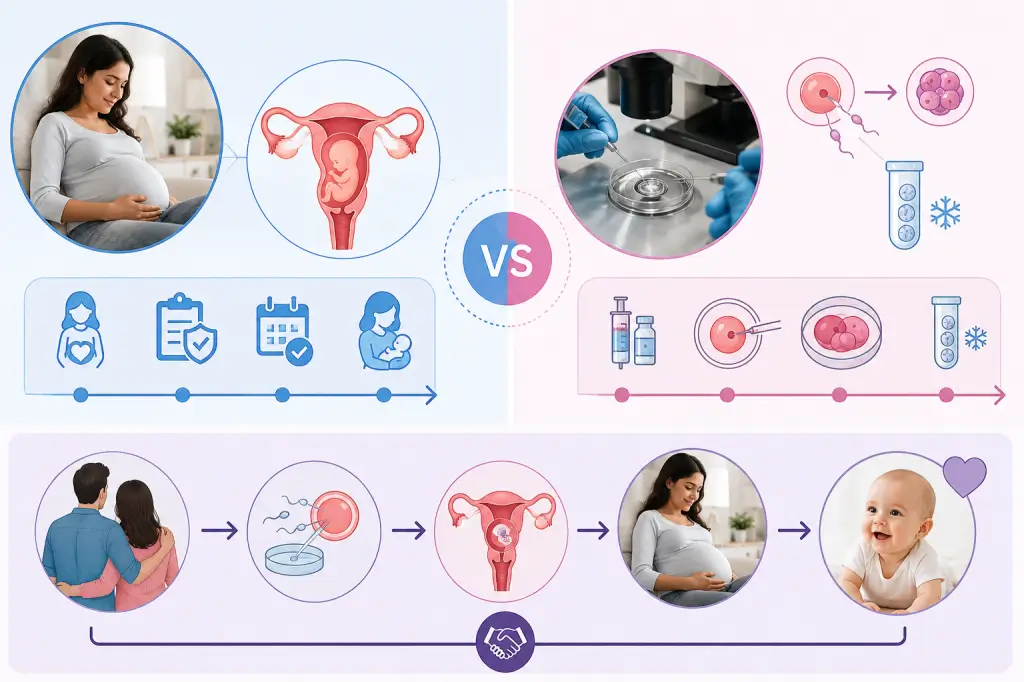
IVF and surrogacy are not competing treatments. IVF is a medical procedure used to create embryos, while gestational surrogacy is a family-building arrangement in which another person carries the pregnancy. In most gestational surrogacy journeys, IVF is used first to create an embryo, which is then transferred to the gestational carrier.
Introduction
People often search for surrogacy vs IVF because the two terms are closely connected but mean different things. IVF (in vitro fertilization) is a fertility treatment that creates embryos outside the body. Surrogacy involves a gestational carrier carrying a pregnancy for intended parents.
For many families, the two work together. IVF creates the embryo, while gestational surrogacy provides a way for the pregnancy to be carried by someone other than the intended parent. Surrogacy4All helps intended parents understand these options and navigate the surrogacy journey with guidance and support.
Look at a Comprehensive Table of IVF and Surrogacy
| Comparison | IVF | Gestational Surrogacy |
| What is it? | A fertility treatment used to create embryos outside the body. | A family-building arrangement in which a gestational carrier carries the pregnancy. |
| Main purpose | Helps people conceive by creating embryos through assisted reproductive technology. | Allows intended parents to have a pregnancy carried by another person. |
| Uses IVF? | Yes, IVF is the treatment itself. | Usually yes, because an IVF-created embryo is transferred to the gestational carrier. |
| Who carries the pregnancy? | The intended parent may carry the pregnancy when medically possible. | A gestational carrier carries the pregnancy for the intended parents. |
| Genetic connection | Genetic connection depends on whose egg and sperm are used to create the embryo. | The gestational carrier has no genetic connection to the baby because she does not provide the egg. |
| Main professionals | Fertility specialist, embryologist, nurses, and other fertility professionals. | Surrogacy agency, fertility specialist, reproductive attorney, and medical professionals. |
| Legal agreements | Legal requirements are generally different from those involved in a surrogacy arrangement. | Comprehensive legal agreements are important and requirements vary by state. |
| Cost | Costs vary based on fertility treatment, medications, testing, and clinic fees. | Costs can include IVF, agency fees, carrier compensation, legal services, insurance, and pregnancy-related expenses. |
| Pregnancy Monitoring | The person undergoing IVF receives medical monitoring during treatment and, if successful, pregnancy care. | The gestational carrier receives regular prenatal care and pregnancy monitoring throughout the pregnancy. |
| Best For | People who need fertility treatment and may be able to carry a pregnancy themselves. | Intended parents who need or choose to have another person carry the pregnancy. |
| How the Process Starts | Usually begins with fertility evaluation, ovarian stimulation, egg retrieval, fertilization, and embryo development. | Usually begins with intended-parent preparation, carrier screening and matching, legal agreements, and IVF preparation. |
| Embryo Transfer | An embryo may be transferred to the uterus of the person undergoing IVF. | The embryo is transferred to the gestational carrier’s uterus after medical and legal preparation. |
| Medical Screening | Intended parent(s) and potential egg or sperm donors may undergo appropriate medical testing. | The gestational carrier typically undergoes medical and psychological screening before the transfer. |
| Legal Considerations | Primarily focuses on fertility treatment and applicable reproductive healthcare requirements. | Parentage, contracts, medical decisions, compensation, and state-specific laws may need to be addressed. |
| Main Goal | To achieve pregnancy using assisted reproductive technology. | To help intended parents build a family when they need or choose a gestational carrier. |
| How They Work Together | IVF creates the embryo that may be used for a surrogacy journey. | Gestational surrogacy can use the embryo created through IVF to establish a pregnancy. |
| Professional Guidance | A fertility specialist guides the medical treatment. | Intended parents generally work with fertility, legal, and surrogacy professionals throughout the journey. |
| Important Consideration | Success depends on factors such as age, egg and sperm quality, embryo quality, and individual medical circumstances. | The journey involves medical, legal, financial, and emotional considerations for both intended parents and the gestational carrier. |
What Should Intended Parents Consider?
Before choosing a path, intended parents should discuss their medical situation with a qualified fertility specialist. If pregnancy is medically impossible or presents significant risks, a gestational carrier may be considered.
It is also important to understand that surrogacy laws differ by jurisdiction. Legal advice should come from an attorney experienced in reproductive law.
FAQs about IVF and Surrogacy
Q: Is it cheaper to do IVF or surrogacy?
A. IVF alone is generally less expensive than surrogacy because surrogacy adds carrier compensation, legal, agency, insurance, and pregnancy-related expenses.
Q: Do surrogates still get paid if they miscarry?
A. Payment after miscarriage depends on the contract; compensation may continue for completed services, while additional benefits depend on circumstances.
Q: Can a surrogate carry an IVF baby?
A. Yes. In gestational surrogacy, an IVF-created embryo is transferred to a surrogate who carries the pregnancy.
Q: What is the downside of surrogacy?
A. Surrogacy can involve substantial costs, medical risks, emotional challenges, complex coordination, and legal requirements that vary between states.
Q: Is a surrogate baby still biologically yours?
A. If the intended parents’ egg and sperm create the embryo, the baby can be genetically related to one or both parents.
Q: Is 37 too late for IVF?
A. No. IVF is possible at 37, but fertility and egg quality generally decline with age, affecting treatment outcomes.
Q: Do surrogate babies look like the mother?
A. A gestational carrier does not contribute the egg, so she does not pass her genetic traits directly to the baby.
Q: At what age are 90% of your eggs gone?
A. The often-repeated 90% figure is only a rough estimate; ovarian reserve varies, and age remains a major fertility factor.

Dr. Veera Saghar
As an Egg Donor Coordinator, she plays a critical role in our company. Her background as a medical graduate from ISRA UNIVERSITY in Pakistan provides us with a solid foundation in the medical sciences. She has seven years of clinical experience practicing in the USA. This has given her firsthand experience when collaborating with patients and their families.
She is responsible for managing the process of egg donation from start to finish. We identify and screen potential egg donors.
- Dr. Veera Saghar

- Dr. Veera Saghar
- Dr. Veera Saghar
- Dr. Veera Saghar